
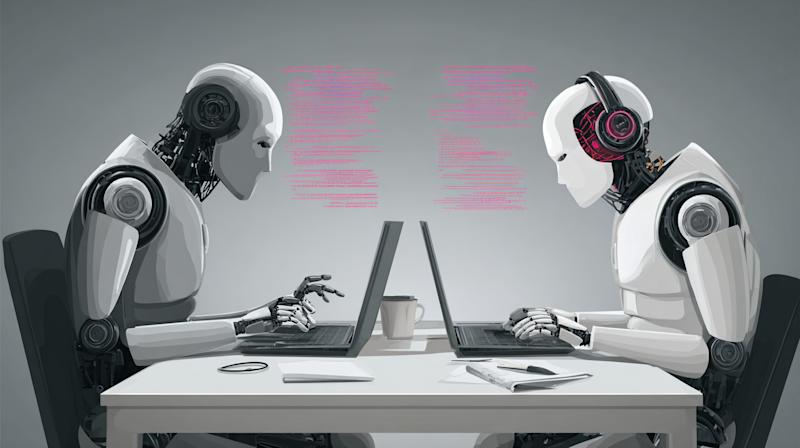
Egnyte’s AI Strategy: Scaling Engineering Capacity, Not Replacing Engineers
The narrative surrounding artificial intelligence often centers on automation and job displacement.However, a growing number of companies are demonstrating a different path – one where AI augments human capabilities, scales engineering capacity, and fosters a more robust talent pipeline. Egnyte, a $1.5 billion cloud content governance company,is a prime example. rather than reducing its workforce, Egnyte has strategically integrated AI coding tools across its 350+ developer team to accelerate onboarding, deepen understanding of its complex codebase, and expedite the development of junior engineers into seasoned contributors.
The Rise of AI-Assisted Coding: A New Paradigm
For years, the tech industry has debated the potential for AI to replace software developers. While AI can automate certain coding tasks, the reality is far more nuanced. Egnyte’s approach directly challenges the notion of wholesale replacement, instead focusing on how AI can empower developers and unlock new levels of productivity. “To have engineers disappear or us not hiring junior engineers doesn’t look like the likely outcome,” explains Amrit Jassal, egnyte’s CTO and co-founder, in an interview with VentureBeat. “You’ve got to have people, you’re training and doing all types of succession planning. The junior engineer of today is the senior engineer of tomorrow.”
This ideology is rooted in the understanding that AI is a tool – a powerful one, but still a tool – that requires human oversight, critical thinking, and creativity. Egnyte isn’t simply throwing AI at the problem; it’s carefully integrating it into existing workflows to enhance, not supplant, human expertise.
How Egnyte Developers are Leveraging AI
Egnyte has rolled out a suite of AI-powered coding tools, including Claude Code, Cursor, Augment, and Gemini CLI, to support its core business objectives and its expanding AI offerings, such as customer-facing copilots and customizable AI agents. These tools are being utilized across a wide range of tasks, from the mundane to the complex.
Everyday Tasks, Elevated by AI
At the most basic level, developers are using AI for:
- Data Retrieval: quickly accessing relevant facts from vast codebases.
- Code Comprehension: Understanding complex code structures and logic.
- smart Search: Efficiently locating specific code snippets or functionalities.
- Code Lookup: Finding examples and documentation for various libraries and APIs.
Egnyte’s codebase, heavily reliant on Java and numerous libraries with varying versions, benefits substantially from these capabilities. AI tools facilitate peer-to-peer programming, allowing new team members to quickly grasp the intricacies of the system and experienced developers to efficiently navigate different code repositories. As Jassal notes,“Let’s say you’re looking at an iOS application,but you’re not well versed; you will fire up Google CLI or an Augment,and ask it to discover the code base.”
Beyond the Basics: AI-Powered Automation
Egnyte is also exploring more advanced applications of AI, such as:
- Automatic Pull Request Summaries: AI generates concise overviews of code changes, explaining the “what,” “how,” and “why” behind modifications.
- Unit Testing: AI assists in running code components in isolation to ensure functionality and identify potential bugs.
However, Egnyte maintains a crucial safeguard: human oversight. “But obviously, any change that’s made, we don’t want to hear that AI made the change; it has to be that developer made the change,” Jassal emphasizes. “I would not trust AI to commit to the production code base.” All code commits undergo rigorous human review and security validation, with any flagged issues escalated to senior engineers. Developers are actively cautioned against blindly trusting AI-generated code, recognizing that models may lack sufficient training data for specific components.
AI’s Expanding Role: Collaboration and Prototyping
The benefits of AI extend beyond the core engineering team. Egnyte is leveraging AI to improve collaboration between developers and other departments, such as product management and UX design.
Product managers are using tools like Vercel to create “demo-worthy” prototypes,providing developers with a clear vision of desired features. UX designers are utilizing AI to rapidly generate multiple design options, such as different widget configurations, allowing for faster iteration and experimentation. “Then you come to engineering with that, and the engineer immediately knows what you really intend to do with it,” Jassal explains.
investing in the Next Generation of Engineers
A key component of Egnyte’s AI strategy is its commitment to developing junior engineers. Rather than replacing entry-level positions, egnyte is using AI to accelerate their learning and growth.Junior developers are actively involved in all phases of the development lifecycle,from requirement analysis to deployment and maintenance,gaining hands-on experience and building a strong foundation of “Egnyte-specific tacit knowledge.”
senior engineers play a vital role in this process, providing mentorship and guidance. Tasks requiring a holistic understanding of the platform, such as authoring architecture notes, remain the domain of experienced engineers. AI is streamlining the more routine aspects of development, allowing junior engineers to focus on learning and contributing at a higher level.
Egnyte anticipates a significantly faster learning curve for new hires, with AI-assisted tools helping them overcome customary roadblocks and deliver value more quickly. Though, the company also recognizes the need to manage expectations and provide support to senior engineers who might potentially be hesitant to adopt new technologies.
The Future of AI in Software Development: A Human-Centered Approach
Egnyte’s experience underscores a critical point: AI is not about replacing developers; it’s about empowering them. Jassal dismisses the hype surrounding the obsolescence of human coders, preferring the term “AI-assisted coding,” which emphasizes the collaborative relationship between humans and machines. “Vibe coding” – a term gaining traction – falls into a similar category, highlighting the iterative process of generating, analyzing, and refining code with AI assistance.
While AI-driven productivity gains may lead to a slower pace of hiring, Egnyte remains committed to expanding its engineering team. “We are not just hiring for scale,but to develop the next generation of senior developers and inject fresh perspectives into our development practices,” Jassal states.
The key takeaway for technical decision-makers is that AI will reshape the talent landscape, but it won’t eliminate the need for skilled engineers. Companies that treat AI as a replacement risk undermining their future innovation pipeline. Those that embrace AI as infrastructure – a tool to augment human capabilities and accelerate learning – will be best positioned to thrive in the evolving world of software development.
Published: 2026/01/17 17:40:15
