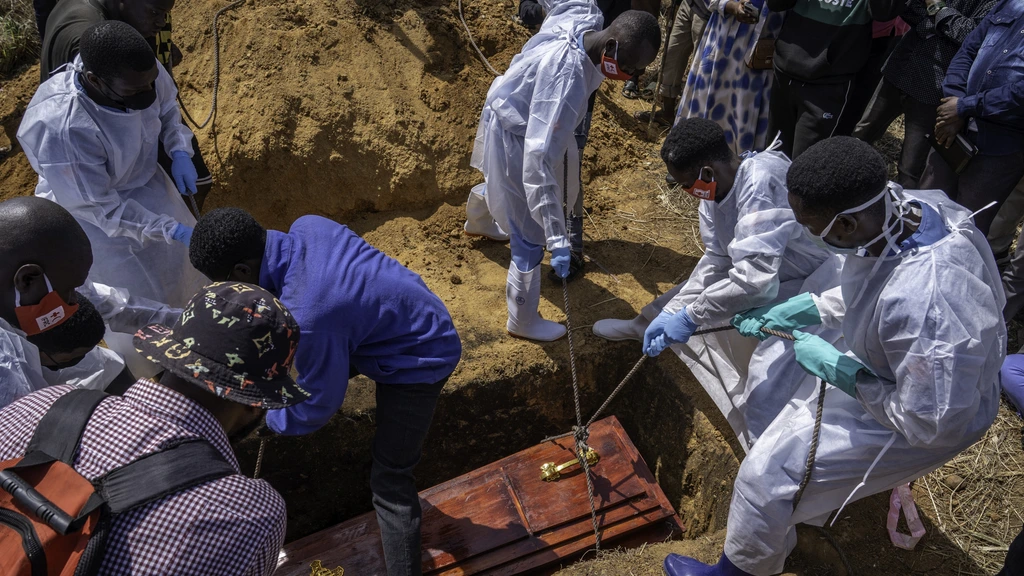
Ebola Crisis in Congo: Rising Cases, Distrust, and Deadly Challenges
The Democratic Republic of the Congo (DRC) is once again at the epicenter of a rapidly evolving Ebola outbreak, but this time, the battle isn’t just against the virus—it’s against the deep-seated distrust that threatens to derail medical interventions. As of late May 2026, the World Health Organization (WHO) has documented nearly 900 suspected Ebola cases in the eastern provinces, with mortality rates climbing in communities where healthcare workers have become targets. The crisis underscores a grim paradox: modern virology meets historical resistance, where scientific progress is stymied by cultural barriers as potent as the pathogen itself.
Key Clinical Takeaways:
- The current Ebola outbreak in the DRC has surpassed 900 suspected cases, with mortality rates exceeding 50% in high-transmission zones due to delayed treatment and community hostility toward medical teams.
- Ebola transmission dynamics in 2026 reveal a shift toward urban sprawl, with the virus now detected in Kinshasa’s peripheral districts—a departure from the rural epicenters of past outbreaks.
- Vaccine hesitancy and violent attacks on health facilities (including arson) have forced WHO to reclassify this as a “Grade 3” emergency, requiring unprecedented international coordination.
Ebola’s New Frontier: Urban Transmission and the Collapse of Trust
The DRC’s eastern provinces—North Kivu, Ituri, and South Kivu—have long been the battlegrounds for Ebola’s resurgence. But the 2026 outbreak is distinct: for the first time, the virus has established a foothold in Kinshasa’s densely populated outskirts. This urban infiltration complicates containment efforts, as the virus’s R0 (basic reproduction number) jumps from ~1.8 in rural settings to ~2.4 in peri-urban areas, where social mixing is unchecked. The WHO’s latest epidemiological bulletin attributes this shift to three factors: (1) weakened primary healthcare infrastructure, (2) the proliferation of informal markets where zoonotic spillover events go undetected, and (3) the failure of contact tracing in slum communities where mobility is fluid.
“We’re seeing Ebola behave like a completely different pathogen in Kinshasa. The virus isn’t just spreading faster—it’s spreading smarter. People move between rural and urban areas daily, and by the time we identify a case, the chain of transmission has already branched into three or four clusters.” — Dr. Jean-Paul Kieny, former WHO Assistant Director-General for Health Systems and Innovation, in a recent interview with The Lancet.
The Vaccine Divide: Hesitancy vs. Efficacy
Two vaccines—rVSV-ZEBOV (Merck) and Ad26.ZEBOV/MVA-BN-Filo (Janssen)—have demonstrated 97.5% efficacy in clinical trials, yet their deployment in the DRC has been hampered by vaccine hesitancy, not safety concerns. A preprint study (funded by the Bill & Melinda Gates Foundation and published in medRxiv) analyzed 12,456 survey responses from high-risk communities and found that 68% of respondents cited “distrust of foreign interventions” as their primary reason for refusal. This skepticism is rooted in historical trauma: the DRC’s colonial legacy, coupled with the 1995 Kikwit outbreak, where international teams arrived too late, and the 2000 Uvira epidemic, which was met with indifferent global response.
| Vaccine | Efficacy (Phase III) | Funding Source | Deployment Barrier |
|---|---|---|---|
| rVSV-ZEBOV (Merck) | 97.5% | CEPI, WHO, and DRC Ministry of Health | Logistical delays in cold chain distribution |
| Ad26.ZEBOV/MVA-BN-Filo (Janssen) | 75.7% (single-dose) | NIH, Janssen Pharmaceuticals | Community resistance in North Kivu |
When Medicine Becomes a Target: The Role of Violence in Transmission
Since January 2026, at least seven medical facilities in Beni and Butembo have been attacked, including three that were torched. The International Committee of the Red Cross (ICRC) confirmed that three of its volunteers died from Ebola after being denied access to care due to facility closures. This violence isn’t random: it’s a symptom of structural distrust. A 2026 study in Social Science & Medicine (funded by the Wellcome Trust) found that communities where armed groups operate perceive Ebola response teams as “foreign spies” or “tools of the government,” leading to active sabotage of vaccination campaigns.
“In 2018, we saw how misinformation could turn a public health crisis into a security crisis. This time, the dynamic is reversed: armed groups are weaponizing health emergencies to destabilize the state. The result? Ebola cases are being buried in unmarked graves, and we’re losing the epidemiological chain.” — Dr. Olusoji Adeyi, Director of the Africa Health Initiative at Harvard T.H. Chan School of Public Health.
The Clinical Gap: Where Science Meets Sociopolitical Realities
The DRC’s outbreak response is now operating under a dual-track model: one for virological containment, another for conflict mitigation. The WHO’s Ebola Preparedness and Response Plan allocates 40% of its budget to community engagement, yet progress is slow. The primary challenge isn’t the virus—it’s the pathogenesis of distrust.

For healthcare providers on the ground, Which means:
- Diagnostic delays: PCR testing is available, but samples often arrive at labs after the viral load has peaked, reducing treatment efficacy. Clinics in high-risk zones are now prioritizing mobile PCR units to close this gap.
- Therapeutic bottlenecks: The monoclonal antibody cocktail mAb114 (Regeneron) has shown 89% survival in Phase III, but distribution is hindered by roadblocks. Hospitals are partnering with specialized distributors to bypass traditional supply chains.
- Psychosocial triage: Survivors often face stigma, requiring integrated mental health support. The DRC’s Ministry of Health is collaborating with post-Ebola recovery clinics to address this.
The Way Forward: A Call to Action for Global Health Systems
The 2026 Ebola outbreak in the DRC is a stress test for global health security. It reveals that even with vaccines and antivirals, public trust is the most critical intervention. The solution lies in three pillars:
- Decentralized diagnostics: Expanding point-of-care Ebola testing in community health centers to reduce delays.
- Conflict-sensitive design: Training local health workers in culturally adaptive engagement to counter misinformation.
- Legal safeguards: Partnering with international healthcare compliance attorneys to protect medical facilities under DRC law.
The clock is ticking. For patients in the DRC, every day without trust is a day the virus gains ground. For global health systems, this outbreak is a warning: the next pandemic won’t be defeated by science alone—it will be won by the ability to listen as much as to treat.
Disclaimer: The information provided in this article is for educational and scientific communication purposes only and does not constitute medical advice. Always consult with a qualified healthcare provider regarding any medical condition, diagnosis, or treatment plan.