
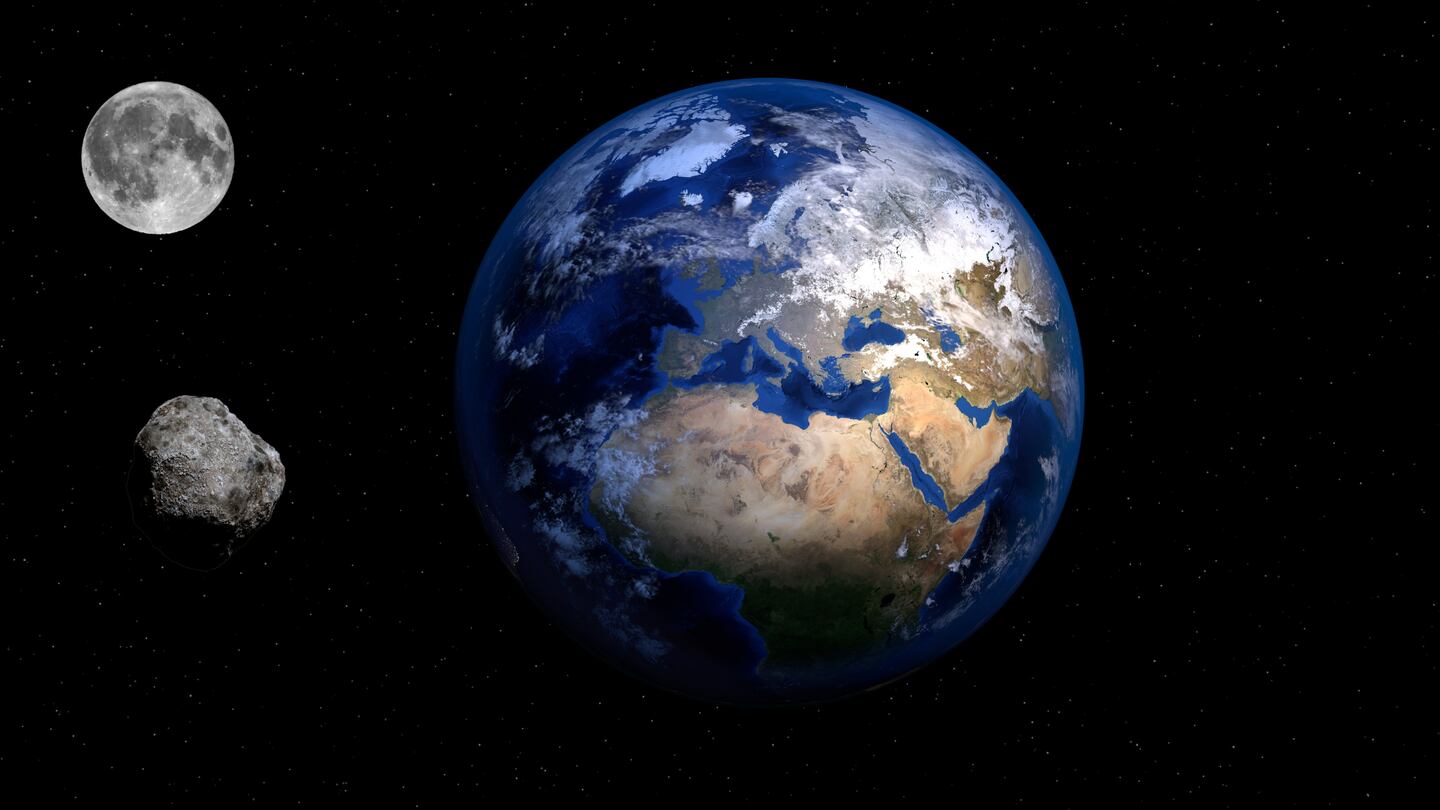
A small rocky body, designated 2025 PN7, is currently traveling alongside Earth in its orbit around the Sun. The discovery, confirmed by astronomers, has sparked scientific interest, though experts emphasize it is not a second moon. Instead, 2025 PN7 is classified as a quasi-satellite, a type of celestial object already known within orbital dynamics.
Unlike traditional satellites, quasi-satellites do not directly orbit Earth. Rather, their trajectory around the Sun closely aligns with our planet’s, resulting in a prolonged gravitational interaction. “Quasi-moons are interesting because they don’t actually orbit our planets like the moon orbits the Earth, they simply are in our neighborhood,” explained Dr. Jenifer Millard, an astronomer at Fifth Star Labs in Wales, according to the BBC.
The discovery, made by the Pan-STARRS observatory in Hawaii, highlights the dynamic nature of Earth’s cosmic environment. Astronomers note that such findings challenge a static view of the solar system. Ben Sharkey, an astronomer at the University of Maryland, stated that these objects “force us to reconsider an ordered and static view of the Solar System,” demonstrating that small bodies can share Earth’s orbit for decades without becoming true satellites.
Quasi-satellites orbit the Sun in a period nearly identical to Earth’s. From Earth’s perspective, their movement appears as a loop around the globe, but without the stable gravitational bond characteristic of a natural satellite. Currently, at least seven quasi-satellites have been identified orbiting Earth, according to data from the Minor Planet Center and the Planetary Science Institute.
2025 PN7 was first detected by the Pan-STARRS system and analysis of its orbit indicates it has been in this configuration since the mid-20th century. Its relatively small size – approximately 20 meters in diameter, comparable to a small office building – explains why it remained undetected for so long. These objects are typically observed using telescopes capable of capturing the faint sunlight reflected off small, rapidly moving bodies.
Grigori Fedorets, an astronomer at the University of Turku, noted that detection is directly linked to advancements in technology, as many of these objects are too small for traditional instruments. The object is expected to remain in this configuration until approximately 2083.
While often referred to as “mini-moons,” these objects differ from quasi-satellites. Mini-moons are temporarily captured by Earth’s gravity, but their orbits are unstable and their stay is typically less than a year. Four mini-moons have been directly observed, as confirmed in studies published in the journal Icarus.
The origin of these objects remains a topic of research. The Planetary Science Institute and the University of Maryland have proposed that some originate from the main asteroid belt, displaced inward by gravitational interactions with Jupiter. Spectroscopic analysis of quasi-satellite Kamoʻoalewa, however, revealed similarities to lunar composition, suggesting some bodies may be fragments ejected from ancient impacts on the Moon.
Planetary scientist Kat Volk, of the Planetary Science Institute, explained that observing quasi-satellites allows for the study of celestial mechanics in real-time, processes that typically unfold over much longer timescales elsewhere in the solar system. Despite the public interest in a “second moon,” astronomers maintain that 2025 PN7 does not meet the criteria for a permanent natural satellite. Its presence confirms that Earth travels accompanied by a changing population of small bodies.
