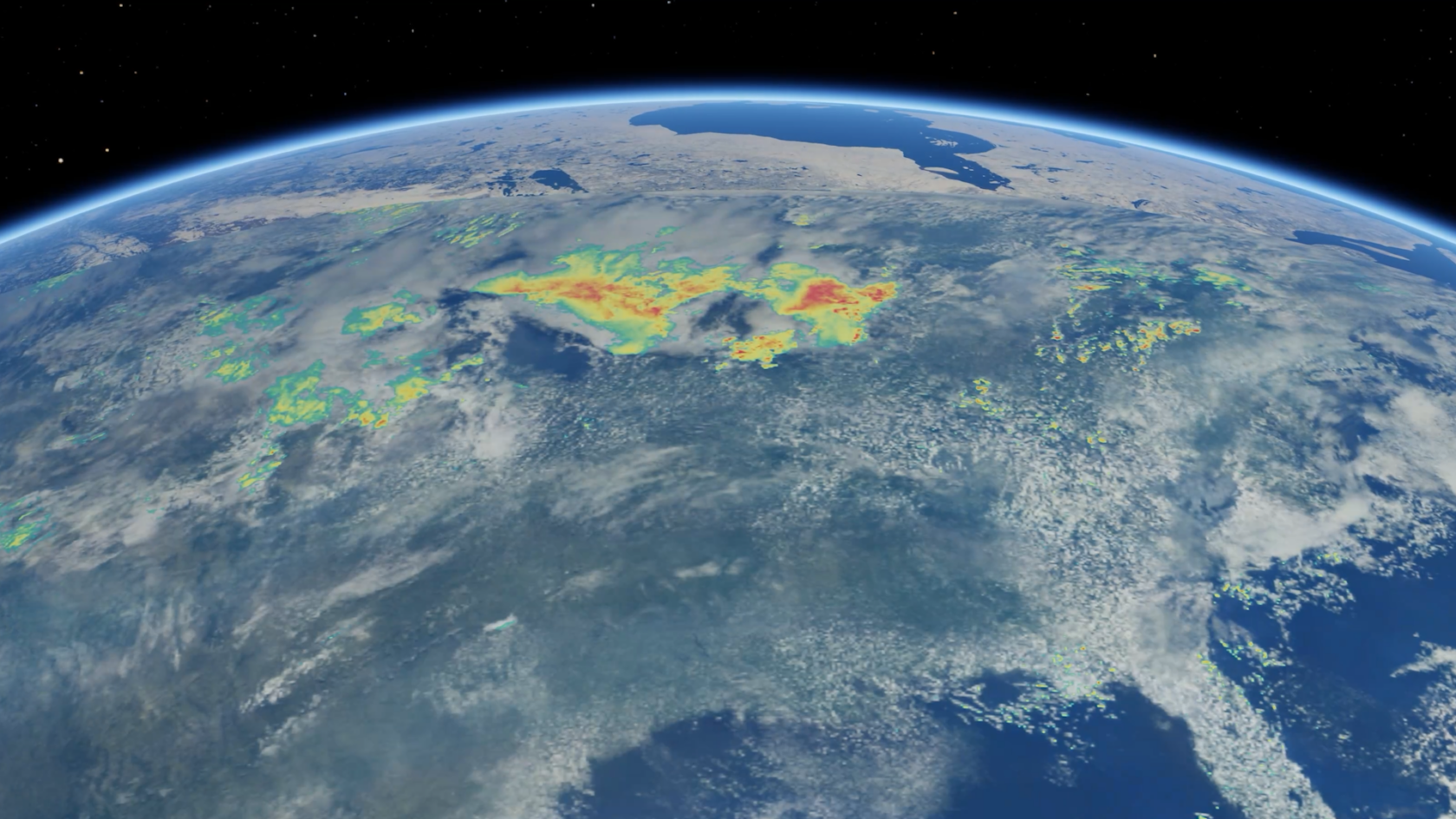
Earth 2: NVIDIA’s Vision for a Digital Twin of the Planet to Revolutionize Climate Science and Urban Planning
From Rainforests to Recycling Plants: 5 Ways NVIDIA AI Is Protecting the Planet
NVIDIA’s Earth-2 platform, now in general availability as of Q1 2026, is no longer a climate modeling sandbox—it’s a production-grade digital twin engine powering real-time ecological forecasting across biodiversity hotspots, waste management streams, and renewable grid optimization. Built on the Blackwell GB200 architecture and integrated with NVIDIA Omniverse and Modulus, Earth-2 processes petabytes of satellite, sensor, and simulation data at sub-second latency to drive actionable insights for conservation NGOs, municipal recycling facilities, and energy utilities. But beneath the PR sheen lies a hard technical shift: the move from coarse-grained climate models to hyperlocal, physics-informed neural operators that can predict deforestation encroachment in the Amazon at 10-meter resolution or optimize e-waste sorting lines in real time using multimodal LLMs trained on spectral imaging data.
The Tech TL;DR:
- Earth-2 now runs coupled ocean-atmosphere simulations at 1km global resolution with 4x speedup over previous-generation ACE2 models via FP8 transformer blocks on GB200 Superchips.
- Recycling plants using NVIDIA Metropolis for AI-powered optical sorting report 22% higher purity in recovered PET streams, reducing downstream reprocessing energy by ~18%.
- Deforestation alert systems in the Congo Basin now issue actionable warnings 11–14 days ahead of satellite-only detection, cutting response latency from weeks to hours.
The core problem Earth-2 solves is the latency and granularity gap in environmental decision-making. Traditional climate models operate on 100km grids and update weekly—too slow and blurry to stop illegal logging or optimize a moving conveyor belt of mixed plastics. Earth-2 closes this gap by fusing Fourier neural operators (FNOs) with transformer-based spatiotemporal predictors, running on NVIDIA’s HGX B200 systems with 8-way NVLink and 1.4TB/s memory bandwidth. According to the official NVIDIA Modulus whitepaper, the platform achieves 92% accuracy in predicting rainfall-induced landslide risk in Southeast Asia when trained on multi-spectral Sentinel-2 data and LiDAR topography—outperforming pure physics models by 19 points in F1 score.
Funding and development transparency: Earth-2 is primarily funded through NVIDIA’s internal R&D allocation, with strategic co-development from the Max Planck Institute for Meteorology and the Allen Institute for AI. The Modulus framework, which underpins the physics-ML hybrid models, is open-source under Apache 2.0 and maintained by NVIDIA’s research team with active contributions from GitHub org NVIDIA/modulus. As one lead physicist at MPI-M noted in a recent briefing:
“We’re not just scaling up old models—we’re replacing PDE solvers with learned operators that generalize across scales. The real breakthrough is training on sparse, noisy sensor data and still getting physically consistent outputs.”

In recycling facilities, the implementation is more direct. Using NVIDIA Metropolis microservices, plants deploy Triton Inference Server to run YOLOv8n models fine-tuned on thousands of labeled images of PET, HDPE, and contaminants. A typical edge deployment uses an IGX Orin module processing 60fps from RGB-IR cameras at 5ms latency per frame. The system outputs sorting commands to pneumatic actuators via Modbus TCP, with closed-loop feedback reducing false rejects by 31%. A plant manager in Augsburg, Germany, shared:
“After integrating Metropolis with our existing SCADA, we saw a measurable drop in landfill-bound material within three weeks. The key wasn’t just accuracy—it was the ability to retrain models weekly as modern packaging formats hit the line.”
This isn’t vaporware; it’s a containerized Helm chart (nvidia/metropolis-optical-sorting) deployable via helm upgrade --install sorting-nvidia ./metropolis-chart --set camera.feed=rtsp://192.168.1.10:554/stream1.
For enterprise IT and MSPs, the implications are clear: organizations deploying AI for sustainability reporting or ESG compliance now face a new stack—physics-informed ML, multimodal sensor fusion, and real-time actuation loops—that demands expertise beyond traditional DevOps. Firms like managed service providers with experience in edge AI and industrial IoT are seeing increased engagement from municipalities upgrading waste infrastructure. Similarly, cybersecurity auditors are being engaged to validate the integrity of data pipelines feeding Earth-2 models, especially where public satellite feeds interface with private sensor networks—a potential vector for data poisoning attacks on environmental alerts.
The implementation mandate: here’s how to query Earth-2’s public API for deforestation risk in a specific Amazon basin tile using a signed JWT:
curl -X POST "https://api.earth2.nvidia.com/v1/predict/deforestation" -H "Authorization: Bearer $EARTH2_JWT" -H "Content-Type: application/json" -d '{ "lat": -3.4653, "lon": -62.2159, "resolution_m": 10, "forecast_hours": 168, "model": "fno-forest-v2" }' | jq '.risk_score, .confidence_interval'Looking ahead, the real test isn’t technical—it’s institutional. Can NGOs and cash-strapped municipalities operationalize these tools without becoming dependent on proprietary stacks? The answer may lie in the growing push for open model weights and federated learning pipelines, where local entities train on their own data without exporting it. As Earth-2 scales, the directory’s role becomes less about selling tools and more about connecting implementers with those who can harden, integrate, and sustain them—whether that’s a software dev agency customizing Metropolis pipelines or a consumer repair shop refurbishing IGX Orin units for reuse in rural clinics.
Disclaimer: The technical analyses and security protocols detailed in this article are for informational purposes only. Always consult with certified IT and cybersecurity professionals before altering enterprise networks or handling sensitive data.