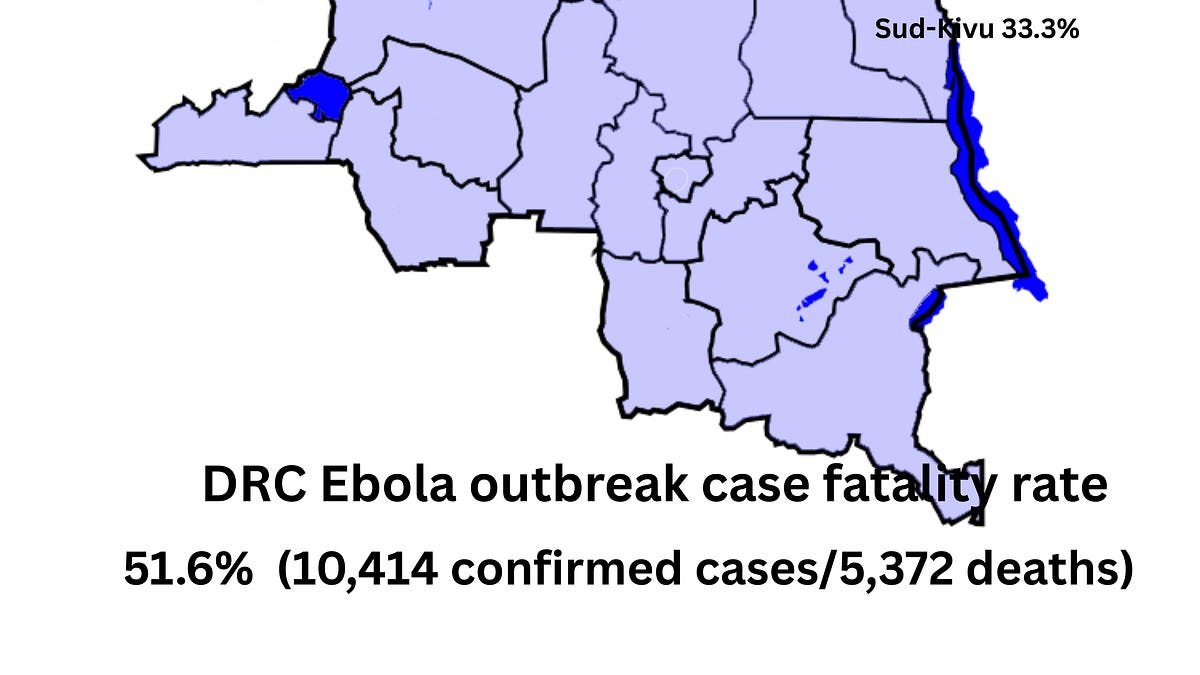
DRC Ebola Death Rate Tops 50% With 10,414 Cases
The case fatality rate for the ongoing Ebola virus disease outbreak in the Democratic Republic of the Congo has surpassed 50 percent, according to public health data released at the end of October 2026. As international travel restrictions tighten ahead of new U.S. screening requirements taking effect on November 3, 2026, continental health officials report that the outbreak continues to strain resources across central Africa.
- Total confirmed cases reached 10,414 with 5,372 deaths reported by the Democratic Republic of the Congo Ministry of Health as of October 30, 2026, establishing an overall case fatality rate of 51.6 percent.
- Ituri, North Kivu, and Sud Ubangi provinces record case fatality rates at or above 50 percent, with Ituri remaining the primary epicenter of active transmission.
- Global travel controls expand as the United States, Canada, Rwanda, and Uganda implement mandatory screening, quarantine policies, or entry suspensions for travelers with recent exposure to affected areas.
Epidemiological Spread Across Affected Provinces
The Democratic Republic of the Congo Ministry of Health reported sixty-three new confirmed cases of Ebola virus disease across three provinces by the close of October 30, 2026. Ituri recorded thirty-four new cases, North Kivu added twenty-five, and Haut-Uélé reported four. During the same period, thirty-two total confirmed deaths were registered, split between twenty-three community deaths and nine fatalities within designated Ebola Treatment Centers.
The Bundibugyo Ebola outbreak that’s now spread to 5 countries highlights that Nobody is safe till Everybody is safe & the need for R&D investment in neglected diseases. https://t.co/MUInaUHfXZ @ICMRDELHI @WHO @Chikwe_I @NCDCgov @CEPIvaccines @gavi @AfricaCDC
Since the beginning of the epidemic, the nation has documented 10,414 confirmed cases and 5,372 deaths, yielding a case fatality rate of 51.6 percent. Specific provincial burdens remain high. Nord-Kivu records a fatality rate of 55.5 percent, Ituri stands at 51.1 percent, and Sud Ubangi records 50 percent. Ituri accounts for 70.9 percent of all reported confirmed cases in the country, while North Kivu represented 39.7 percent of the newly reported cases over the last 24 hours.
Recovery numbers continue to update alongside active monitoring. Fifteen patients—twelve in Ituri, two in North Kivu, and one in Haut-Uélé—were discharged after testing negative for the virus twice. Out of one hundred seventy-eight total health zones nationwide, sixty-seven across eight provinces have sustained infections since the outbreak began, though no new health zones were newly impacted in the final 24 hours of October.
It is not just a medical issue. It is a community issue.In the Democratic Republic of the Congo, supporting prevention while addressing the socioeconomic impact of the Ebola crisis has been the key to reaching communities and strengthening resilience. https://t.co/u1oRLaytK6 pic.twitter.com/2AOz0Ln7I8
African Ministers Reinforce Cross-Border Coordination
The geographic reach of the virus has prompted broad regional responses. Jean Kaseya, Director-General of the Africa Centres for Disease Control and Prevention, addressed more than forty African ministers regarding the trajectory of the epidemic, stating that the situation has evolved into a continental health security test complicated by thirty years of regional armed conflict, humanitarian needs, and limited funding. Ministers agreed to maintain open borders while reinforcing cross-border coordination and preparedness.
Ten neighboring nations remain categorized as at risk by the Africa CDC, including Rwanda, Kenya, Tanzania, Angola, Burundi, the Central African Republic, the Republic of Congo, Ethiopia, South Sudan, and Zambia. In response to regional transmission risks, Uganda instituted movement limits on October 25 restricting border crossings to essential personnel such as humanitarian workers and truck drivers subject to health screening. Rwanda suspended entry for travelers transiting the Democratic Republic of the Congo within thirty days, requiring returning citizens and permanent residents to complete quarantine protocols.

US and Canada Restrict Travel from Affected Nations
Governments outside Africa have introduced stringent control measures targeting individuals with recent travel histories in the Democratic Republic of the Congo, Uganda, or South Sudan. The United States prohibits commercial flight boarding for any traveler who has visited the Democratic Republic of the Congo within the preceding 21 days, regardless of citizenship. Effective November 3, 2026, all passengers boarding international flights to the United States must formally attest to lacking any travel history in the country during that 21-day window.
Canada barred foreign nationals who visited the Democratic Republic of the Congo within twenty-one days of travel. Bahrain imposed a thirty-day travel-history restriction, while Saudi Arabia suspended visas and entry for travelers from the Democratic Republic of the Congo, Uganda, and South Sudan, including third-country arrivals. Israel, Jordan, and Kuwait also enacted entry limitations.
The Intra-Action Review (IAR) of the response to the #Bundibugyo Ebola outbreak in the #DRC began today in Kisangani, Tshopo Province.Over the next three days, the Ministry of Health and all response partners will review interventions, reflect on challenges and lessons learned,… pic.twitter.com/N4NoKjuowZ
The World Health Organization maintains its guidance against general travel or trade restrictions, advising nations instead to focus on active surveillance, rigorous contact tracing, and screening at points of entry. According to data monitored by the European Centre for Disease Prevention and Control, historical figures underline the continuous accumulation of mortality burdens as containment efforts persist across central African border corridors.
Disclaimer: The information provided in this article is for educational and scientific communication purposes only and does not constitute medical advice. Always consult with a qualified healthcare provider regarding any medical condition, diagnosis, or treatment plan.
According to #DRC🇨🇩 government data, as of Friday the #Ebola outbreak in the country has infected more than 10,000 people, killing more than 5,000, making it the second deadliest ever. No approved treatments or vaccines exist for the Bundibugyo strain. https://t.co/hpkyZvfKdh