Distribution and Trends of Cervical Intraepithelial Neoplasia (CIN) in Bahia, Brazil: 2014-2023
Between 2014 and 2023, the public health system in the Brazilian state of Bahia recorded 9,355 histopathological examinations confirming cervical intraepithelial neoplasia, according to a descriptive time-series study. The findings show that CIN 3 accounted for nearly half of all diagnosed precursor lesions, with proportions rising significantly following the full implementation of the national Cancer Information System.
Cervical cancer remains a significant public health challenge in Northeast Brazil, where incidence rates follow a clear socioeconomic gradient.
Distribution of Histopathological Grades in Bahia
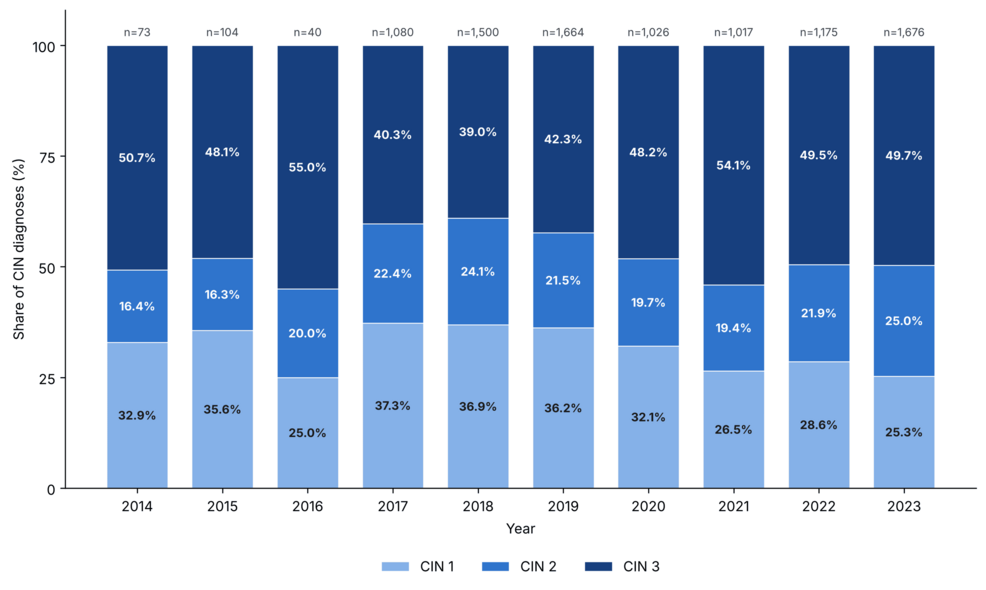
Analysis of the Department of Informatics of the Brazilian Unified Health System database revealed that among the 9,355 total examinations included in the study, CIN 3 was the most frequent diagnosis at 45.9% (4,293 examinations). CIN 1 accounted for 32.0% (2,990 examinations), while CIN 2 represented 22.1% (2,072 examinations). Annual counts remained low between 2014 and 2016, ranging from 40 to 104 examinations per year during the ramp-up phase of the Cancer Information System, known as SISCAN. Following full system implementation, annual counts exceeded 1,000 examinations per year from 2017 onward, peaking at 1,664 in 2019 before dropping 38.3% to 1,026 in 2020 and subsequently recovering to 1,676 by 2023.
Shifts in CIN Proportions After SISCAN Implementation
Inferential analysis restricted to the 2017–2023 period demonstrated a distinct upward shift in the proportion of high-grade lesions. The proportion of CIN 3 diagnoses stood at 40.6% between 2017 and 2019, but increased to 50.3% from 2020 through 2023, yielding an odds ratio of 1.48. Statistical modeling confirmed a persistent level change in 2020 without an underlying continuous annual trend thereafter. This proportional increase was driven primarily by a reduction in recorded CIN 1 examinations, which fell from 9.5 to 6.7 per 10,000 cytology examinations, while CIN 3 rates shifted from 10.5 to 12.1 per 10,000.
Age Distribution and Screening Volumes Among Young Women
Women aged 25 to 44 years accounted for 71.6% of all CIN 3 examinations recorded during the study period. For younger cohorts, the share of women aged 15 to 24 years declined among both CIN 1 and CIN 2 examinations. However, the data show that overall cytology screening volume within this youngest age group also fell from 16.0% to 11.7%. When evaluated relative to total cytology volume, the declines in young women’s precursor lesions were not statistically significant. The authors note that while these trends may partly reflect the introduction of HPV vaccination, reduced screening participation among women under 25 years remains an equally plausible factor that requires individual-level data to fully separate.
Because the investigation relied on aggregated ecological data from public health registries, individual patient trajectories and repeated examinations of the same person cannot be tracked. The extent to which HPV vaccination versus screening participation accounts for the changing ratios among younger cohorts remains unproven without linked, individual-level health records.
Disclaimer: The information provided in this article is for educational and scientific communication purposes only and does not constitute medical advice. Always consult with a qualified healthcare provider regarding any medical condition, diagnosis, or treatment plan.