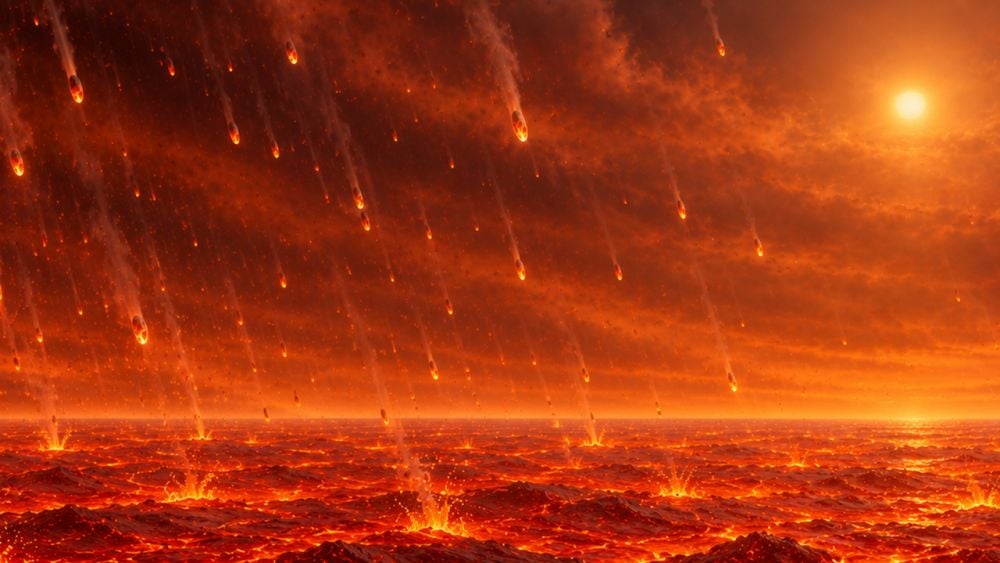
Did Molten Pebble Rain Create Earth’s Oceans? New Research Suggests Local Origin of Water
Silicate Pebble Experiments Challenge Extraterrestrial Water Delivery Theories
Looking out over a large body of water, it is hard to imagine that that water may have been produced 4 ½ billion years ago in a hell-like atmosphere, but it very well may have, according to Zachary Sharp, professor and director of Earth and Planetary Sciences at the University of New Mexico. New laboratory experiments published in Nature Geoscience indicate that Earth may have generated much of its own water locally during planetary formation rather than relying entirely on impacts from comets and asteroids.
The Tech TL;DR:
- Researchers at the University of New Mexico demonstrated that high-temperature reactions between silicate rocks and hydrogen gas can rapidly produce water vapor and metallic iron.
- Laboratory runs subjecting mafic and ultramafic silicates to hydrogen at 1,200 to 1,400 degrees Celsius converted nearly 80 percent of iron oxide into metallic iron.
- The findings suggest terrestrial planets can synthesize water natively during the magma ocean phase, altering traditional models of planetary habitability.
High-Temperature Hydrogen Reduction Generates Rapid Water Production
The traditional paradigm holds that the vast oceans covering approximately 71 percent of Earth’s surface arrived via icy comets and asteroids bombarding the young planet. However, fitting external delivery models into chronological constraints—such as the giant impact forming the Moon and the Late Heavy Bombardment—remains difficult. To test an alternative mechanism, graduate student Susmita Garai and Professor Zachary Sharp investigated whether a primordial hydrogen-helium envelope could react with accreting rocky material to produce water in situ.

During the Hadean eon, protoplanets exceeding roughly 0.3 Earth masses accumulated millimeter- to centimeter-sized silicate pebbles falling slowly through dense, hydrogen-rich atmospheres. Gravitational potential energy heated these atmospheres above 3,000 K with pressures exceeding 200 bars, melting settling pebbles and driving extensive iron oxide reduction. To quantify this kinetics, researchers melted mafic and ultramafic silicates in helium and hydrogen gas streams at temperatures between 1,200 and 1,400 degrees Celsius for durations ranging from 15 minutes to three hours.
# Experimental parameters mirroring Hadean atmosphere conditions
temperature_range = (1200, 1400) # Celsius
gas_streams = ["Hydrogen (H2)", "Helium (He)"]
reaction_duration = ("15 minutes", "3 hours")
iron_oxide_reduction_efficiency = 0.80 # 80% converted to metallic iron
Under hydrogen streams, roughly 80 percent of the iron oxide in the silicate samples converted to metallic iron, releasing water vapor as a direct by-product. Control runs using helium gas produced no such reduction. Extrapolating these high-temperature reaction rates suggests that partial reduction of pebble FeO yields prodigious amounts of water, potentially generating tens to hundreds of ocean masses during planetary accretion.
Divergent Perspectives on Planetary Water Inventories
While the University of New Mexico team emphasizes local atmospheric synthesis as a fundamental step in building habitable worlds, other outlets and researchers note that the exact proportion of Earth’s modern water budget derived from this pebble rain remains unquantified. Scientists note that because they cannot yet calculate the precise net water gain from atmospheric reduction versus exhaust loss to the solar nebula, external delivery mechanisms like asteroids and comets cannot be entirely ruled out.
Sharp noted in a press release that pebble accretion is a relatively young concept in planetary science, having emerged over the past decade, yet it resolves longstanding contradictions in terrestrial formation models. Because this reduction process is tied to the physical mechanics of capturing silicate pebbles within a hydrogen envelope, researchers argue that virtually any Earth-sized rocky planet orbiting another star should similarly generate native water.
Future investigations will focus on refining models of atmospheric volatile escape and gas extraction to constrain how much of the produced water remained ingassed in the planetary magma ocean versus venting into space.