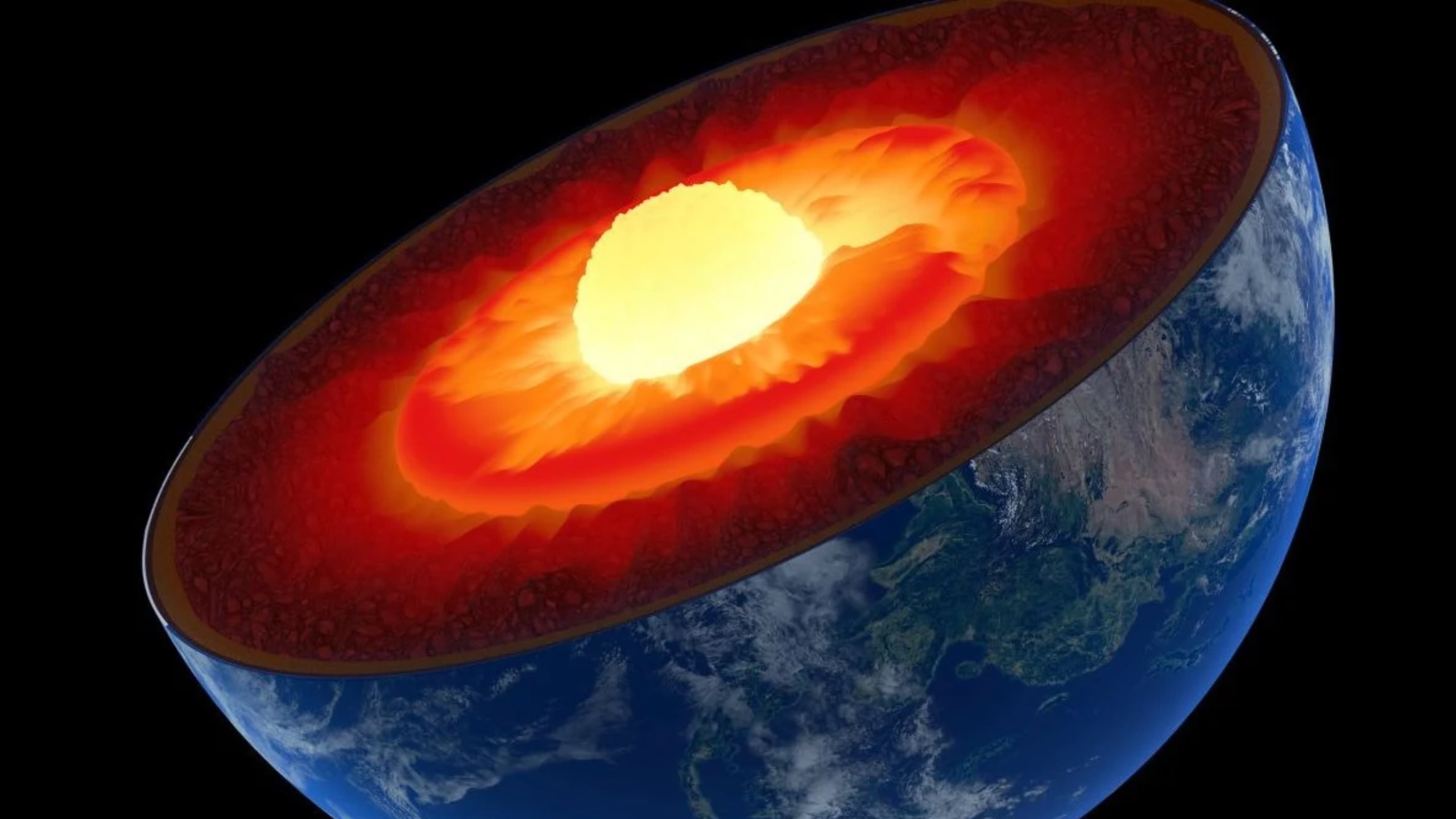
New Study Reveals Earth’s Core Is Leaking Primordial Materials into the Mantle
University of Science and Technology of China researchers trace Earth’s core materials
Earth’s core is continuously leaking primordial materials trapped since the planet’s formation 4.5 billion years ago, according to a study published in Science Advances. Researchers at the University of Science and Technology of China in Hefei used machine-learning-boosted path-integral simulations to analyze how quantum-quirky hydrogen, helium, and tungsten migrate upward from the core through the mantle, contradicting the theory that deep mantle chemical differences are merely relics of early magma ocean crystallization.
The Tech TL;DR:
- Researchers discovered that Earth’s metallic core is actively leaking primordial hydrogen, helium-3, and tungsten isotopes upward into the mantle.
- The team used machine-learning-boosted path-integral simulations to model quantum-level atomic transport and deuterium-to-hydrogen ratios under extreme pressures and temperatures.
- Data from ocean island basalts in places like Baffin Island and Iceland confirm these atomic signatures originate from ongoing core-mantle exchange rather than static ancient crystallization.
Quantum simulations reveal hydrogen transport mechanisms
To determine whether deep mantle chemical variations stem from early crystallization or continuous core-mantle exchange, the Hefei research team deployed quantum-level path-integral simulations. Because hydrogen is exceptionally light and exhibits quantum-quirky behavior, the researchers tracked deuterium-to-hydrogen (D/H) ratios across various thermal and baric models. The initial magma ocean starting hydrogen isotope composition served as the dominant variable, while initial water content up to two ocean masses exerted negligible influence on the resulting distribution. The conditions of early Earth were too violently energetic for deuterium and hydrogen to sort neatly, rendering mineral-melt fractionation relatively weak and producing an essentially homogeneous primitive mantle prior to subsequent core leakage.

Ocean island basalts capture atomic signatures from the core boundary
Evidence for this continuous core leakage surfaces in ocean island basalts (OIBs), which form via upwellings originating near the core-mantle boundary. These lavas erupt prominently in Iceland and at Baffin Island in Nunavut, Canada. As light hydrogen accumulated from the primordial Solar nebula escapes upward, it enriches the mantle and lowers its local D/H ratio. Helium isotope ratios corroborate this dynamic, as primordial helium-3 from the Solar nebula mixes with radiogenic helium-4 produced in Earth’s upper layers. Heavy tungsten isotopes initially sequestered during core separation hitch rides on rising thermal plumes, providing a physical trace of core material regurgitating through Earth's interior.
Dynamic core-mantle exchange reshapes deep Earth models
The convergence of hydrogen, helium, and tungsten ratios establishes a triumvirate chemical cocktail proving active transport from the planet’s deepest reservoirs. The study’s conclusion is that hydrogen isotope signatures in the present-day deep lower mantle do not represent simple relics of early differentiation. Instead, the data reflect dynamic modification by ongoing core-mantle exchange throughout Earth’s evolutionary timeline. These geochemical time capsules offer a direct window into the chaotic accretion processes that forged the Solar System before terrestrial life emerged.