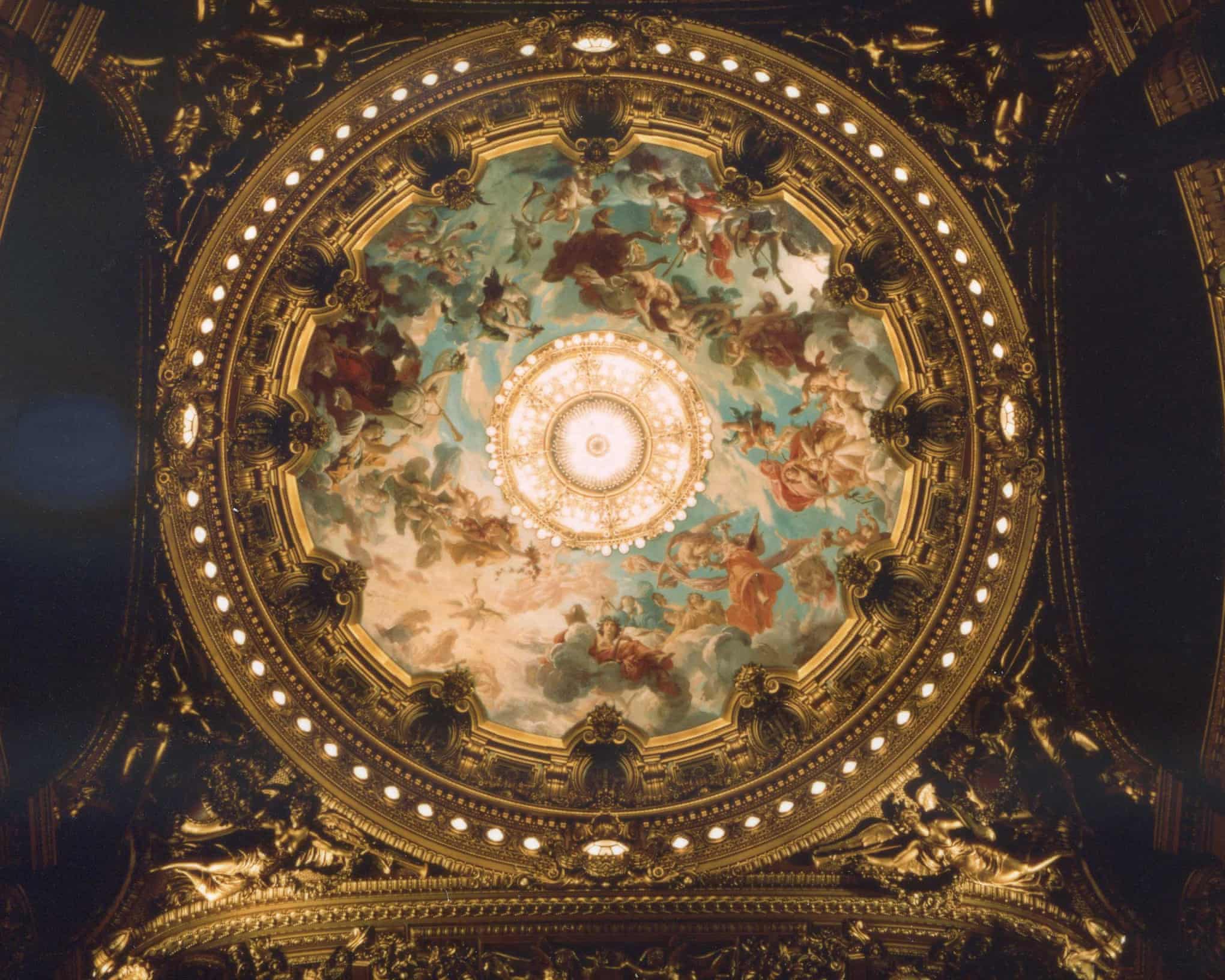
Descendant Threatens Lawsuit to Uncover Hidden Paris Opera Ceiling
Sixty years after a Marc Chagall ceiling was installed over the top of a 19th-century classical work at Paris’s Palais Garnier, a descendant of the original artist has instructed a lawyer to take the fight to court to have the historic dome uncovered and restored.
Three Years of Letters and a Refused Compromise
Arnaud Carayon, the president of the Friends of Lenepveu Society and a descendant of Jules-Eugène Lenepveu, stated that he had asked nicely for the original ceiling to be uncovered for three years. This effort included writing two letters to French President Emmanuel Macron, which resulted only in an Élysée Palace reply stating that the president was particularly attentive to the subject. With no administrative movement, Carayon instructed a lawyer to take the dispute to court.
The hidden artwork, titled The Muses and the Hours of Day and Night, is a classical and allegorical oil painting directly on the copper plates of the opera house dome. Chosen by architect Charles Garnier and completed by his friend and artistic collaborator Lenepveu, the work was given historic monument listing in 1923. It has remained entirely hidden from view for 60 years.

Carayon proposed an alternative solution for the Palais Garnier closure scheduled between 2027 and 2032. He suggested alternating the Lenepveu and Chagall ceilings after the venue reopens, displaying each for a decade. According to Carayon, Chagall’s 24 wedge-shaped canvases were designed from the beginning to be removable without damage. We thought the idea of alternating ceilings was very positive and promising, but it seems nobody has the guts to touch the Chagall ceiling,
Carayon said.
Malraux Commissioned Chagall to Redesign the Opera Ceiling
The current dispute traces back to 1962, when then French culture minister André Malraux grew bored watching a ballet at the opera house and decided the classical ceiling needed a makeover. Malraux turned to his friend Marc Chagall, who sat nearby, and commissioned a new ceiling. Over the next two years, Chagall worked in secret and for free to produce 24 enormous canvas sections covering 220 square metres around the central chandelier.
The installation immediately triggered international opposition. Before the work went up, the Royal Institute of British Architects in London wrote to the French culture minister urging him to abandon the plan. The unique character of this edifice is based on the fact that all its elements: architecture, paintings, sculptures and mosaics work together in harmony,
the institute wrote at the time, though the plea was ignored.
Supporters of the Chagall installation defend its artistic footprint. Anne Montfort-Tanguy, a curator at the Pompidou Centre during a 2023-24 Chagall exhibition, described the dome as the artist’s autobiography and a moving, fluid cinematic work. It was Chagall’s gift to the country that welcomed him; a homage to France and to Paris,
Montfort-Tanguy added.

Courts May Decide the Fate of the Dome
Alexander Neef, the director of the Paris Opera, acknowledged the longevity of the dispute. The debate over the Chagall ceiling has gone on for more than 60 years. The Lenepveu ceiling has been listed as a historic monument since 1923 so its heritage value is recognised. That his descendants wish to defend his memory is legitimate,
Neef told Le Monde.
With legal action now prepared, the future of the concealed 19th-century dome depends on whether the courts compel the state to reopen the debate before the 2027-2032 renovation window begins.