
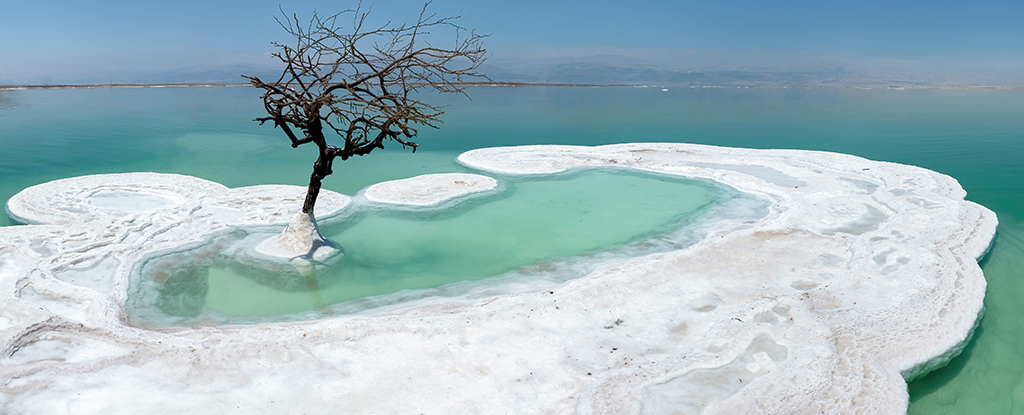
Dead sea “Salt Giants” Form Year-Round, Revealing Clues to Global Coastal Erosion & Ancient Climate Shifts
Breaking: new research published this week in the annual review of fluid Mechanics overturns long-held assumptions about the formation of massive salt formations – dubbed “salt giants” – in the Dead Sea, revealing they develop throughout the year, not just in winter. This finding, alongside detailed observations of their formation, offers a unique window into geological processes impacting coastlines worldwide and echoes events from Earth’s distant past.
For decades, scientists believed the Dead Sea’s impressive salt crystal formations were primarily a winter phenomenon. Though, a recent study led by researchers examining the unique hydrological conditions of the Dead Sea has demonstrated that these formations occur consistently, year-round. The findings provide critical insights into the dynamics of salt deposition and have broader implications for understanding coastal erosion and the impact of changing water levels in seas and lakes globally.
The Dead Sea, the lowest land elevation on Earth, boasts an exceptionally high salt concentration. This extreme habitat fosters the growth of these “salt giants,” but the how and when of their formation remained partially mysterious. Researchers, including Erik Meiburg and Lena Lensky, meticulously observed the process, discovering that evaporation, cooling, and sinking of the top water layer in summer leads to salt crystal formation. These crystals then descend as “snow” to the seabed, building up the impressive structures.
Crucially, the rate and manner of this “snowfall” are directly influenced by water temperature, a detail previously unappreciated. This temperature-dependent process explains the year-round formation and contributes to the variability in the size and shape of the salt giants.
The study challenges previous understandings and highlights the Dead Sea’s significance as a natural laboratory. The researchers emphasize that the lessons learned from the dead Sea are directly applicable to other coastal regions facing similar challenges.
“All of these observations provide valuable lessons for coastlines around the world regarding their stability and erosion under sea level change,” the researchers write in their published paper.
This relevance is underscored by the Dead Sea’s alarming rate of decline – approximately 1 meter (3.3 feet) per year. This shrinking is not unique; many seas and lakes worldwide are experiencing similar water level drops due to climate change.
The Dead Sea’s current predicament, however, isn’t entirely new. The research draws parallels to the Mediterranean Sea’s near-total desiccation millions of years ago. During a period of tectonic activity, the Strait of Gibraltar closed, cutting off inflow from the North Atlantic. This resulted in increased salinity and a dramatic drop in water levels, mirroring the conditions currently affecting the Dead Sea. The eventual reopening of the Strait and subsequent refilling of the Mediterranean offer a historical analogue for potential recovery scenarios, though the speed and scale of modern climate change present a different context.
As Meiburg explains, the Mediterranean’s history demonstrates that even temporary disruptions to water inflow can have profound and lasting effects. The Dead Sea, therefore, isn’t just experiencing a modern crisis; it’s offering a glimpse into Earth’s geological past and potential future.
Key Details Not Included in the Original Article:
Specific Researchers: The names of Erik Meiburg and Lena Lensky are explicitly mentioned as key researchers.
Publication Date: The article specifies the publication date of the research in Annual Review of Fluid Mechanics as 2025.
Quantitative Data: The exact rate of the Dead Sea’s decline (1 meter/year or 3.3 feet/year) is highlighted.
Emphasis on Year-Round Formation: The breaking news aspect of the year-round salt giant formation is emphasized at the beginning.
Connection to Tectonic Activity: The role of tectonic motion in the closure and reopening of the Strait of Gibraltar is clarified.
Direct Quote from Meiburg: A direct quote from Meiburg is included, providing further context.
