
A Simple Compass Offers New Independence to Those with Early-stage Dementia
A new GPS-enabled compass developed by Rens Brankaert, a professor at Tilburg University and the Technical University of Eindhoven, is offering a lifeline of independence to individuals in the early stages of dementia. Inspired by brankaert’s personal experience with his grandfather’s struggles with disorientation, the device focuses on empowering users rather than simply tracking them.
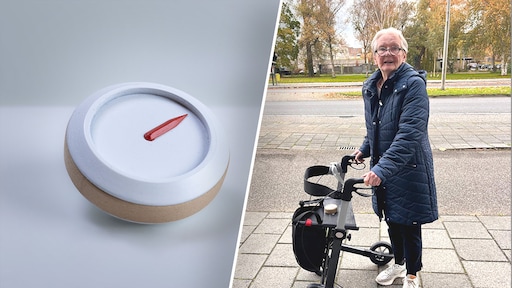
The compass, designed for simplicity, features a sensor that consistently points towards a pre-set “home” location, established by the user with a single pin-point setting. Unlike many assistive technologies that actively intervene, this compass allows individuals to navigate independently, relying on a familiar directional guide.
Early trials, including one with 86-year-old Truus, whose mother has Alzheimer’s, have demonstrated the device’s effectiveness. Truus’s daughter, Sandra Hendricx, explained that while her mother still manages daily tasks like cooking, returning home after outings had become increasingly arduous, particularly after a recent move.The compass, attached to Truus’s walker with Velcro, has restored her ability to venture out independently, providing both freedom for Truus and peace of mind for her family.
“She can now go out on the street independently. It gives me certainty that she will figure it out,” Hendricx shared. She also emphasized the importance of respecting the intelligence and autonomy of individuals with dementia, noting that her mother, despite memory lapses, remains a capable adult.
Brankaert initially considered more complex features, such as the ability to store multiple destinations. However,feedback from individuals living with dementia steered him towards a more streamlined design. “They said: this is too elaborate,” he explained. “In the end we made it so simple that you don’t have to press a button. You just have to look.”
The compass is specifically intended for those recently diagnosed with dementia who are still living independently, and may be particularly helpful in navigating unfamiliar or visually similar environments. Brankaert notes it is less effective in later stages of the disease.
The device is slated for release around next summer and represents a core ideology of Brankaert’s team: to create technology that supports independence, rather than removing it. He contrasts this approach with solutions like traceable shoe sensors, arguing that while those technologies offer location data, they don’t address the underlying feeling of being lost and lacking control. “We want people to remain in control,” Brankaert stated.
