Comparative Review of Etiology, Pathogenesis, Vaccines and Antivirals for Influenza and COVID-19
Influenza has caused four pandemics since 1918; SARS-CoV-2 caused one in its first three years.
A peer-reviewed comparison of the two respiratory pathogens, published in the International Journal of Molecular Sciences on March 28, 2023, set out why that gap matters for vaccines, antivirals and pandemic readiness — and where each virus still outmaneuvers medicine.
Key Clinical Takeaways:
- Influenza and SARS-CoV-2 share transmission routes and pathogenesis but evolve by different genetic mechanisms — reassortment for influenza, recombination and mutation for coronaviruses.
- Existing antivirals work, with limits: oseltamivir shortened symptom remission by 21% versus placebo, yet 0.5–1.0% of circulating A(H1N1)pdm09 isolates already show resistance.
- Vaccination and antivirals both carry documented roles and documented limitations in controlling both diseases, according to the comparative review.
Two Respiratory Pathogens, One Clinical Problem
The review, led by Luo J., Zhang Z., Zhao S. and Gao R. of the Chinese Center for Disease Control and Prevention’s National Institute for Viral Disease Control and Prevention in Beijing, drew on work from the NHC Key Laboratory of Biosafety, the NHC Key Laboratory of Medical Virology and Viral Diseases, and the Chinese National Influenza Center.
Its finding was direct: studies show certain similarities in transmission mode and pathogenesis between influenza and COVID-19, and both vaccination and antiviral drugs play positive roles alongside several limitations.
The authors framed the stakes historically. Influenza virus, a seasonally circulating respiratory pathogen, has triggered four global pandemics since 1918 through the emergence of novel variants. In December 2019, SARS-CoV-2 emerged and produced a pandemic that, by the paper’s publication, had persisted for almost three years. Two viruses, one clinical playbook — and the playbook has gaps on both sides.
Why the Viruses Evolve Differently
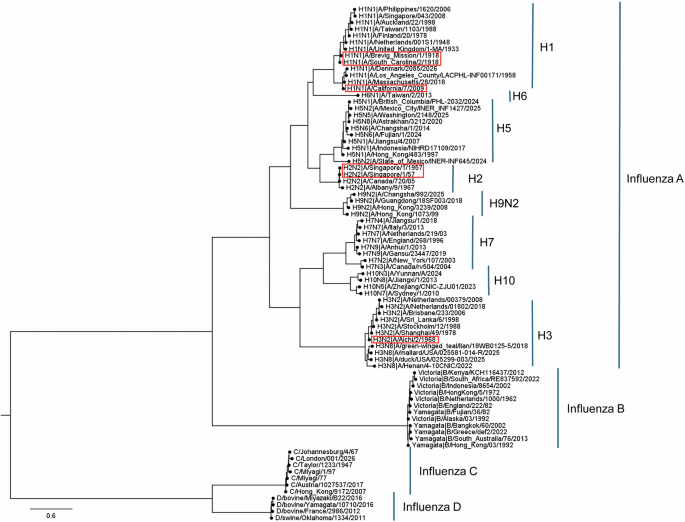
The mechanistic contrast runs through the genetics. Influenza A carries its genome on eight RNA segments, which allows reassortment — the wholesale swapping of segments when two strains coinfect a cell. Research collected in the review’s source base shows reassortment complements spontaneous mutation in accelerating adaptation to a new host, and the 2009 swine-origin H1N1 pandemic virus itself emerged through reassortment, per the genomic analysis published in Nature in 2009.
Coronaviruses take the opposite route. The coronavirus recombination pathway, described in Cell Host & Microbe in 2023, relies on template switching during replication rather than segmented exchange. SARS-CoV-2’s evolution over the pandemic, mapped in Nature Reviews Microbiology, proceeded largely through mutation and recombination within a single lineage rather than the abrupt segment swaps that characterize influenza.
One consequence is pharmacological: coronaviruses carry a proofreading exoribonuclease, whose structural and catalytic diversity was detailed in Nature Communications in 2025, a feature influenza lacks — and one that raises the barrier for nucleoside-analogue drugs.
Where the Antivirals Stand
The comparative drug data, compiled in the review’s own tables on PubMed Central, show how much of the influenza armamentarium is already strained. Zanamivir can cut disease duration by 1–2.5 days when started within 48 hours of symptom onset. Oseltamivir shortened time to remission of all symptoms by 21% versus placebo in the intention-to-treat population (time ratio 0.79, 95% CI 0.74–0.85; p < 0.0001). Yet approximately 0.5–1.0% of community A(H1N1)pdm09 isolates are currently resistant to oseltamivir.
The older class fared worse. Amantadine and rimantadine, the M2 ion channel blockers, show severe resistance in circulating influenza virus and are not recommended for clinical use. Newer agents hold more promise: baloxavir marboxil produced a shorter duration of detectable virus than oseltamivir — 24 hours versus 72 hours (p < 0.001) — while favipiravir showed activity against strains resistant to both adamantanes and neuraminidase inhibitors.
On the SARS-CoV-2 side, the picture is narrower: research published in Nature in 2023 identified multiple distinct pathways by which the virus develops resistance to nirmatrelvir, the main oral antiviral in use.
Antigenic Drift Expands Influenza Escape Pathways
Influenza vaccination rests on more than a century of antigenic surveillance, but the virus’s drift keeps eroding it. Work published in Immunity in 2025 showed antigenic drift expands influenza’s escape pathways from recalled humoral immunity — the immune system’s memory antibodies chase a moving target.
T-cell research offers a complementary angle: nucleoprotein-specific CD8(+) T cells are critical for heterosubtypic immunity, the cross-strain protection that does not depend on the hemagglutinin head. SARS-CoV-2 vaccines were built at pandemic speed, and the comparative review positioned both vaccine platforms as positive but limited tools — limited in influenza’s case by drift and reassortment, in COVID-19’s case by the speed of variant emergence.
The H5N1 Watch List
The review’s source base also flagged the virus that keeps preparedness officers awake. A 2026 review in Viruses covered expanding host range and treatment strategies for highly pathogenic avian influenza H5N1 and H7N9.
Laboratory work has identified the specific mutations that matter: the Q226L mutation can convert a highly pathogenic H5 2.3.4.4e virus to bind human-type receptors, per the study in PNAS, and mammalian-adaptive PB2 mutations such as E627K enhance polymerase activity and pathogenicity in cattle-derived H5N1, according to Nature Communications research from 2025. None of these findings describes a pandemic strain; they describe the genetic distance remaining to be covered.
The practical takeaway from the comparison is timing and vigilance. For institutions tracking resistance or variant emergence, the surveillance literature — including the influenza virus characteristics study in department of defense populations, 2024–2025, published in NEJM Evidence — points to genomic monitoring as standard practice, and laboratories weighing that capability can draw on vetted diagnostic centers and infectious disease specialists in their region.
The Question Still Open
The comparative review closed on the same note it opened: comparative understanding helps prevention and control, but neither virus has surrendered its evolutionary edge. Influenza keeps four pandemic precedents and a drifting hemagglutinin; SARS-CoV-2 keeps a proofreading enzyme and multiple demonstrated routes to antiviral resistance. Which pathogen forces the next global response — and whether vaccines and drugs arrive before it does — remains unanswered in the literature as it stands.
The institution behind the review has its own place in pandemic history. The Chinese Center for Disease Control and Prevention was established on January 23, 2002, succeeding the China Center for Preventive Medicine, founded on December 23, 1983, and is based in Changping, Beijing, under the National Health Commission.
On January 10, 2020, the center uploaded the genetic sequence of SARS-CoV-2 to GISAID for global dissemination, and in 2022 it shared a phylogenetic analysis of over 32 independent introductions of the virus identified in the first quarter of that year.
As of 2016, the center counted 2,120 staff, of whom 1,876 were technical professionals, and it publishes or co-sponsors 16 journals, including China CDC Weekly, launched in 2019.
Disclaimer: The information provided in this article is for educational and scientific communication purposes only and does not constitute medical advice. Always consult with a qualified healthcare provider regarding any medical condition, diagnosis, or treatment plan.