
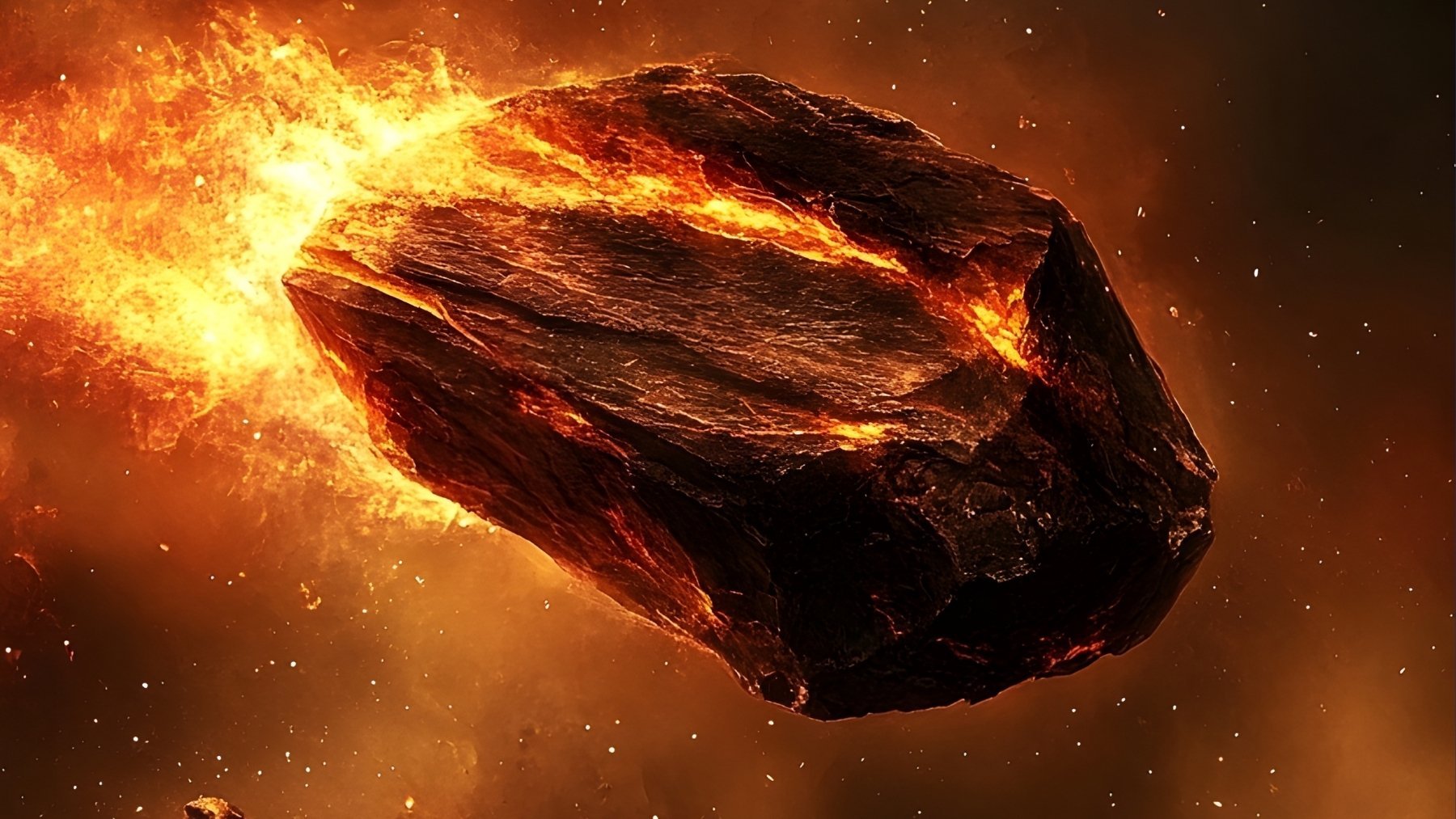
A simulation allowing users to model the impact of asteroids on Earth has gained attention as astronomers track the interstellar comet 3I/ATLAS, currently making its closest approach to the sun. The online tool, Asteroid Launcher, created by software engineer Neal Agarwal, allows users to specify an asteroid’s size, speed, composition, and impact location to visualize the potential devastation.
NASA’s Planetary Defense Coordination Office estimates approximately 17,000 comets enter Earth’s atmosphere annually, with some classified as Potentially Hazardous Asteroids (PHAs) if they approach within 7.5 million kilometers and exceed 150 meters in diameter. The recent focus on 3I/ATLAS stems from its unique interstellar origin and relatively large size.
Discovered on July 1, 2025, by the Asteroid Terrestrial Impact Last Alert System (ATLAS) telescope in Río Hurtado, Chile, 3I/ATLAS is only the third interstellar object detected passing through our solar system, following ‘Oumuamua and 2I/Borisov. Unlike typical comets, its orbit doesn’t follow a closed path around the sun.
Astronomers are currently observing 3I/ATLAS as it aligns almost perfectly with Earth and the sun, providing a rare opportunity to study its characteristics. Astrophysicist Avi Loeb, writing in Medium, explained that this alignment, lasting approximately a week between January 19 and 26, 2026, will allow for unprecedented characterization of the comet’s albedo, structure, and composition. The comet will be approximately 3.33 Astronomical Units (AU) from the sun and 2.35 AU from Earth during this period.
While scientists don’t yet realize the exact size of 3I/ATLAS, observations from the Hubble Space Telescope indicate its nucleus is at least 440 meters in diameter. When first detected within Jupiter’s orbit, the comet was traveling at approximately 221,000 kilometers per hour, accelerating to 246,000 kilometers per hour as it approached the sun. Based on its initial velocity, researchers believe 3I/ATLAS originated in a remarkably aged planetary system.
Analysis of the comet has revealed a higher proportion of carbon dioxide to water than typically found in solar system comets, as well as nickel-rich gas compared to iron. NASA scientist Tom Statler described 3I/ATLAS as “a window to another solar system, and a window to the deep past, so deep it’s even before the formation of our Earth and our Sun.”
Simulations using Asteroid Launcher demonstrate the catastrophic consequences of a direct impact. If 3I/ATLAS were to strike the Puerta del Sol in Madrid, the impact would create a crater 3.8 kilometers in diameter and 439 meters deep, effectively obliterating the city center. Neighborhoods including Centro, Salamanca, Chamberí, Arganzuela, and Retiro would be vaporized. More than 2,000 people would die within the crater area alone.
The impact would release energy equivalent to 826 megatons of TNT, exceeding the combined yield of all existing nuclear weapons. The resulting shockwave, reaching 242 decibels, would cause hundreds of thousands of fatalities within seconds. Severe lung damage would be widespread within a 18-kilometer radius, encompassing much of the city and surrounding municipalities like Getafe, Leganés, and Alcobendas. Eardrums would rupture up to 24 kilometers away, and most buildings would collapse within 41 kilometers.
Winds exceeding 4 kilometers per second would devastate Madrid and its surroundings, potentially causing over 1.7 million deaths. A magnitude 6.4 earthquake would exacerbate the destruction. While such an impact is statistically rare, occurring on average once every 30,000 years, a strike in a densely populated area like Madrid would result in total city destruction.
