
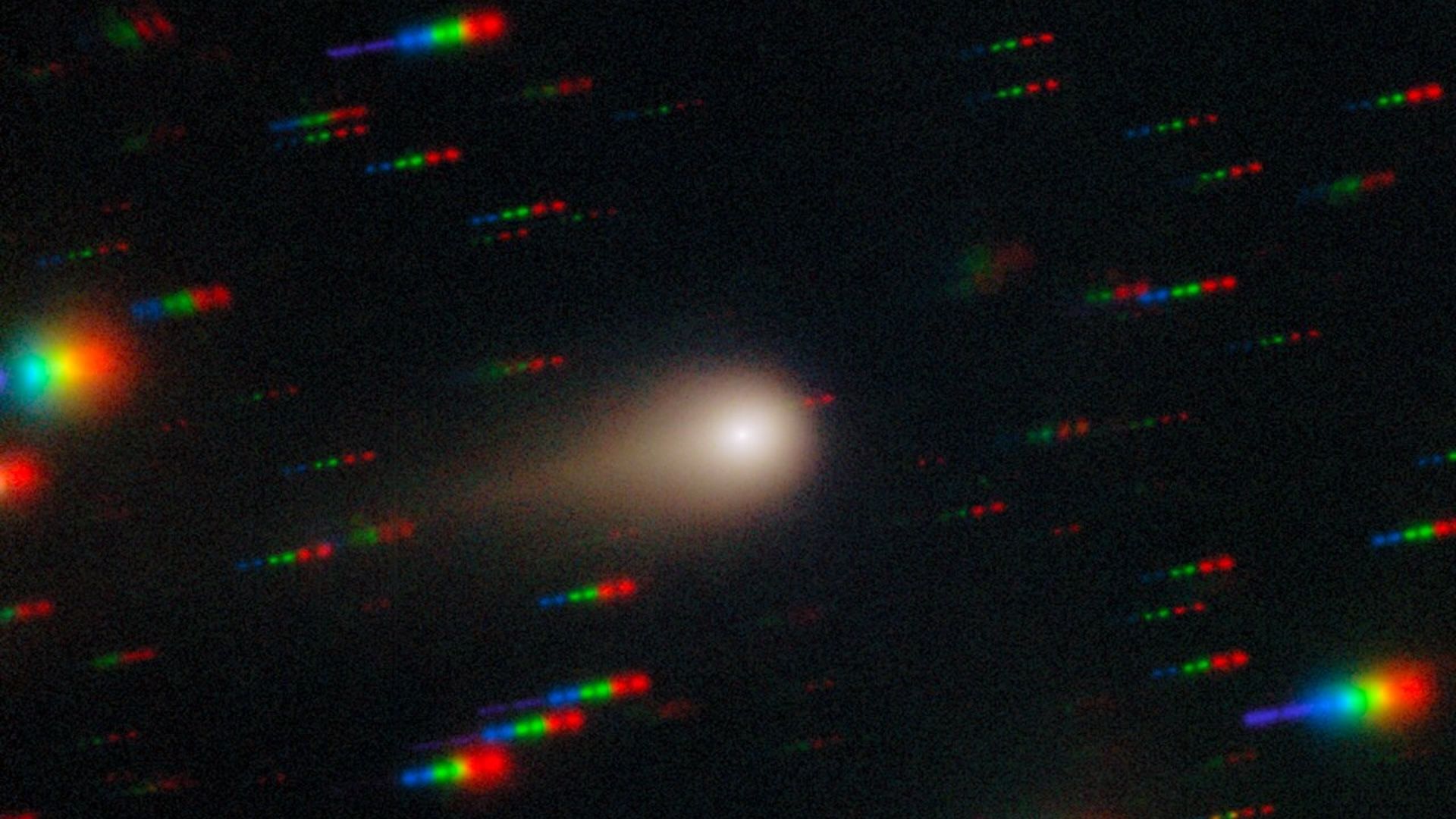
Interstellar Comet 3I/ATLAS Shows Signs of billions of Years in Deep Space
WASHINGTON – New research, bolstered by observations from the James Webb space Telescope (JWST), indicates that interstellar comet 3I/ATLAS has undergone significant conversion after an estimated one billion years traveling through interstellar space. The comet’s surface has developed a deep, irradiated crust due to prolonged exposure to galactic cosmic rays, a finding that impacts how scientists interpret data gathered from this rare visitor.
The study, led by researchers adapting models initially developed for comet 67P (which orbits between Jupiter and Earth), suggests that the intense radiation environment of interstellar space fundamentally alters the composition and structure of comets over vast timescales. This aging process, while complicating analysis, doesn’t diminish the comet’s scientific value. “We have to be careful and take into account aging processes, so it’s more work for scientists, but [3I/ATLAS] remains very engaging,” said researcher Federico Maggiolo.
Previous JWST observations in August confirmed that 3I/ATLAS is rich in carbon dioxide (CO2), and further data from NASA’s SPHEREx orbiter, also collected in August, contributed to the current understanding. The team modeled the effects of galactic cosmic ray exposure on ice structure and chemical composition,relying on laboratory experiments simulating interstellar conditions.
The simulations demonstrate that one billion years of irradiation is sufficient to create the observed crust. While laboratory simulations aren’t a perfect replication of interstellar conditions, the research provides a valuable indicator of the changes comets experience during their long journeys between stars. Understanding these alterations is crucial for accurately interpreting the data collected by telescopes like JWST and for gaining insights into the origins and evolution of comets throughout the galaxy.
