
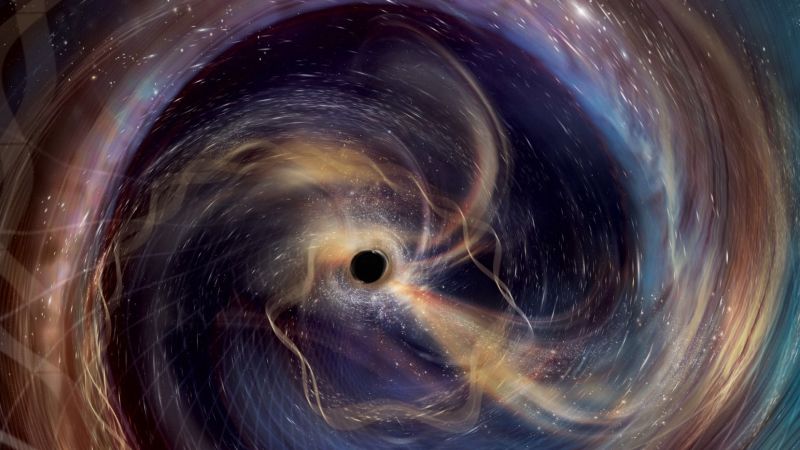
Black Hole Merger Confirms Decades-Old Predictions by Einstein and Hawking
WASHINGTON – A newly analyzed collision of black holes detected in January 2025 has provided the most accurate confirmation yet of predictions made decades ago by Albert Einstein and stephen Hawking regarding gravitational waves and black hole behavior,scientists announced today. The event, designated GW250114, yielded unprecedented data allowing researchers to isolate and analyze the “pure tones” emitted as the resulting black hole settled, including a previously undetectable harmonic.
The landmark study, published this week, represents a significant milestone in the burgeoning field of gravitational wave astronomy.Researchers were able to extract two distinct tones from the final black hole – a primary tone and a weaker harmonic, known as the first “envelope” – offering the most precise test to date of general relativity in extreme conditions. This detection validates long-held theoretical expectations about how black holes interact and the nature of spacetime itself.
Leor Barack, Professor of Mathematical Physics at the University of Southampton in England, who was not involved in the study, described the event as “especially stunning” among the over 300 black hole mergers registered by the Laser Interferometer Gravitational-Wave Observatory (LIGO). He qualified the new analysis as a “long-awaited” growth, adding that the ability to extract these tones is a breakthrough. “This included, for the first time, a clear extraction of the first ‘envelope’, a weaker harmonic sound of the resonant hole, along with the primary tone,” Barack said. “This type of proof is the most accurate to date, by a wide margin.”
The findings build upon Einstein’s 1916 theory of general relativity,which predicted the existence of gravitational waves – ripples in spacetime caused by accelerating massive objects. hawking’s work further theorized about the properties of black holes, including the radiation they emit. GW250114 provides compelling evidence supporting both frameworks.
macarena Lagos, an assistant professor at the Institute of Astrophysics of the Andrés Bello University in Chile, who was also not involved in the research, emphasized the importance of the detection of the second tone. “GW250114 demonstrates the success of continuous LIGO improvements and shows that gravitational wave detections can prove the fundamental physics in ways never before possible,” she stated.
Lagos added that while current tests of gravity still carry uncertainties, this work lays “the foundations for future detections” of even higher quality expected in the coming years. “These future observations promise to provide more precise evidence of our understanding of space-time and gravity.”
