Closed-Loop Control of Spinal Cord Blood Flow Following Acute Injury
- Closed-loop norepinephrine titration automatically adjusts drug delivery every second based on real-time blood flow feedback.
- Animal models subjected to acute hemorrhagic and mechanical challenges showed stable sulcal artery velocity under closed-loop control compared to fixed-rate infusions.
- Accompanying datasets and codebase architectures have been deposited on Figshare under DOI: 10.6084/m9.figshare.32521884 and hosted on GitHub to support independent verification.
Controlling Sulcal Artery Velocity via Automated Infusion
Acute spinal cord trauma frequently triggers severe hemodynamic instability, dropping mean arterial pressure and starving the injured neural tissue of oxygenated blood. Traditional clinical management relies on open-loop norepinephrine administration, where medical staff manually adjust vasopressor infusions based on systemic blood pressure targets.
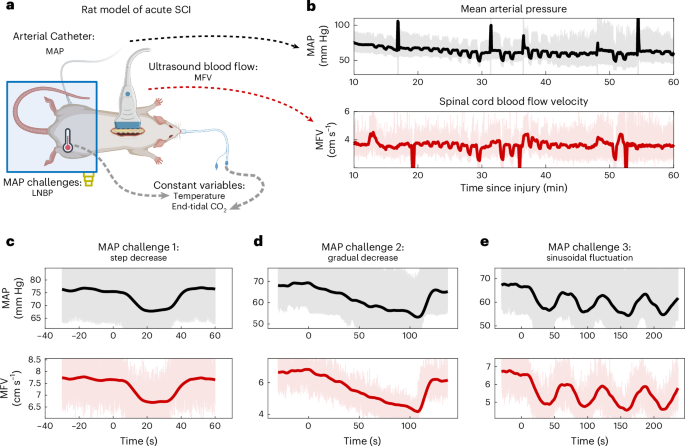
When lower-body negative pressure or hemorrhage challenges reduce perfusion, the feedback algorithm recalculates and updates the syringe pump every second.
Experimental Parameters in Rat and Pig Models
The study evaluated hemodynamic control across female Sprague–Dawley rats and Yorkshire pigs under strict institutional animal care guidelines. In the rodent experiments, investigators utilized a custom lower-body negative pressure chamber to simulate intensive care unit hemodynamic instability. To prevent the negative central venous pressure generated by the chamber from confounding the drug delivery, researchers infused norepinephrine directly into the femoral artery rather than a vein.
Large-animal evaluations in pigs incorporated hemorrhagic challenges and controlled alterations in arterial carbon dioxide and intraspinal pressure. While rat models required intra-arterial access to bypass vacuum-induced pressure distortions, the porcine models tolerated standard intravenous norepinephrine delivery without confounding intravascular artifacts. These methodological distinctions highlight the physiological rigor required to translate automated vasopressor control from bench to bedside.
GitHub Repository Provides Computational Framework for Physiological Signals
Parallel documentation hosted on GitHub by Denis Routkevitch provides the computational framework required to process the physiological signals captured during the experiments. The repository outlines the directory architecture for raw text exports, blood pressure calibrations, and real-time MATLAB scripts used to drive the Genie syringe pumps via standard RS-232 protocols. Researchers replicating these trials must configure their operating-room PicoScope blood-pressure calibrations and point their setup paths to unzipped Figshare archives containing compiled per-subject mat files.
Signal processing pipelines handle raw audio output from Doppler ultrasound machines using short-time Fourier transforms with periodic Hann windows. These automated workflows filter out noise and isolate microvascular flow dynamics from external respiratory artifacts. Such transparent data sharing allows biomedical engineers to audit the exact transfer functions and controller choices utilized during the spinal cord injury trials.
Disclaimer: The information provided in this article is for educational and scientific communication purposes only and does not constitute medical advice. Always consult with a qualified healthcare provider regarding any medical condition, diagnosis, or treatment plan.