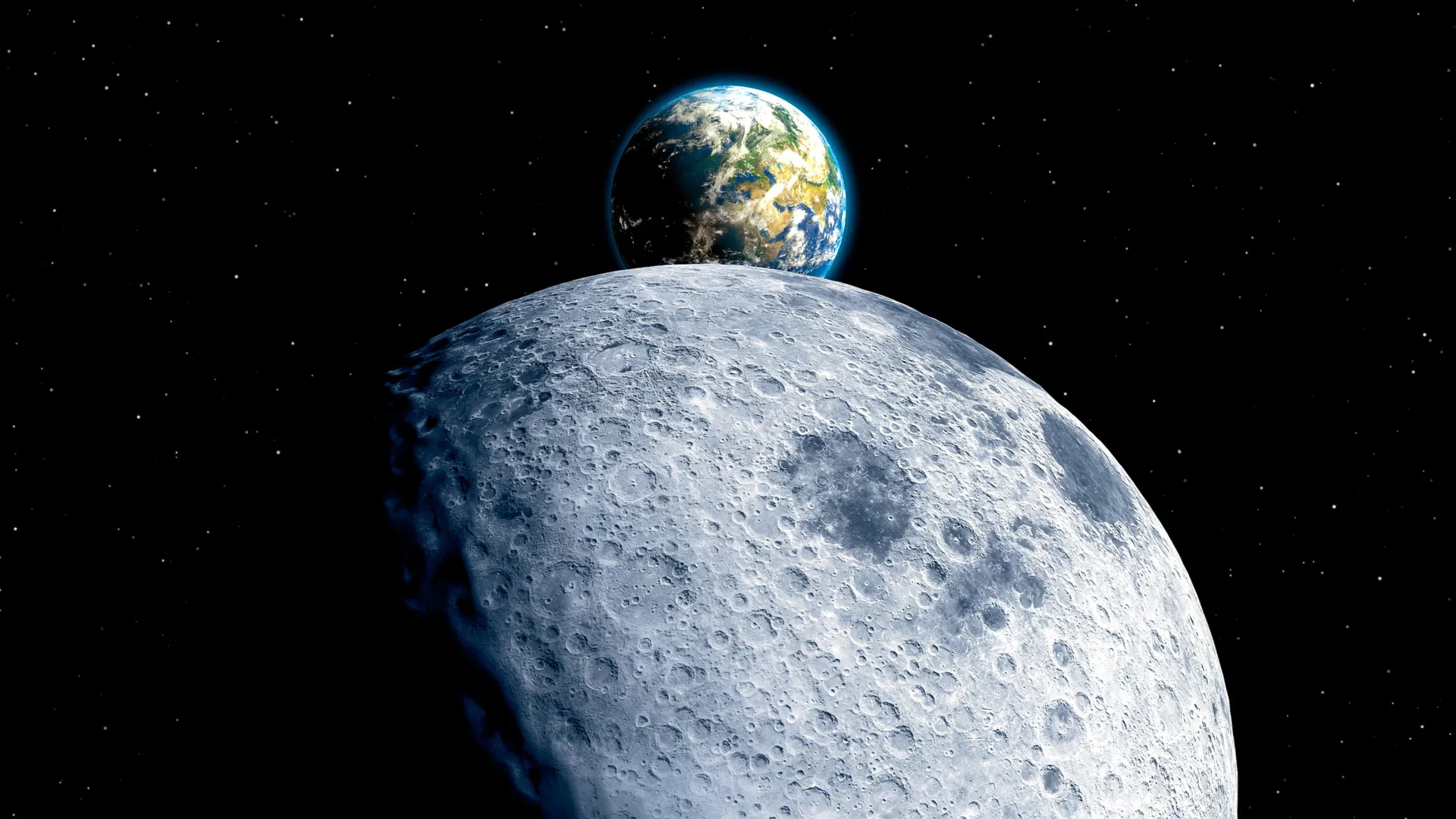
Chinese Researchers Find Asteroid Impacts Declined Gradually on Moon’s Far Side
Ancient lunar rocks collected from the Moon’s far side reveal that asteroid impacts decreased gradually over billions of years rather than occurring in a single catastrophic bombardment, challenging decades of scientific theory.
By examining tiny pieces of lunar rock, the research team identified impact events dating from approximately 4.33 billion to 1.13 billion years ago.
The samples reached Earth through China’s Chang’e-6 mission, which landed in 2024 in the southern portion of the Apollo basin within the northeastern South Pole-Aitken basin and returned approximately 1,935.3 grams of lunar soil, according to The Brighter Side of News. This return provided scientists with their first direct opportunity to examine far-side material in Earth-based laboratories, contrasting with near-side samples gathered during the Apollo program.
Dr. Fred Jourdan said

The data indicate that asteroid collisions became progressively less frequent over more than three billion years rather than clustering in a brief, intense bombardment. Dr.
A team led by Professor Guochun Zhao and Dr.
A study published in Communications Earth & Environment in July 2025 examined the mineral composition and radioactive ages of lunar norites from Chang’e-6 samples, proposing an alternative timeline for the SPA basin’s formation.
Yuqi Qian identified two types of magnesium-rich rocks with distinct geological origins. The researchers combined these sample analyses with surface measurements from the Chang’e-4 mission — which landed inside the 186-kilometer-wide Von Kármán crater in January 2019 — alongside remote sensing and numerical simulations.
Spanning roughly 2,500 km in diameter and 6.2–8.2 km deep, the South Pole-Aitken basin is the Moon’s largest, oldest, and deepest recognized impact structure. Radiometric dating of lunar zircons proposed to originate from the basin suggests a precise formation age of 4.338 billion years, placing it in the pre-Nectarian epoch.
Its immense scale implies a crustal thickness of only about 30 km beneath the floor — far thinner than the 60–80 km surrounding it — meaning the impact likely excavated deep lower-crust or mantle material not sampled by previous missions. Orbital data confirm a distinct composition richer in iron, titanium, thorium, and pyroxenes than typical highlands, offering a unique window into the lunar interior.
| Lunar Feature or Basin | Estimated Age |
|---|---|
| South Pole-Aitken basin | 4.34 billion years ago |
| Apollo basin | 4.2 billion years ago |
| Orientale basin | 3.87 billion years ago |
The South Pole-Aitken basin formed approximately 140 million years before the Apollo basin and roughly 470 million years before the Orientale basin, Wisevoter reported. These contrasting ages help explain how the original collision and subsequent impacts transformed the lunar interior and scattered ancient materials across the surface, according to The Brighter Side of News.
Related reading
- OPPO launches A7 Pro 5G in Romania with 7400 mAh battery
- Beaver’s Mini Mart Seeks Dismissal of Buc-ee’s Trademark Lawsuit, Citing No Consumer Confusion
- Chinese University Hong Kong Study Finds Postdiagnostic Support Boosts Activity, Medication Adherence (time.news)
- Gold Recovers on Chinese Buying After AI Sell-Off Decline (archyde.com)