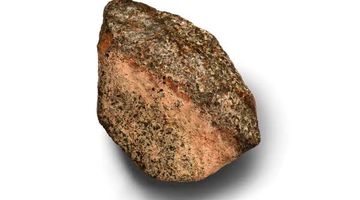
Ancient Martian Meteorite Reveals Water Interaction 4.1 Billion Years Ago
Analysis of the Teghaza 001 meteorite, recovered from the salt flats of Mali in 2022, provides evidence that liquid water interacted with the Martian crust approximately 4.1 billion years ago.
These findings suggest that Mars possessed a more dynamic, potentially habitable environment during its early formation than previously assumed.
Key Clinical Takeaways:
- The Teghaza 001 meteorite dates to the first 400 million years of Martian history, offering a rare window into the planet’s infancy.
- Advanced laser-based dating techniques identified specific mineral signatures, including zircon and calcium-rich crystals, that point to historic water interaction.
- Researchers have identified 13 additional candidate sites for further meteoritic recovery to expand the current understanding of early Martian geology.
Evidence of Aqueous Activity 4.1 Billion Years Ago
The study, published in the journal Science in late October 2026, details the chemical composition of the 798.5-gram (1.76-pound) specimen. While the majority of Martian meteorites found on Earth belong to the shergottite group—which typically dates to approximately 600 million years ago—Teghaza 001 originates from the planet’s primordial era.
According to reporting by Lentera.co, the meteorite’s mineralogy, specifically the presence of zircon and unique oxygen isotope ratios, indicates that these rocks underwent aqueous alteration while embedded in the Martian crust.
Zircon acts as a stable geochemical archive, preserving the conditions under which it crystallized. Yang Liu, a planetary scientist at NASA’s Jet Propulsion Laboratory, noted the significance of this discovery in the context of terrestrial evolution, according to Lentera.
“This is a rare ancient Martian meteorite, and it gives us a chance to look at the early crust and mantle of Mars, at a time when life was just beginning on Earth,” Liu told Lentera.co.
Advanced Analytical Methodology
To determine the age of the eight-fragment collection, researchers utilized a novel laser-based dating technique developed by Hayward Melton, a doctoral candidate at the California Institute of Technology.
This method represents a technical shift from conventional practices, which often require the dissolution of larger rock samples. By using a laser to vaporize microscopic portions of the material, the team successfully analyzed individual mineral grains without destroying the integrity of the larger sample.
| Meteorite Metric | Specification |
|---|---|
| Total Mass | 798.5 grams |
| Largest Fragment | 442 grams |
| Estimated Age | 4.1 billion years |
| Candidate Search Sites | 13 locations |
Geological Implications for Martian Habitability
The presence of water on early Mars remains a central focus for planetary scientists investigating the potential for past biological processes. While the identification of water-altered minerals in Teghaza 001 does not confirm the existence of life, it confirms that the necessary chemical environment existed during the planet’s formation.
This data provides a necessary benchmark for researchers modeling the transition of Mars from a potentially wet environment to the arid, cold desert observed today.
The scientific community is now looking to refine the search for similar specimens. Following the initial characterization of Teghaza 001, researchers are focusing their efforts on 13 specific geographic locations identified as high-probability sites for finding additional meteorites from the same epoch. These efforts are expected to provide a more comprehensive map of the geological activity occurring within the Martian mantle billions of years ago.
Yang Liu, a planetary scientist at NASA’s Jet Propulsion Laboratory since 2012, earned a Ph.D. in Geology from the University of Michigan in 2003 after completing a B.S. in Petroleum Geology at Chengdu College of Technology in 1995.
Her research has included the discovery of vapor condensate minerals on lunar volcanic beads and the determination of magmatic water signatures on Mars using an impact-melt hygrometer. She has also classified several meteorites, including the shergottite NWA 13134 in 2020 and the lunar breccia NWA 13638 in 2021.
For individuals interested in the intersection of planetary science and modern analytical chemistry, staying informed through peer-reviewed journals is the standard for accuracy.