
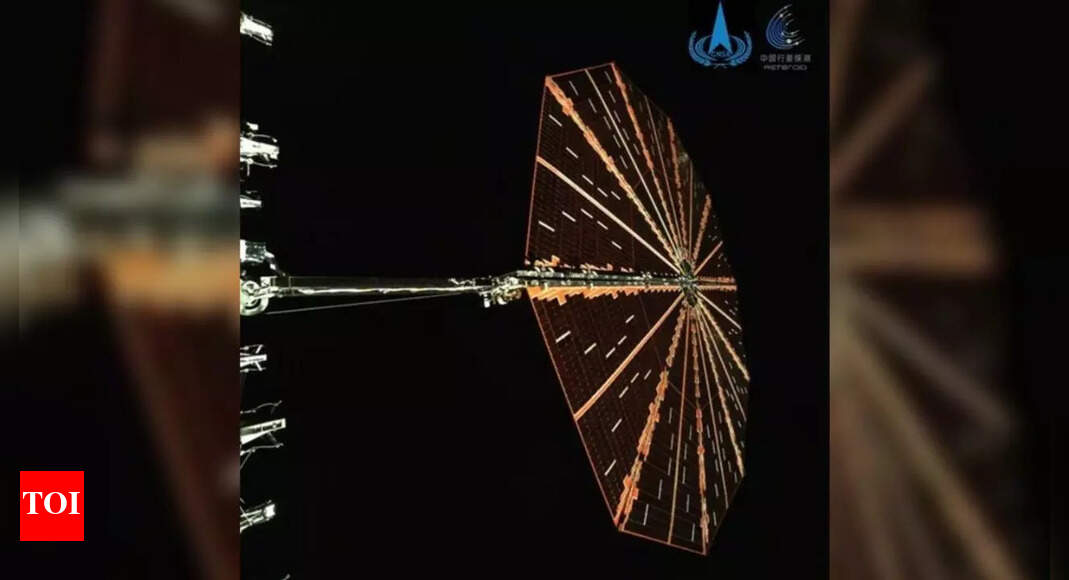
China Reveals First Images of ‘Quasi-Moon’ Probe
Tianwen 2 Mission Targets Asteroid Orbiting Alongside Earth
China’s space agency has released the initial photograph of its secretive Tianwen 2
spacecraft, currently en route to study a unique asteroid that shares Earth’s orbit. The mission marks a significant advancement in China’s ambitious space exploration program.
Mission Details Unveiled
The China National Space Administration (CNSA) launched the Tianwen 2
probe on May 29th aboard a Long March 3B rocket from the Xichang spaceport. The launch wasn’t broadcast live, with the CNSA announcing its success approximately one hour after liftoff. As of June 6th, the spacecraft is roughly 1.9 million miles (3 million kilometers) from Earth—eight times the distance to the Moon—and operating as intended.
Target: Kamoʻoalewa
In July 2026, Tianwen 2
will approach Kamoʻoalewa, a small asteroid approximately the size of a Ferris wheel. This celestial body is a quasi-satellite
—it orbits the Sun alongside Earth but isn’t gravitationally bound to our planet, and will eventually drift away. Scientists estimate Kamoʻoalewa is between 40 and 100 meters in width and maintains a distance of at least 4.6 million kilometers from Earth.
The discovery of Kamoʻoalewa and other quasi-moons highlights the growing field of near-Earth object (NEO) research. According to NASA’s Center for Near Earth Object Studies, over 31,000 near-Earth asteroids have been discovered as of June 7, 2024, with more being identified regularly. NASA’s CNEOS tracks these objects to assess any potential impact risks to Earth.
Origin and Significance
Researchers believe Kamoʻoalewa may have originated from the Moon, potentially ejected into space by a meteor impact millions of years ago. Earth currently has six other known quasi-moons, often referred to as “minimoons,” which temporarily orbit our planet for shorter periods. Astronomers suspect many more such objects remain undiscovered, and similar co-orbitals may exist around Venus, potentially posing future gravitational challenges.
The Tianwen 2
mission aims to land on Kamoʻoalewa and collect samples, providing valuable insights into its composition and origin. The probe’s design bears similarities to a current NASA spacecraft, sparking interest in the technological approaches being utilized by both space agencies.
This mission represents a bold step forward in China’s space ambitions, demonstrating its growing capabilities in deep-space exploration and sample return missions.
