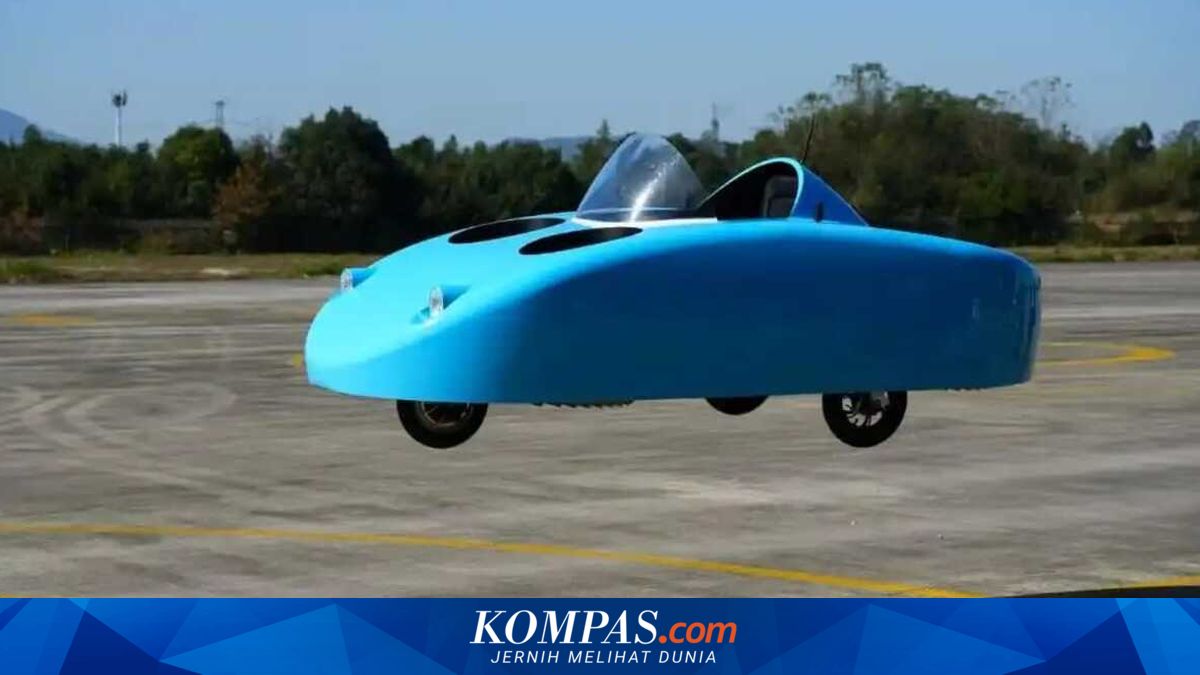
China Successfully Tests Wingless Flying Car Prototype Capable of Vertical Takeoff and Road Driving
Zhongfei Smart Manufacturing has tested a wingless flying car prototype in China, advancing the country's low-altitude economy.
JawaPos.com reports that the current climate of aerial mobility technology is highlighting two distinct approaches between China and the United States. The vehicle, which is capable of vertical takeoff and landing, completed its maiden flight at a general aviation airport in Changsha, Hunan Province, on November 21, 2026, according to tekno.kompas.com.
The prototype distinguishes itself from conventional multirotor aircraft by replacing exposed propellers with a multi-stage vector ducted-fan system. This design houses the propulsion units within protective channels to generate lift and manage altitude, a configuration that developers claim reduces noise and energy consumption.
According to reports from the Xinhua News Agency, the vehicle utilizes a ducted fan system integrated with multi-stage thrust vectoring technology. This design ensures that no propellers protrude from the body of the vehicle.
“This design eliminates safety risks associated with exposed propellers. "Its noise and energy consumption during cruising flight are lower compared to multirotor models," said Yang, Technical Director of Zhongfei Smart Manufacturing, according to tekno.kompas.com.”
Following the initial test in Changsha, the vehicle underwent further evaluation across various scenarios in Yiyang on November 22, 2026, as noted by Aktualita.co, according to Kompas. The current prototype is designed as a single-seat craft, with a maximum takeoff weight of 280 kilograms and a payload capacity of 120 kilograms.
Zhongfei Smart Manufacturing claims that this prototype is the first crewed aircraft in the world to utilize this specific propulsion system. For the initial development phase, the prototype being tested uses a single-passenger configuration.

| Performance Metric | Value |
|---|---|
| Max Flight Speed | 150 km/h |
| Max Road Speed | 80 km/h |
| Flight Range | 300 km |
| Max Altitude | 3,000 m |
The vehicle is engineered to transition into a road-legal car after landing, allowing for dual-mode operation. While the craft is designed for a maximum altitude of 3,000 meters, its typical operational height is approximately 100 meters, according to data cited by GadgetSquad.ID. Development plans for the project include future configurations capable of carrying between six and 15 passengers.
The project has attracted attention from officials, including the Chinese Ambassador to India, Xu Feihong. The test flight footage was shared by the ambassador on the platform X. “Mobil terbang tanpa sayap buatan Tiongkok telah menyelesaikan penerbangan perdananya di Changsha,” wrote Xu, according to KOMPASIANA.
He noted the vehicle can lift off without a runway, according to JawaPos.com.
The Economic Times, cited by JawaPos.com, reported that the ambassador highlighted the ducted fan design which conceals blades inside the body to make urban flights safer. Xu Feihong shared the footage on November 25, 2026, drawing international attention to the test program.

Project lead Shen Guanqing described the successful maiden flight as important progress for multi-stage thrust-vectoring ducted fan technology, according to Aktualita.co.
Developers outlined plans for larger configurations ranging from six-to-eight-seat models up to 12-to-15-seat variants, with a maximum takeoff weight of 5.5 tons and a payload capacity of 2 tons, Aktualita.co reported. Potential applications include mountain logistics, emergency medical services, firefighting, security patrols and aerial mapping.
Despite the successful test flights, the vehicle remains in the prototype stage and is currently undergoing further certification processes, according to reports from Topik.ID. This development follows China’s testing of 6G internet technology, from factory applications to maritime use.