China Successfully Lands Reusable Orbital Rocket Boosters
<>
China has become first to recover orbital launch rockets with 2 distinct paths, achieving the milestone through two engineering pathways pursued by state and private contractors. According to SpaceNews, the China Aerospace Science and Technology Corporation (CASC) launched a Long March 10B rocket early Friday, July 10, from the Hainan Commercial Space Launch Site, successfully capturing the booster at sea using a tensioned net system.
CASC Deploys Net Capture System for Long March 10B Booster
The July 10 mission lifted off at 12:15 a.m. Eastern time from the southern island province of Hainan. CASC confirmed the successful recovery of the rocket’s first stage 11 minutes later. The operation utilized a sea platform equipped with a net capture system, marking a departure from traditional landing-leg methodologies.
Videos reviewed following the flight showed a controlled, powered descent with black smoke billowing from the top of the first stage. Hooks deployed from the booster were caught by a tensioned net on the Linghang Zhe recovery vessel, occurring six minutes after stage separation. The five-meter-diameter, two-stage Long March 10B stands 63 meters long, has a lift-off mass of 760,000 kilograms, and provides a low Earth orbit payload capacity of 16,000 kg in reusable mode. CASC stated its intention to reuse the first stage from the flight before the end of the year, according to SpaceNews.
Commercial Competitors Pursue Land-Based Landing Legs
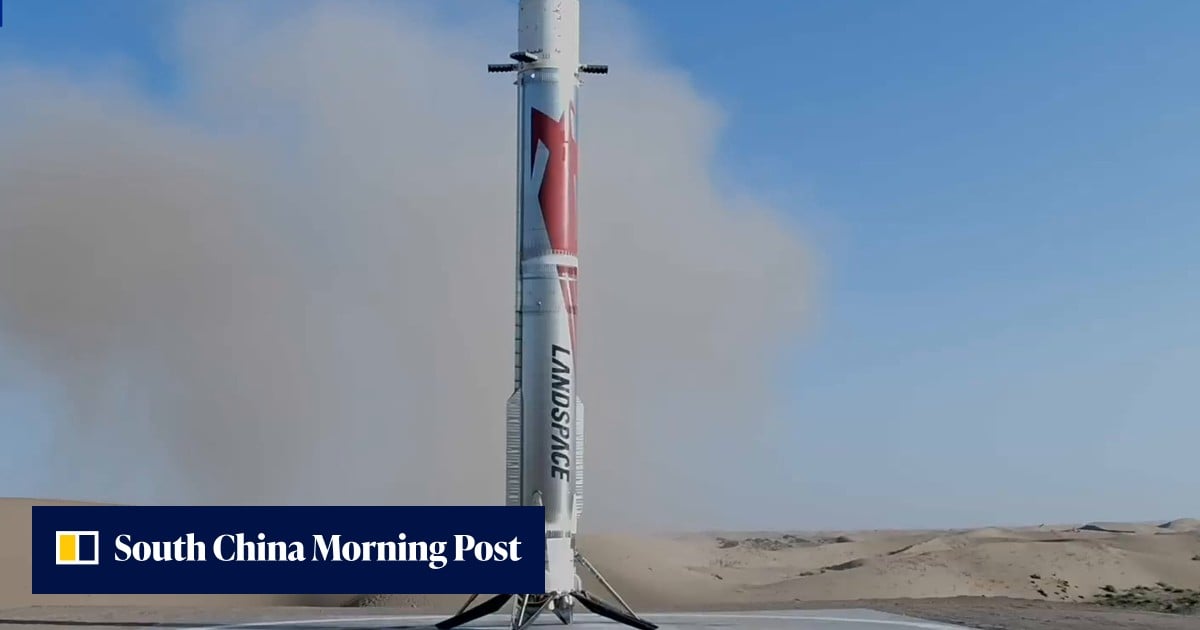
While CASC utilized a sea-based net capture mechanism, other domestic aerospace entities have pursued alternative architectures. Unlike the CASC net-capture method, commercial variants such as the LandSpace Zhuque-3 and CASC’s Long March 12A are equipped with landing legs for vertical propulsive touchdowns.

Lunar Program Milestones and Fiscal Outlook
The successful Long March 10B mission serves as a full-profile validation flight for the Long March 10A, designed to launch the Mengzhou crew spacecraft. This larger, partially reusable successor to the Shenzhou vehicle is a cornerstone of China’s commitment to landing astronauts on the lunar surface before 2030. The full, tri-core variant of the Long March 10 will ultimately transport lunar landing stacks.
>