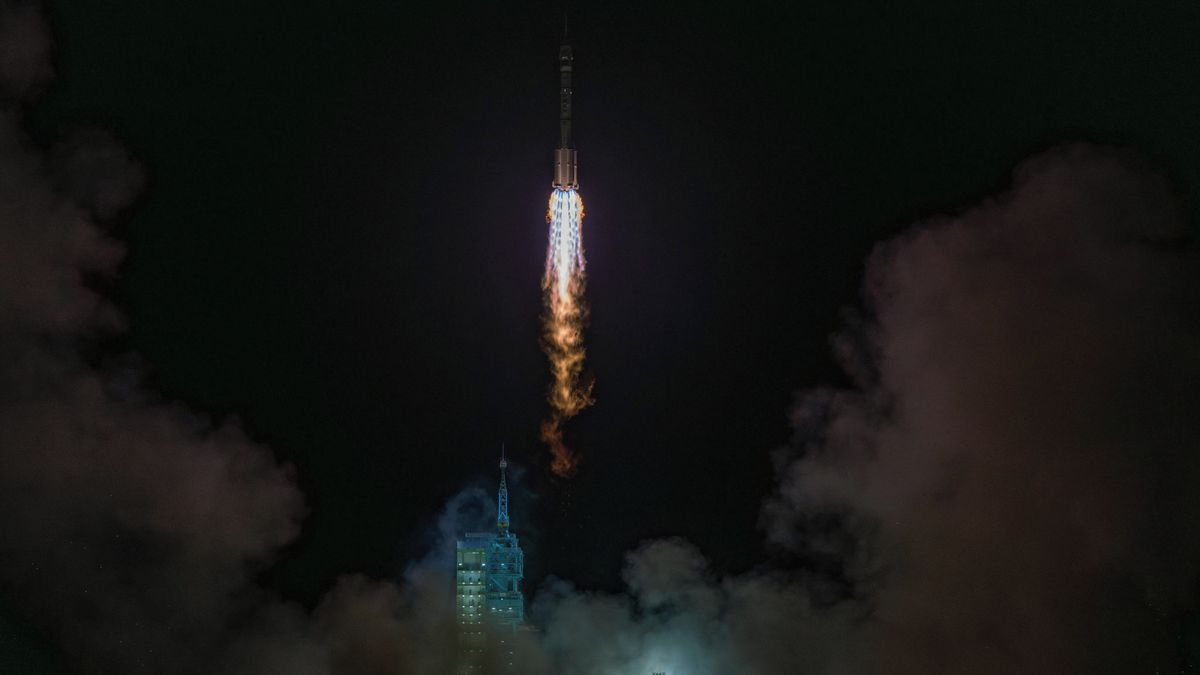
China Sends Three-Member Crew to Space Station for Year-Long Mission
China launched a three-person crew to its Tiangong space station on May 24, 2026, with one astronaut scheduled to spend a full year in orbit—a mission that underscores Beijing’s accelerating push to establish a permanent human presence in low Earth orbit. The Shenzhou-23 mission, carrying a veteran taikonaut and two newcomers, marks a critical step in China’s self-sufficiency in space, while raising geopolitical tensions as the U.S. And its allies watch closely. This is not just a scientific milestone; it’s a strategic maneuver with implications for global space governance, military surveillance capabilities, and the future of international cooperation—or competition—in the final frontier.
The Space Race 2.0: Why China’s Year-Long Mission Matters
China’s decision to extend a taikonaut’s stay to 365 days on the Tiangong station is a deliberate signal. The U.S. Has not conducted a year-long mission since the 1980s, and Russia’s Mir program ended in 2001. This gap is now being filled by China, which has systematically outpaced Western partners in orbital infrastructure since the 2011 retirement of the Space Shuttle. The mission’s objectives—testing life-support systems, radiation shielding, and psychological resilience—are framed as scientific, but the subtext is clear: China is positioning itself as the default leader in long-duration space habitation, a domain critical for future lunar and Mars missions.
“This is a watershed moment for China’s space program. A year-long mission is not just about endurance; it’s about proving you can sustain a presence in space indefinitely. That’s the difference between a spacefaring nation and a spacefaring empire.”
Geopolitical Fallout: The New Space Order
The U.S. And its allies are watching this development with a mix of alarm and strategic recalibration. The Artemis Accords, signed by 48 nations, emphasize “peaceful exploration” and “transparency,” but China’s exclusion from the agreement—and its parallel space diplomacy with Russia, Pakistan, and the UAE—has created a bifurcated system. The Shenzhou-23 mission is a test case for how China will leverage its space achievements to expand its sphere of influence, particularly in regions where Western dominance is waning.

- Military Implications: Tiangong’s low Earth orbit is ideal for surveillance of U.S. Naval movements in the Indo-Pacific. China’s ability to maintain a continuous human presence in space could accelerate the development of space-based weapons systems, a violation of the 1967 Outer Space Treaty’s ban on “weapons of mass destruction” in orbit. The Artemis Accords explicitly prohibit such deployments, but enforcement remains a challenge.
- Economic Leverage: China’s space program is a cornerstone of its “Made in Space” initiative, which aims to commercialize orbital manufacturing. A year-long mission demonstrates viability for private-sector partnerships, potentially sidelining Western firms in sectors like microgravity research and satellite servicing. Analysts warn that this could trigger a “space Schengen” dynamic, where China’s orbital infrastructure becomes the default for Asian and African nations seeking cost-effective access.
- Diplomatic Isolation: The U.S. And EU have imposed restrictions on Chinese space collaborations, but the Shenzhou-23 mission highlights the limits of these measures. China’s space station is already hosting experiments from 17 countries, including Brazil and Thailand, despite Western sanctions on dual-use technology. This raises questions about the effectiveness of export controls in the face of China’s self-sufficiency.
Macro-Economic Ripples: Who Wins and Who Loses?
The space economy is projected to reach $1.1 trillion by 2040, with China targeting a 20% share by 2035. The Shenzhou-23 mission is a strategic play to capture market share in three critical areas:
| Sector | China’s Advantage | Western Vulnerability | Corporate Response |
|---|---|---|---|
| Orbital Manufacturing | Tiangong’s microgravity labs can produce high-purity materials (e.g., fiber optics, pharmaceuticals) at lower cost than ISS partners. | U.S. And EU companies rely on ISS access, which is politically constrained and expensive. | Multinational firms are already diversifying their supply chains to include Chinese orbital facilities, but face legal risks under U.S. Export controls. |
| Satellite Constellations | China’s reusable Long March rockets and homegrown satellite tech reduce dependency on Western launch providers. | U.S. And EU firms face delays and higher costs due to geopolitical restrictions on semiconductor exports. | Telecom giants are scrambling to secure insurance and risk assessments for launches involving Chinese partnerships. |
| Lunar Gateway Competition | Tiangong’s year-long mission proves China can sustain crewed lunar missions without relying on NASA’s Orion or SpaceX. | Artemis partners are falling behind in lunar infrastructure, risking a “first mover” disadvantage in helium-3 mining and ISRU (In-Situ Resource Utilization). | Energy and mining firms are consulting with international space law specialists to navigate the legal gray areas of lunar resource extraction. |
The Legal Gray Zone: Who Polices the Final Frontier?
The Outer Space Treaty of 1967 is the foundation of international space law, but it was drafted in an era when only three nations had space capabilities. Today, the treaty’s ambiguity is being exploited. Article II prohibits “national appropriation” of celestial bodies, yet China’s lunar sample returns and Tiangong’s commercial partnerships blur the line between “exploration” and “exploitation.” The Shenzhou-23 mission forces a reckoning: if China can sustain a permanent human presence in orbit, does it have the right to claim sovereignty over the resources it harvests?

“The real question isn’t whether China will exploit space resources—it’s whether the international community will allow them to do so unchecked. The Artemis Accords are a start, but they’re a club, not a global standard. China’s space station is already the most inclusive orbital lab on Earth, and that’s a problem for those who want to maintain a monopoly on space governance.”
The legal risks are magnified by the lack of a unified enforcement mechanism. While the U.S. Can sanction Chinese entities for violating export controls, there is no equivalent for space law. This creates a vacuum that specialized space law firms are rushing to fill, drafting contracts that anticipate conflicts over resource rights, liability for orbital debris, and jurisdiction in the event of an accident.
The Corporate Playbook: How Firms Are Adapting
The Shenzhou-23 mission is a catalyst for three major corporate strategies:
- Dual-Sourcing Space Logistics: Companies like Airbus and Lockheed Martin are hedging their bets by partnering with Chinese firms for launch services while maintaining Artemis Accords compliance. Space logistics consultants are advising clients on how to structure these relationships to avoid U.S. Sanctions.
- Insurance Arbitrage: The space insurance market is fragmenting. Lloyd’s of London underwriters are now offering separate policies for “China-aligned” missions, given the higher risk of political interference. Firms are turning to geopolitical risk consultants to model scenarios where a mission could be stranded in orbit due to sanctions.
- Lunar Resource Arbitrage: With China poised to dominate early lunar mining, Western firms are exploring “backdoor” partnerships with Asian allies (e.g., Japan, South Korea) to access helium-3 deposits. Trade lawyers are drafting “space resource sharing agreements” to navigate the legal limbo of celestial resource extraction.
The Long Game: What’s Next?
China’s year-long mission is not an endpoint—it’s a prologue. The next phase will see Tiangong expanded into a multi-module complex, capable of supporting six astronauts. This will directly compete with NASA’s Lunar Gateway, which remains underfunded and behind schedule. The real battle is over who controls the narrative of space governance: a U.S.-led regime of exclusionary alliances, or a China-dominated model of “open collaboration” (with strings attached).
The stakes are higher than science. The ability to sustain human life in space is the ultimate geopolitical leverage. Whoever masters it first will dictate the rules of the next century—whether in orbit, on the Moon, or beyond.
For corporations navigating this shifting landscape, the message is clear: the old playbook is obsolete. The firms that thrive will be those that can anticipate the fault lines, draft the new contracts, and manage the risks before the next mission launches. The clock is already ticking.