Atlantic Council: Iran Launches Drone Attacks on Bahrain as Third US Carrier Arrives
Bahrain spent this week absorbing fresh Iranian drone attacks three days after President Donald Trump declared the war with Iran “militarily is effectively over,” while a third US aircraft carrier strike force arrived in the region — a posture Gulf waters have not seen since the 2003 invasion of Iraq.
For Manama, the war is not over.
The Atlantic Council, in a dispatch from Manama published as Trump made his statement, reported that Iran launched two drone attacks against Bahrain in the days that followed, reportedly targeting a US military base. Earlier this week, US Central Command announced the third carrier strike force had entered its area of responsibility. It remains unclear whether that carrier reinforces the existing deployment or replaces another ship.
The stakes for Bahrain are specific and severe. The small kingdom hosts US Naval Forces Central Command and the US Fifth Fleet, depends entirely on the Strait of Hormuz for its economy, and — unlike Qatar and Kuwait — has no sovereign wealth fund worth hundreds of billions of dollars to cushion a renewed conflict.
Atlantic Council reporting describes Bahrain as the Gulf ally most vulnerable, physically and economically, if major combat operations resume.
USS Theodore Roosevelt (CVN 71) transits the Indian Ocean, Nov. 15. The aircraft carrier is currently operating in the CENTCOM area of responsibility as part of a scheduled deployment. pic.twitter.com/xal3oET37A
“Militarily is effectively over,” Trump said of the war with Iran, according to the Atlantic Council account. The attacks on Bahrain that followed, and the carrier buildup Washington announced this week, tell a different story in the Gulf itself.
Strategists in the region, the report notes, understand that force surges can acquire momentum of their own — a dynamic that contributed to US decisions to go to war both in 2003 and earlier this year.
Three carriers, one unresolved question
The naval picture is the clearest new fact on the ground. A third carrier strike force in Central Command’s area of responsibility marks a posture the region last witnessed under President George W. Bush as the United States prepared to invade Iraq.
Whether the ship adds weight to the current force or rotates in for another carrier is unknown, and that ambiguity matters: the same surge logic, Atlantic Council argued, can instigate the war it was meant to deter.
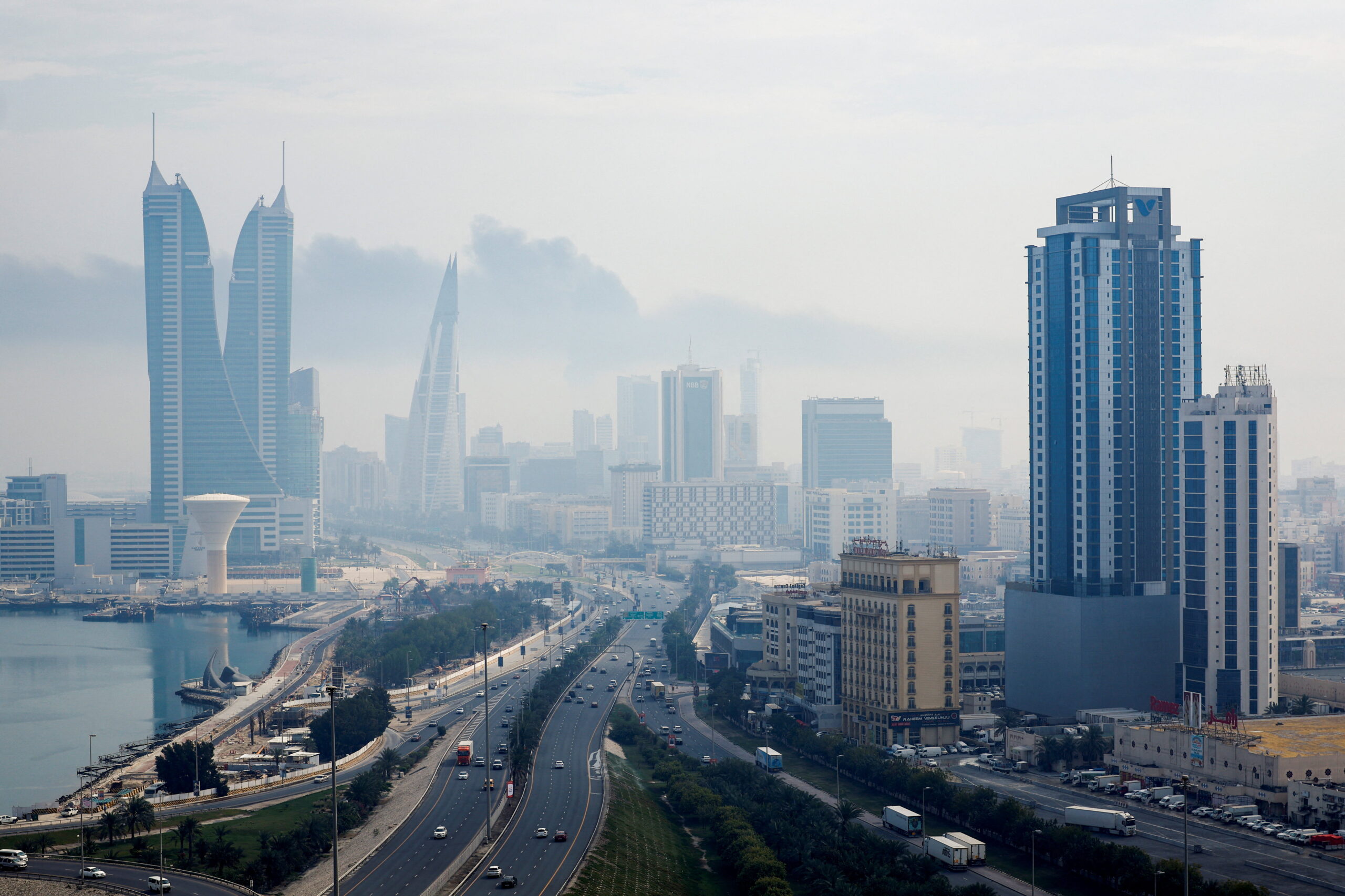
Life in Bahrain, as in neighboring countries, continues with what the report calls a striking degree of normality. Smoke rose over Sitra Island on March 9, when a strike hit an oil refinery there during the US-Israeli conflict with Iran. Normality, in this reading, is not the same as safety.
Gulf governments are no longer moving together
The deeper shift the dispatch identifies is fragmentation. The war has sharpened differences among Gulf governments, which are entering what the report terms an “age of agency” — outside powers weigh less, and each capital feels more empowered to protect its own interests, unilaterally where it can and through shifting bilateral ties where it cannot.
A two-month pause ends as Iran strikes US targets in Bahrain | Iran fired drones across the Persian Gulf on Tuesday at a U. S. radar facility in Bahrain, its third attack in recent days on American military targets in the tiny island kingdom as Tehran resumed strikes on its Arab… pic.twitter.com/MwKz6hZ8uH
The responses diverge sharply. Oman has reacted to Iranian attacks by seeking to legitimize rather than reject Iranian aggression, Atlantic Council reported. The Houthis demanded $51 billion from Saudi Arabia to halt their attacks on the kingdom, according to the recent report the dispatch cites; Riyadh quickly rejected it.
Kuwait, attacked yet again, is preparing for a future in which it expects less from Washington. Saudi Arabia, hit from east, north and south, signed the Mecca Joint Defense Agreement with Turkey and Pakistan in August and has sought to involve Syrian forces against the Houthis.
Qatar took another path. After what the report calls a phase of “strategic shock” — attacked by Iran and suffering the sharpest economic contraction in the region, Doha doubled down on mediation, making itself indispensable to US diplomacy with Hamas and Iran. The UAE instead reinforced ties with those that helped it in its moment of need, a list Atlantic Council says explicitly includes the United States and Israel.

Why Bahrain doubled down on Washington
Bahrain’s choice stands out against its constraints. With limited energy production, high debt, a small population, and a Shia majority — the only Gulf state with one — it could plausibly have acquiesced to Iranian power or settled into the role of a Saudi protectorate. It moved closer to the United States instead.
The relationship was built over three decades, and the record is public. The United States and Bahrain signed a Defense Cooperation Agreement in 1991 under President George H. W. Bush, formalizing the Fifth Fleet’s presence. Bahrain became a major non-NATO ally in 2002.
The two countries signed a free trade agreement in 2004. Bahrain joined the Abraham Accords in 2020 without requesting any special favors from Washington, and signed a Comprehensive Security Integration and Prosperity Agreement under President Joe Biden in 2023.
Manama is also building regionally. Earlier this month it hosted the signing of an agreement to advance a railway network across the Gulf, and its leaders suggest countries not yet able to join the Abraham Accords adopt the principles in the accompanying declaration.
Unlike Saudi Arabia and the UAE, which sent ambassadors to Tehran in 2022 and 2023 in what Atlantic Council calls a fruitless effort, Bahrain refused. It has not courted Russia or China, nor struck private understandings with Hamas or the Houthis, while keeping financial lifelines to both Riyadh and Abu Dhabi.
Overlooked in Washington, exposed on the map
That record is well understood among US policymakers who work on Middle East security, the dispatch notes, but less recognized outside that circle — where Bahrain is often viewed solely as an undemocratic monarchy with a mixed human rights record.
Members of Congress visiting the region frequently skip Manama. The Trump administration sent no regional envoy or cabinet-rank official to the Manama Dialogue earlier this month, an absence noticed by many in attendance. Before the war, Atlantic Council argues, that was excusable. Today it is not.
For companies and institutions exposed to the Gulf, the practical question is continuity planning: with tensions in the region high and preparations for a return to major combat operations continuing, firms with interests there face a situation that belies the striking degree of normality across countries like Bahrain. The structural facts they weigh are the ones Bahrain itself lives with.
The dispatch comes from the Atlantic Council, a Washington, DC-based think tank on international affairs founded in 1961 by Christian Herter and William L. Clayton to encourage cooperation between North America and Europe after World War II.
Though rooted in Atlanticism, its work has since widened well beyond the transatlantic relationship — it manages sixteen regional centers and functional programs, including a South Asia Center opened after the war in Afghanistan and, since 2016, a Digital Forensic Research Lab studying disinformation.
Bahrain was attacked by Iran, the report concludes, precisely because of its longstanding commitment to the United States. If major combat operations resume, it will be the Gulf ally most vulnerable, physically and economically — and the third carrier now in Central Command’s waters has not answered whether they will.