
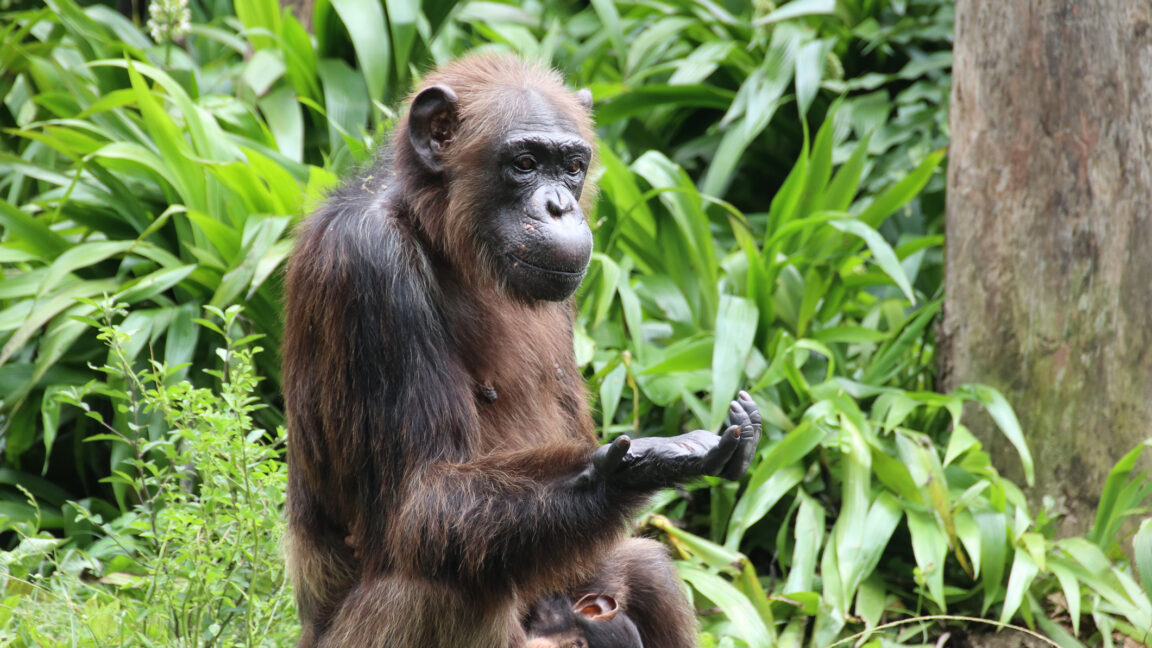
Chimpanzees Demonstrate Surprisingly Advanced Reasoning Skills, Challenging Understanding of Rationality‘s Evolution
WASHINGTON D.C. – New research published in Science (2025, DOI: http://www.science.org/doi/10.1126/science.aeb7565) reveals that chimpanzees exhibit a complex ability too reassess decisions in teh face of new evidence, suggesting a more complex evolutionary history of rationality than previously understood. The study, led by researcher Engelmann, demonstrates that chimps can not only follow initial evidence but also revise their choices when that evidence is demonstrably refuted.
The experiments involved presenting chimpanzees with conflicting clues to locate a food source. Initially, the chimps were given auditory evidence – a rattling sound emanating from one container - alongside indirect visual evidence, a trail of peanuts leading to a second. The animals consistently chose the container associated with the auditory cue, indicating they perceived it as stronger. Crucially, researchers then introduced disconfirming evidence: a rock was removed from the first container, suggesting the rattling wasn’t caused by food.
“At this point, a rational agent should conclude, ‘The evidence I followed is now defeated and I should go for the other option,'” Engelmann explained to Ars. “And that’s exactly what the chimpanzees did.”
Across five experiments involving 20 chimpanzees, the animals followed the evidence in approximately 80% of cases, with 18 out of 20 consistently demonstrating the expected pattern of revising their choices. This suggests a “rudimentary form of rationality” at play, according to Engelmann. Later experiments,deemed “quite arduous,” revealed a more advanced “reflective rationality” – a capacity the researchers currently believe is limited to chimps and potentially bonobos.
The findings contribute to a growing understanding of how rationality evolved.Engelmann posits that rationality isn’t a simple “on/off switch,” but rather exists on a spectrum across different species. The research team is now investigating whether chimpanzees are influenced by the choices of other chimps, finding that they only follow another’s decision when that chimp possesses stronger evidence.
Interestingly, this contrasts with human behavior. While humans possess a further level of rationality – what Engelmann terms “social rationality” – the ability to refine thinking through discussion and collaboration, social interaction can also decrease rationality. “We can discuss and comment on each other’s thinking and in that process make each other even more rational,” Engelmann claims. though, chimps don’t appear to exhibit this susceptibility to irrationality within social contexts.
This research represents a crucial step in understanding the origins of rational thought, and Engelmann’s team continues to explore this question, aiming to pinpoint when and how the first sparks of rationality appeared in the natural world.
