Case study reports metastatic neuroendocrine tumor in 40-year-old male
A 40-year-old male patient presenting with back pain and severe weight loss exhibited an extreme biochemical profile featuring a urine metanephrine-to-creatinine ratio of 42,040 micrograms per gram, according to a case study.
-
Key Clinical Takeaways:
- The patient developed profound biochemical evidence of catecholamine excess alongside hypercalcitoninemia and large 10-centimeter bilateral adrenal masses.
- Histological evaluation of a bone biopsy confirmed a metastatic well-differentiated neuroendocrine tumor, WHO grade 3, with an approximate Ki-67 index of 40%.
- Rapid clinical deterioration prevented the completion of definitive RET genetic testing, functional imaging, and thyroid evaluations suspected for multiple endocrine neoplasia type 2B.
Patient Presents with Back Pain and Labile Hypertension
The patient initially presented to medical attention complaining of back pain, urinary retention, mild unilateral weakness, and significant weight loss. Physical examination revealed a normal baseline temperature of 36.4 degrees Celsius, a heart rate of 88 beats per minute, a respiratory rate of 18 breaths per minute, 100 percent oxygen saturation, and an initial blood pressure of 158 over 104 millimeters of mercury. Within the early phase of admission, the patient developed severe and markedly labile hypertension, displaying recurrent blood pressure readings exceeding 180 over 110 millimeters of mercury and a documented peak of 225 over 106 millimeters of mercury.
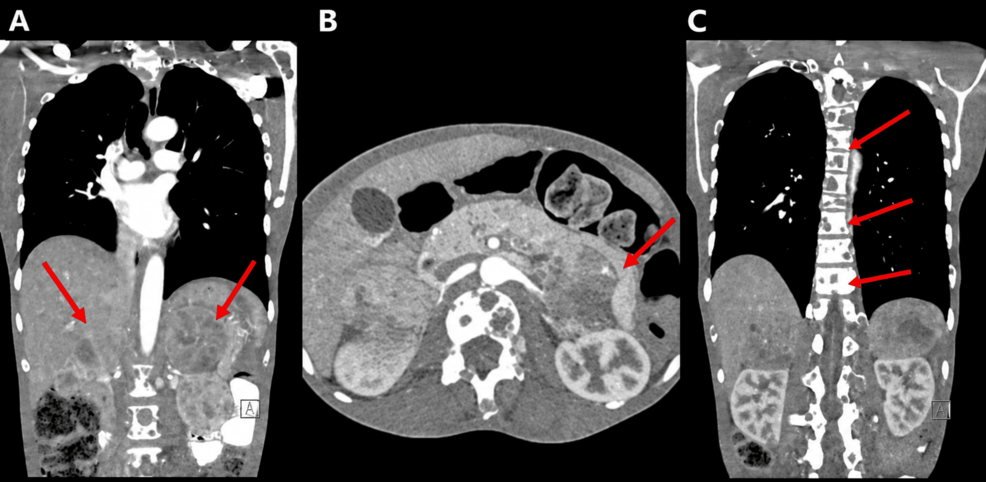
Contrast-enhanced computed tomography scans demonstrated approximately 10-centimeter bilateral heterogeneous adrenal masses accompanied by diffuse lytic skeletal metastases. Initial laboratory evaluations revealed significant hypercalcemia, with serum calcium registering at 11.9 milligrams per deciliter and subsequently peaking at 12.5 milligrams per deciliter, compared to a normal reference range of 8.9 to 10.2 milligrams per deciliter. The initial parathyroid hormone level measured 15.1 picograms per millilitre against a reference range of 15 to 65 picograms per millilitre, reflecting a low-normal concentration in the context of elevated serum calcium. Concurrently, 25-hydroxyvitamin D stood at 19.4 nanograms per millilitre, falling below the standard laboratory sufficiency range of 30 to 100 nanograms per millilitre. Subsequent measurements showed parathyroid hormone rising to 93 picograms per millilitre after the serum calcium dropped to 9.0 milligrams per deciliter, rendering the later value unindicative of primary hyperparathyroidism.
Screening Confirms Catecholamine Overproduction and High Serum Calcitonin
Biochemical screening confirmed profound catecholamine overproduction. Urine metanephrine-to-creatinine reached 42,040 micrograms per gram against a reference range of 29 to 158 micrograms per gram. Normetanephrine-to-creatinine measured 6,079 micrograms per gram against a reference range of 53 to 659 micrograms per gram. Vanillylmandelic acid-to-creatinine was recorded at 212 milligrams per gram against a reference range of 1.1 to 4.1 milligrams per gram. Serum calcitonin measured 4,680 picograms per millilitre against a normal reference of 8.4 or lower, while carcinoembryonic antigen registered at 239 nanograms per millilitre against a reference below 3.8 nanograms per millilitre for non-smokers.
Expert histological review of a bone biopsy identified a metastatic well-differentiated neuroendocrine tumor categorized as WHO grade 3 with an estimated Ki-67 proliferation index of approximately 40 percent. Immunohistochemical staining demonstrated positive expression for chromogranin, synaptophysin, pancytokeratin, thyroid transcription factor 1, carcinoembryonic antigen, paired box 8, and cytokeratin 7. Conversely, the tissue tested negative for calcitonin, thyroglobulin, cytokeratin 20, GATA3, and S100. Small polypoid lesions observed at the tip of the tongue suggested possible mucosal neuromas, which, alongside thyroid calcifications, initially raised strong clinical suspicion for multiple endocrine neoplasia type 2B.
Findings Point Toward Multiple Endocrine Neoplasia Type 2B
The convergence of bilateral adrenal masses, massive catecholamine excess, hypercalcitoninemia, and suspected mucosal neuromas pointed heavily toward multiple endocrine neoplasia type 2B, an autosomal dominant tumor-predisposition syndrome primarily driven by activating germline variants in the RET proto-oncogene. However, definitive diagnostic confirmation remained elusive because thyroid fine-needle aspiration, RET genetic testing, and functional imaging could not be performed prior to rapid patient decline. The clinical picture presented a stark clinicopathologic discordance, where the biochemical profile strongly supported pheochromocytoma, yet the metastatic-site histology failed to definitively establish the primary tumor origin.
Management efforts included the administration of alpha-blockade, palliative spinal radiotherapy, and systemic chemotherapy utilizing carboplatin and etoposide. The hospital course suffered severe complications, including profound pancytopenia, extended-spectrum beta-lactamase-producing Escherichia coli bacteremia, respiratory and renal failure, gastrointestinal bleeding, and intracranial hemorrhage, culminating in the patient’s death.
Disclaimer: The information provided in this article is for educational and scientific communication purposes only and does not constitute medical advice. Always consult with a qualified healthcare provider regarding any medical condition, diagnosis, or treatment plan.