Built Environment, Metabolic Risk Factors, and Self-Reported Kidney Disease in Missouri: A Population-Level Descriptive Study
Statewide self-reported kidney disease prevalence in Missouri stands at 4.10%, according to a population-level descriptive study published in Cureus on October 29, 2026. Researchers analyzed survey-weighted aggregate data from the Missouri Behavioral Risk Factor Surveillance System to map chronic kidney disease across household income levels, education brackets, and seven distinct geographical regions.
The study, authored by J. M. Garchitorena, A. Azeem, A. C. Sharma, and colleagues, reveals regional and socioeconomic disparities in renal health. While the statewide prevalence figure provides a baseline, localized rates fluctuate depending on geography and household earnings.
Geographic Disparities in Southwest and Central Missouri Regions
Geographic patterns emerged across the state’s seven public health surveillance regions. The highest prevalence of self-reported kidney disease was recorded in the Southwest BRFSS region at 6.49%. Conversely, the Central region recorded the lowest prevalence at 2.73%.
The findings quantify public health trends that vary by state. Chronic kidney disease tracks heavily with metabolic comorbidities nationwide, where national data indicates an overall adult prevalence of 14% to 15%. However, the Missouri data highlights how regional infrastructure and localized risk factors intersect.
Low Income Correlates with Higher Kidney Disease Prevalence
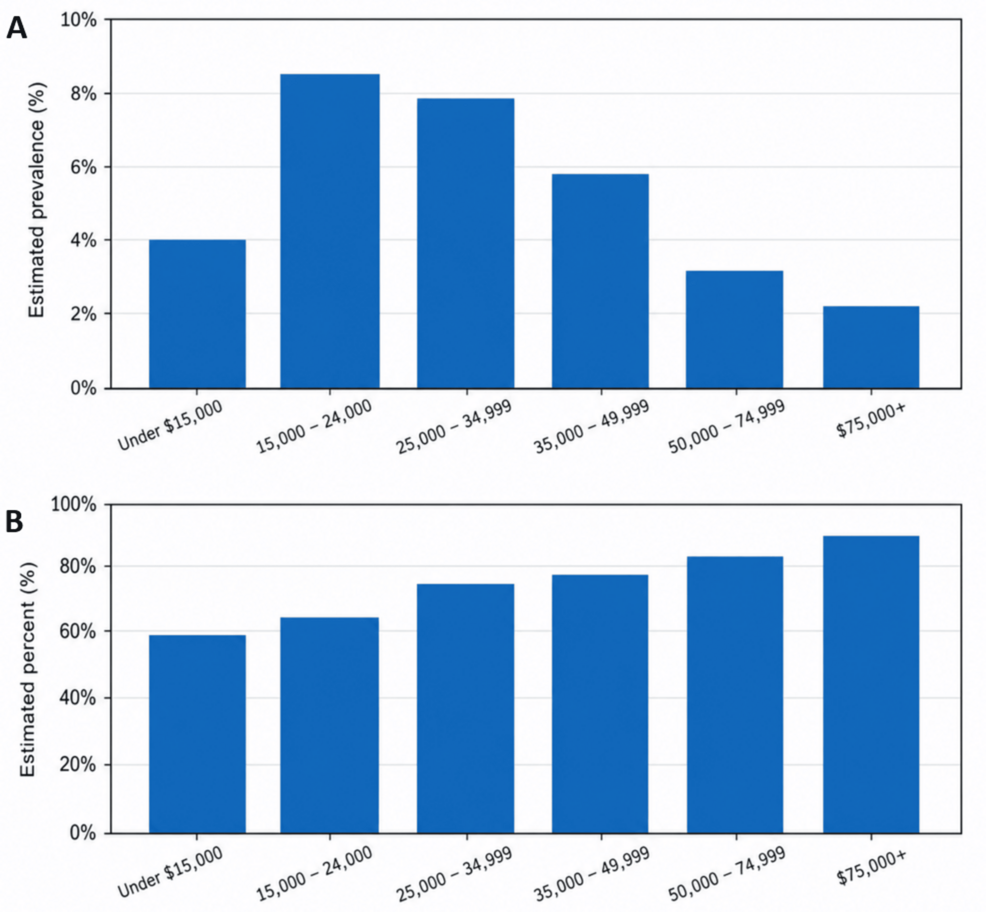
Socioeconomic stratification plays a role in the distribution of renal health indicators across Missouri households. Point estimates for kidney disease varied by income, reaching 8.60% among households earning between $15,000 and $24,000. In contrast, households earning $75,000 or more reported a prevalence of 2.20%.
Built environment indicators followed a socioeconomic gradient. Perceived neighborhood safety ranged from 59.00% in the lowest-income bracket up to 90.60% in the highest-income bracket. Across the entire state, 60.55% of respondents reported that their neighborhood has sidewalks, while 82.42% described their community as extremely or quite safe.
Metabolic Risk Factors and State-Level Surveillance Data
Underlying physiological risks form a critical component of the chronic kidney disease burden. Statewide prevalence for obesity, defined as a body mass index of 30 or higher, reached 34.53% in 2024 data representing 1,552,850 individuals. Diagnosed diabetes stood at 11.31%, accounting for an estimated 548,905 adults.
Additional metabolic indicators from 2023 surveillance data show high blood pressure at 36.20%, affecting 1,748,649 residents, and high cholesterol at 38.51%, impacting 1,460,780 individuals. Access to healthy food was reported by 79.72% of respondents, while community bicycling infrastructure was available to 34.87%.
Analysis Uses Aggregate Survey Data Without Inferential Testing
The published analysis relies on an ecological descriptive design using aggregate survey data re-extracted on October 11, 2026, from the Missouri Adult Health Data Report, an interactive reporting tool developed by University of Missouri Extension CARES Data Tools in partnership with the Missouri Department of Health and Senior Services. The dataset draws from continuous cross-sectional telephone surveys administered by the state in collaboration with the Centers for Disease Control and Prevention.
Investigators performed no inferential statistical testing, noting that all comparisons remain descriptive. The summaries do not establish individual-level co-occurrence, rural-versus-urban differences, or the specific benefits of environmental interventions. Future research utilizing longitudinal and individual-level data remains necessary to formally evaluate causal relationships between structural inequities, metabolic risk factors, and renal disease progression.