Brazil deforestation cuts save global economy 1.16 trillion reals: study
Brazil’s sharp reduction in deforestation across the Amazon and the Cerrado over the past three years has saved the global economy an estimated 1.16 trillion reals, equivalent to 232 billion U.S. dollars, according to a study published on Tuesday. The findings, reported by the state-run news agency Agencia Brasil, calculate that preventing the release of harmful greenhouse gases accounts for the vast majority of these avoided climate-related costs.
Evaluating the Biome Data
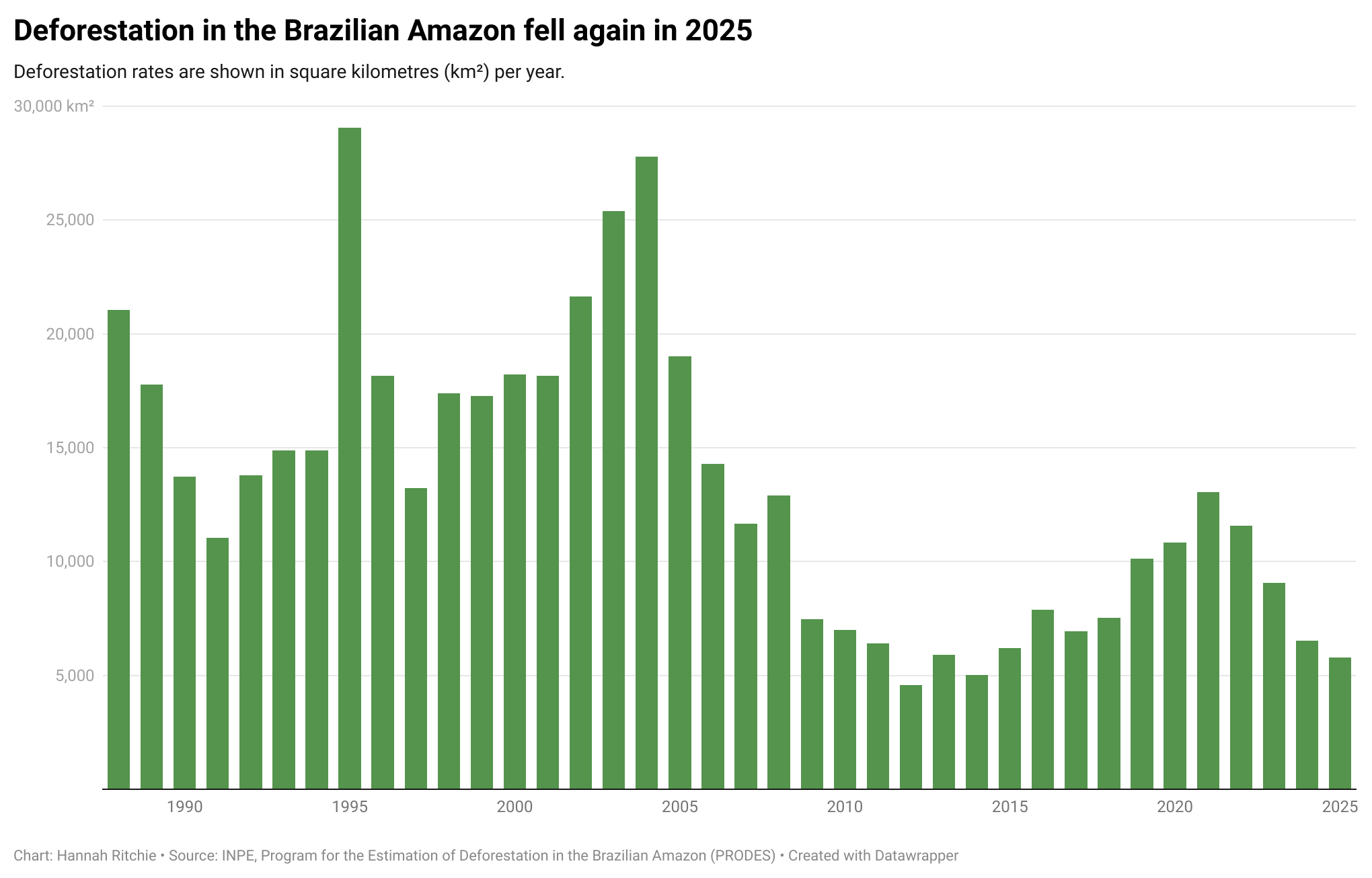
The study, conducted by the Getulio Vargas Foundation think tank, compares environmental outcomes between the 2019-2022 period and the 2023-2026 timeframe. Data from the National Institute for Space Research shows that deforestation dropped by 41.8 percent in the Amazon and by 23.8 percent in the Cerrado between August 2025 and July 2026. Total deforested area in the Amazon fell to 3,335 square kilometers, marking the lowest figure recorded since 1988. In the Cerrado, the affected area reached 5,516.69 square kilometers, the lowest level since 2001.
Combined figures across both biomes reveal a drop from 78,900 square kilometers during the 2019-2022 window down to 56,700 square kilometers in the recent 2023-2026 period. This reduction spared roughly 22,200 square kilometers of native vegetation from clearing. Consequently, the slowdown prevented 1.49 billion tons of greenhouse gases from entering the atmosphere. The Getulio Vargas Foundation based its financial assessment on a cost of 145 dollars per ton of carbon dioxide.

Amazon Preservation Avoids Billions in Climate Damage for Brazil
Out of the total global savings, between 67-192 billion reals—or 13.4-38.4 billion dollars—directly represent avoided climate damage inside Brazil. The calculation excludes regional effects on rainfall, temperature, and local water availability driven by the Amazon’s evapotranspiration cycle. Atmospheric currents known as flying rivers transport forest moisture to supply precipitation across Brazil’s central-western, southeastern, and southern regions.
The report emphasizes that reducing clearing rates does not conflict with agricultural expansion. The agribusiness sector remains a primary beneficiary of the rainfall generated by standing forests. The study also notes that the domestic economic gains of preserving these ecosystems significantly outweigh the financial compensation Brazil receives through international funding schemes.