Boost MacBook Pro AI Performance Using iPhone 17 Pro Max and Backburner
iPhone 17 Pro Max Boosts MacBook Pro M4 Pro AI Performance via USB-C
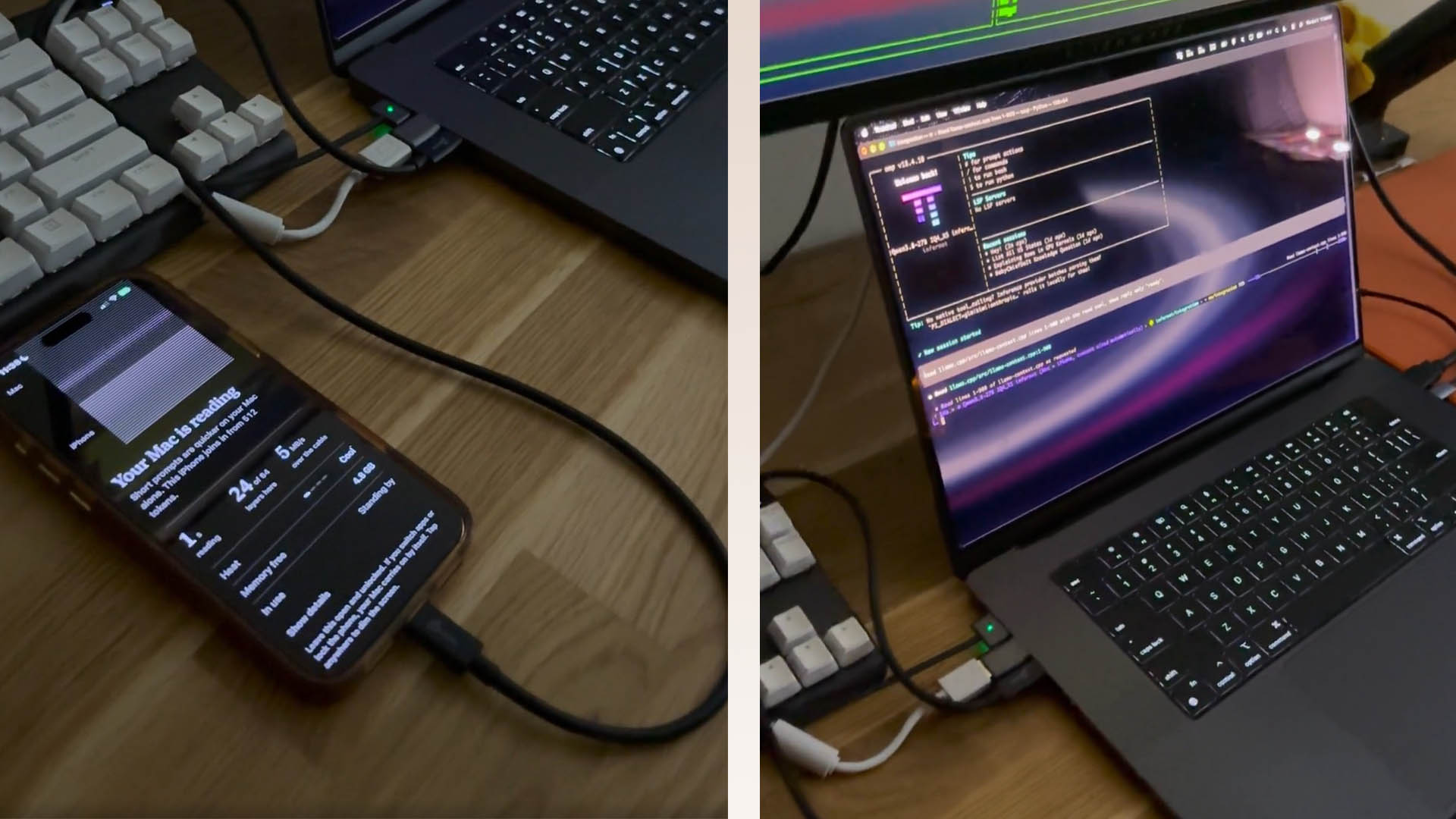
Connecting an iPhone 17 Pro Max via USB-C to a MacBook Pro M4 Pro with 24 GB of unified memory yields up to a 44 percent performance increase in running the local AI model Qwen 3.6 27B. The user u/StayLameBro achieved this distributed processing setup using a custom open-source software project named “backburner” hosted on GitHub, bypassing hardware memory bottlenecks by sharing computational workloads across both Apple Silicon processors.
The Tech TL;DR:
- An iPhone 17 Pro Max connected via USB-C to a 24 GB MacBook Pro M4 Pro shares local AI processing workloads using open-source software.
Workload Distribution Between MacBook Pro and iPhone
The system splits AI execution sequentially between the laptop and the mobile device. As reported by actu.pcastuces.com, the MacBook Pro executes layers 1 through 40 for every 256-token batch before transmitting intermediate data to the iPhone. The iPhone 17 Pro Max then processes layers 41 through 64 utilizing the GPU integrated into its A19 Pro chip. While the mobile device handles its assigned layer segment, the MacBook Pro immediately begins processing the next batch.

Context management and prompt pre-processing also use the iPhone's dedicated hardware accelerators. The Neural Engine compiles historical conversational context into an optimized runtime model, which mitigates latency during prolonged multi-turn sessions. Measured pre-processing gains for a 2,000-token input file scale according to the active context window: performance improves by 35 percent at an 8,000-token threshold, peaks at 44 percent at 16,000 tokens, and adjusts to 29 percent at 32,000 tokens.
Backburner Utility Faces Hardware Operational Ceilings
The orchestration utility driving this cross-device configuration is titled “backburner” and is publicly accessible as an open-source repository on GitHub. However, the implementation retains distinct operational ceilings. Beyond this threshold, token generation reverts entirely to the MacBook Pro due to its superior memory bandwidth and core architecture. Looking toward future silicon revisions, the initial project researcher suggests that upcoming A20 Pro processors found in anticipated iPhone 18 Pro hardware might introduce expanded multi-device capabilities through dual 16-core Neural Engine configurations, potentially eclipsing current GPU efficiency for specialized inference tasks.
Disclaimer: The technical analyses and security protocols detailed in this article are for informational purposes only. Always consult with certified IT and cybersecurity professionals before altering enterprise networks or handling sensitive data.