BMW leads mandatory emission recalls in South Korea
Automotive Emission Control Failures Prompt 366,259 Mandatory Recalls Led by BMW
Between 2022 and the first half of 2026, South Korean authorities logged a total of 100 emission-related parts defect corrections affecting 901,494 vehicles, with BMW accounting for the largest share of mandatory recalls. Out of the total volume, government-ordered mandatory corrections under the Clean Air Conservation Act accounted for 41 cases and 366,259 vehicles, triggered when a specific component defect rate in a given model year hits or exceeds 50 cases and breaches 4% of total sales.
The Tech TL;DR:
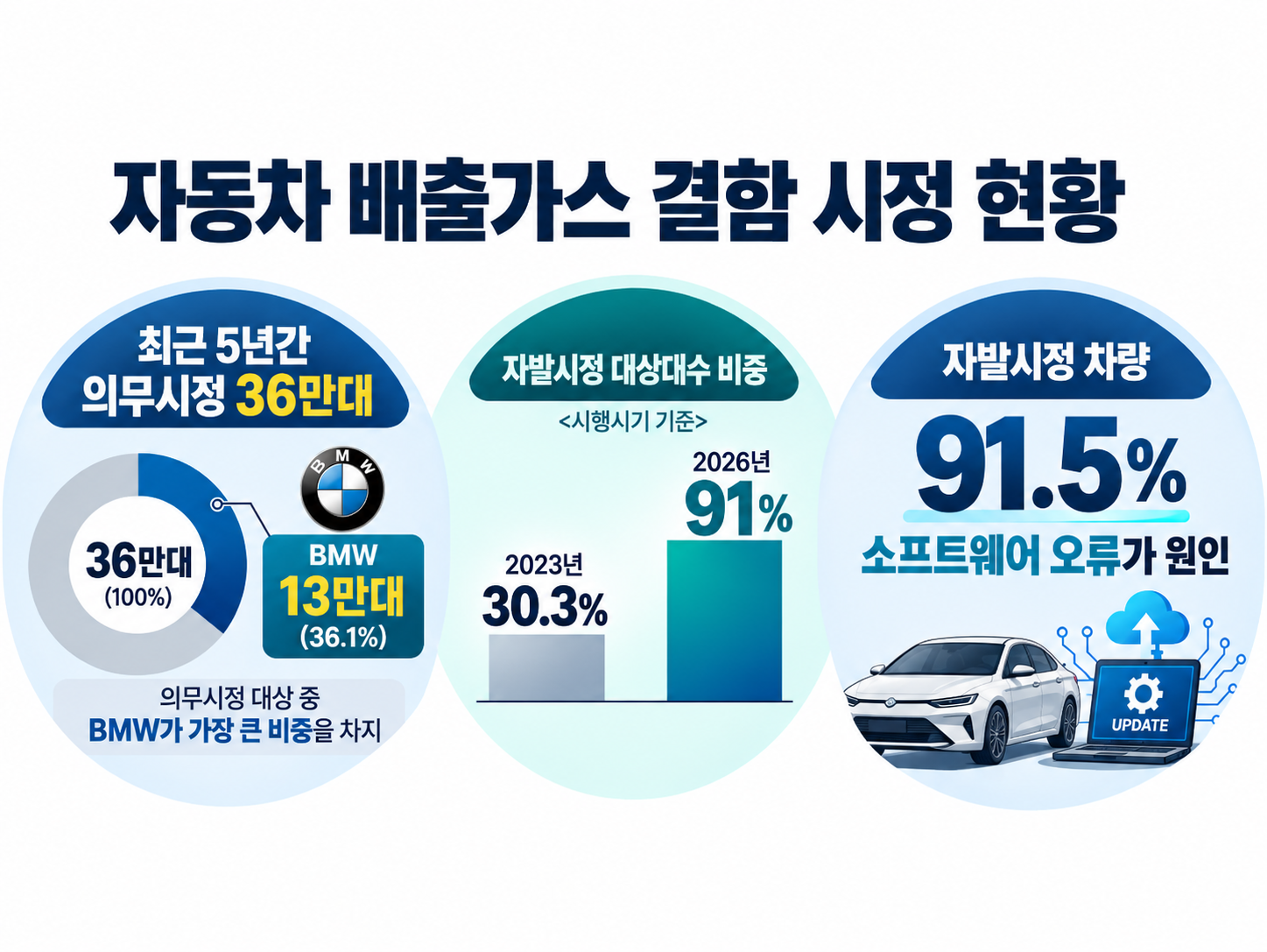
- BMW recorded 132,176 vehicles under mandatory emission part recalls between 2022 and mid-2026, representing 36.1% of all forced corrective actions nationwide.
- Voluntary recalls surged to 91% of total defect corrections by 2026, driven largely by software updates rather than physical hardware replacements.
- Software errors accounted for 91.5% of voluntary recall cases, while physical component faults made up 49.2% of mandatory government-ordered recalls.
BMW Leads Mandatory Emission Recall Volumes
According to data submitted by the Climate, Energy and Environment Ministry to Representative Lee Jong-bae, BMW’s mandatory recall volume reached 132,176 vehicles, marking the highest total among automakers. This figure stands at 1.7 times the mandatory recall volume of Hyundai Motor, which placed second with 78,113 vehicles. Following Hyundai, General Motors Korea registered 76,913 vehicles under mandatory orders, Mercedes-Benz recorded 23,258 vehicles, and Volvo accounted for 16,338 vehicles.
Looking at the yearly rollout of BMW’s mandatory corrective actions, the figures registered at 69,498 units in 2023, 43,965 units in 2024, and 18,713 units in 2025. Although total mandatory volumes declined, BMW still represented 38.4% of all mandatory recall targets in 2025. Addressing the high volume of mandatory actions, BMW Korea stated that the numbers reflect timely reporting and active management of components experiencing issues within their warranty periods.
Mercedes-Benz Records Highest Volume of Voluntary Corrections
While mandatory recalls penalize manufacturers for high failure rates or final non-compliance judgments following government emission testing, voluntary recalls show a different trajectory. Mercedes-Benz recorded the highest volume of proactive, voluntary corrections at 149,193 vehicles, capturing 27.9% of the national total. Kia followed closely with 148,503 vehicles, Hyundai Motor with 143,867 vehicles, Volkswagen with 51,611 vehicles, and BMW with 19,268 vehicles.
The proportion of voluntary recalls shifted upward across the observation window. Voluntary actions made up 5.2% of all defect corrections in 2022, climbing to 30.3% in 2023, 65.9% in 2024, 66% in 2025, and reaching 91% by 2026. This increase coincides with the expanding deployment of automotive software governing fuel injection volumes and emission control unit parameters. Software errors triggered 91.5% of voluntary recall cases, allowing manufacturers to patch control modules without physical part replacements. By contrast, mandatory recalls showed an even split, with physical hardware failures representing 49.2% of cases and software errors accounting for 48.4%.
Industry Response to Government Emission Enforcement
# Typical API log snippet for remote emission ECU calibration check
GET /api/v1/vehicles/ecu/diagnostics?model=2026&module=emissions
Response: {
  "status": "success",
  "calibration_version": "v4.12.0",
  "dtc_flags": 0,
  "software_override_available": true
}