
Blue Origin Sends Crypto Billionaire Justin Sun and Five Others to Space
Sixth Crewed Voyage for New Shepard Features Diverse International Passengers
Crypto billionaire Justin Sun finally reached the final frontier Sunday, August 3rd, aboard Blue Origin’s New Shepard rocket. This mission, designated NS-34, marked the 34th flight for the company’s suborbital vehicle, which lifted off from its West Texas launch site at 8:43 a.m. EDT.
The highly anticipated flight included Sun, the 34-year-old founder of the Tron blockchain platform, who had previously secured a seat for $28 million in an anonymous auction for Blue Origin’s inaugural crewed mission in June 2021. A scheduling conflict prevented Sun from joining that historic July 20, 2021, flight, which carried Jeff Bezos, his brother Mark Bezos, aviation pioneer Wally Funk, and student Oliver Daemen.
A Global Tapestry Aboard NS-34
Joining Sun on this journey were five other individuals: Arvinder (Arvi) Singh Bahal, an Indian-born American real estate investor; Turkish businessman and photographer Gökhan Erdem; Puerto Rican journalist and meteorologist Deborah Martorell; Englishman Lionel Pitchford, who has dedicated three decades to running an orphanage in Nepal; and American entrepreneur James (J.D.) Russell. Notably, Russell was the only returning spaceflyer, having previously flown on Blue Origin’s NS-28 mission in November 2024.
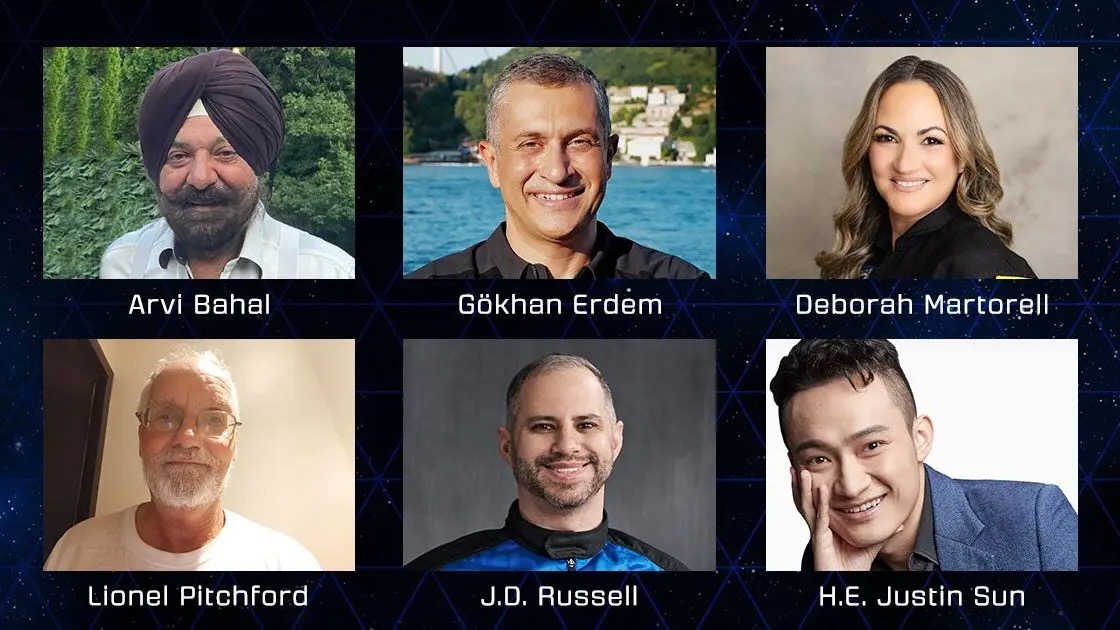
Blue Origin’s Senior Vice President of New Shepard, Phil Joyce, expressed pride in the mission’s international representation.
“It was an honor to see so many nations represented on our flight today,” said **Phil Joyce**, Senior Vice President, New Shepard. “The view of our fragile planet from space has a unifying effect on all who witness it, and I am always eager to see how our astronauts use this experience for the benefit of Earth.”
New Shepard: Reusable Technology for Space Tourism
The NS-34 mission continues Blue Origin’s streak of human spaceflights with its reusable New Shepard system, comprising a booster rocket and a crew capsule. Each element is designed for multiple uses, with the rocket returning for a vertical landing and the capsule descending via parachute.
These suborbital flights typically last between 10 and 12 minutes, carrying passengers above the Kármán line—the internationally recognized boundary of space at 62 miles (100 kilometers) high—and allowing them to experience a few minutes of weightlessness. While Blue Origin has not disclosed current ticket prices, they are understood to be significantly lower than the $28 million Sun paid. That substantial sum was designated as a philanthropic contribution, with proceeds supporting 19 space-focused charities aimed at inspiring future STEAM careers. In 2024, the global space economy was valued at over $600 billion, highlighting the growing commercial interest in space exploration (ReportLinker, 2024).
