
Black hole Jets: Supercomputer Simulations Reveal New Energy Extraction Mechanisms
Recent supercomputer simulations conducted by researchers at Goethe University Frankfurt and the university of Stuttgart have shed new light on how black holes generate powerful, relativistic jets – beams of particles traveling at near the speed of light. The study, published in The astrophysical Journal Letters (2025) with DOI https://doi.org/10.3847/2041-8213/ae06a6, details the complex interplay of gravity, magnetic fields, and plasma surrounding rotating black holes.
The research,led by Dr. Claudio Meringolo and involving Dr. Filippo Camilloni and Prof. Dr. Luciano Rezzolla, utilized the “Goethe” and “HAWK” supercomputers, requiring millions of CPU hours to solve Maxwell’s equations and equations of motion for electrons and positrons within the framework of Albert Einstein’s general relativity. Dr. Meringolo explains the importance of this work: ”The simulation of such processes is crucial for understanding the complex dynamics of relativistic plasmas in curved space in the vicinity of compact objects, which are determined by the interaction of extreme gravitational and magnetic fields.”
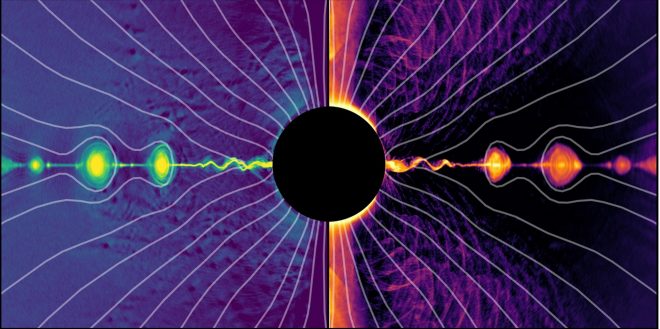
The simulations revealed intense magnetic reconnection activity occurring at the equatorial level of the black hole. This reconnection leads to the formation of a chain of “plasmoids” – condensed plasma “blisters” – that accelerate to speeds approaching the speed of light. This process is also linked to the generation of particles with negative energy, a key driver of extreme astrophysical phenomena like jets and plasma eruptions.
Traditionally, the Blandford-Znajek mechanism has been considered the primary way black holes extract rotational energy. However, this new research suggests magnetic reconnection plays a significant, and potentially previously underestimated, role. “Our results open up the fascinating possibility that the Blandford-Znajek mechanism is not the only astrophysical process that can extract rotary energy from a black hole,” says Dr. Camilloni, “but that the magnetic reconnection also contributes to it.”
Prof. Rezzolla emphasizes the broader implications: “With our work we can show how energy is efficiently extracted from rotating black holes and channeled in jets. In this way we can contribute to the extreme luminous forces of active galaxy nuclei and the acceleration of particles up to almost at the speed of light.” He highlights the importance of both the sophisticated numerical modeling and the rigorous mathematical analysis used to interpret the results.
The simulations visualized a current layer where partial density is high, showcasing magnetic field lines (gray) and the acceleration of particles to high energies, ultimately forming the jet driven by both the blandford-Znajek mechanism and magnetic reconnection.
Contact:
Prof. Dr. Luciano Rezzolla
Institute for Theoretical Physics
Goethe University Frankfurt
Tel: +49 (69) 798-47871
rezzolla@itp.uni-frankfurt.de
https://astro.uni-frankfurt.de/rezzolla/
Publication: Claudio Meringolo, Filippo Camilloni, Luciano Rezzolla: Electromagnetic Energy Extraction from Kerr Black Holes: Ab-Initio Calculations.The Astrophysical Journal Letters (2025) https://doi.org/10.3847/2041-8213/ae06a6
