
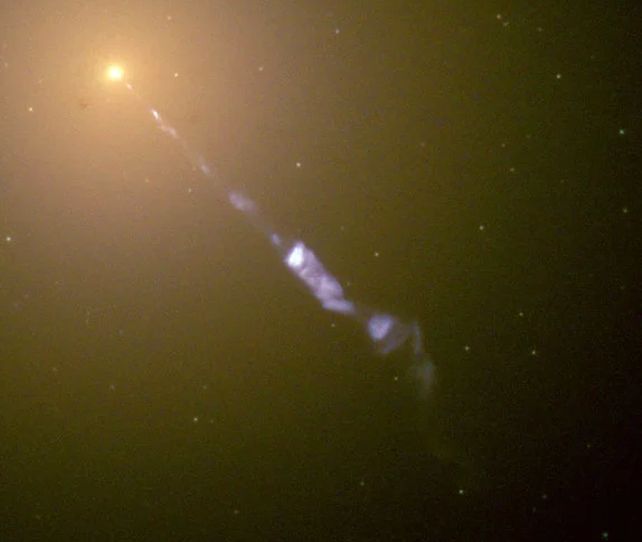
Black Hole M87* Displays Unexpected Magnetic Field Shifts, Challenging Existing Theories
WASHINGTON – New observations of the supermassive black hole M87, the first black hole ever directly imaged, reveal dramatic and previously unseen shifts in its magnetic fields, scientists announced today. The findings,published in *Astronomy & astrophysics,demonstrate a dynamic and turbulent environment around the black hole,forcing researchers to re-evaluate current models of black hole jet formation.
M87, located 55 million light-years away in the galaxy M87, gained fame in 2019 when the Event Horizon Telescope (EHT) collaboration unveiled its groundbreaking image. to understand the mechanisms powering the powerful jets of energy and matter emanating from M87, the EHT team meticulously analyzed a series of images taken over several years. Their focus centered on the polarization of light surrounding the black hole - a key indicator of magnetic field structure.
While the overall “shadow” of the black hole, consistent with Albert Einstein’s theory of general relativity, remained stable, the polarization data revealed notable changes. In 2017, magnetic fields appeared to spiral clockwise. By 2018, they had shifted to an anti-clockwise spiral and appeared to stabilize. Further observations in 2021 showed the fields again spiraling in an anti-clockwise direction.
“What’s remarkable is that while the ring size has remained consistent over the years – confirming the black hole’s shadow predicted by Einstein’s theory – the polarization pattern changes substantially,” says astronomer Paul Tiede of the Harvard & Smithsonian Center for astrophysics. ”This tells us that the magnetized plasma swirling near the event horizon is far from static; it’s dynamic and complex, pushing our theoretical models to the limit.”
These rapid changes, occurring on “very short cosmic timescales,” suggest the magnetic fields around M87* are far more volatile than previously thought. The shifting fields are believed to play a crucial role in directing the flow of material both into the black hole and outwards in the form of its characteristic jets.
The Event Horizon Telescope is planning a series of rapid-fire observations in March and April 2026, aiming to capture the first-ever “movie” of M87. “We are excited to be gearing up to capture the first movie of M87, something that has been on our wish list ever since that first image of a black hole,” says astronomer Remo Tilanus of The University of arizona’s Steward Observatory.
These ongoing observations promise to unlock further secrets of M87*’s magnetic environment and provide deeper insights into the fundamental physics governing supermassive black holes and their powerful influence on the universe.
