
“Cosmic Sound” From Black hole Merger Confirms Einstein & hawking, Scientists Announce
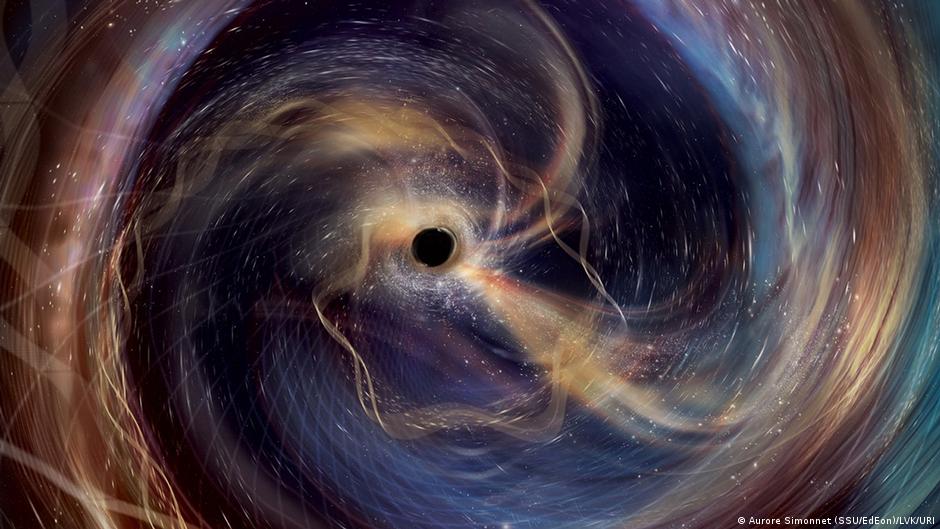
WASHINGTON D.C. – september 11, 2025 – The collision of two black holes has produced gravitational waves revealing a “sound” that confirms decades-old predictions by Albert Einstein and Stephen Hawking, researchers announced today. The analysis of the signal, designated GW250114, provides further evidence supporting the basic simplicity of black holes and offers new insights into the relationship between gravity, quantum mechanics, and the nature of space and time.
The groundbreaking detection, made possible by increasingly elegant facilities like LIGO in the United States, Virgo in Italy, and Kagra in Japan, allowed scientists to observe the entire merger process – from initial collision to the final stabilization of the resulting black hole, all within milliseconds. the resulting black hole boasts a mass equivalent to 63 suns and rotated at 100 revolutions per second.
“Ten milliseconds seems very little time, but our instruments are now so good that it is indeed enough for us to really analyze the sound of the final black hole,” explained a researcher from ISI (name not specified in source). Like distinct tones from different bells,the gravitational wave signature is unique to the properties of the colliding black holes.
The observations have verified a key conjecture dating back to 1963, when Roy Kerr demonstrated that black holes can be fully described by just two characteristics: spin and mass. Furthermore,the data supports Hawking’s 1971 prediction that the event horizon of a black hole – the point of no return – can never decrease in size. The resulting surface area of the merged black hole was found to be no smaller than the combined surface area of the original two.
This confirmation has significant implications for the second law of thermodynamics, wich states that entropy (a measure of disorder) must increase or remain constant over time. “It tells us that general relativity knows something about the quantum nature of these objects and that details, or entropy, contained in a black hole is proportional to its area,” the ISI researcher added.
scientists believe this connection between black hole behavior and entropy could provide a mathematical framework for investigating the fundamental nature of space and time,moving the field beyond theoretical speculation and into the realm of observable phenomena. The findings, published in Physical Review letters and supported by the Simons Foundation, Caltech, and EFE, represent a major leap forward in our understanding of the universe’s most enigmatic objects.
