
Ripples in Space-Time Confirm Century-Old Theory of Black Hole Simplicity
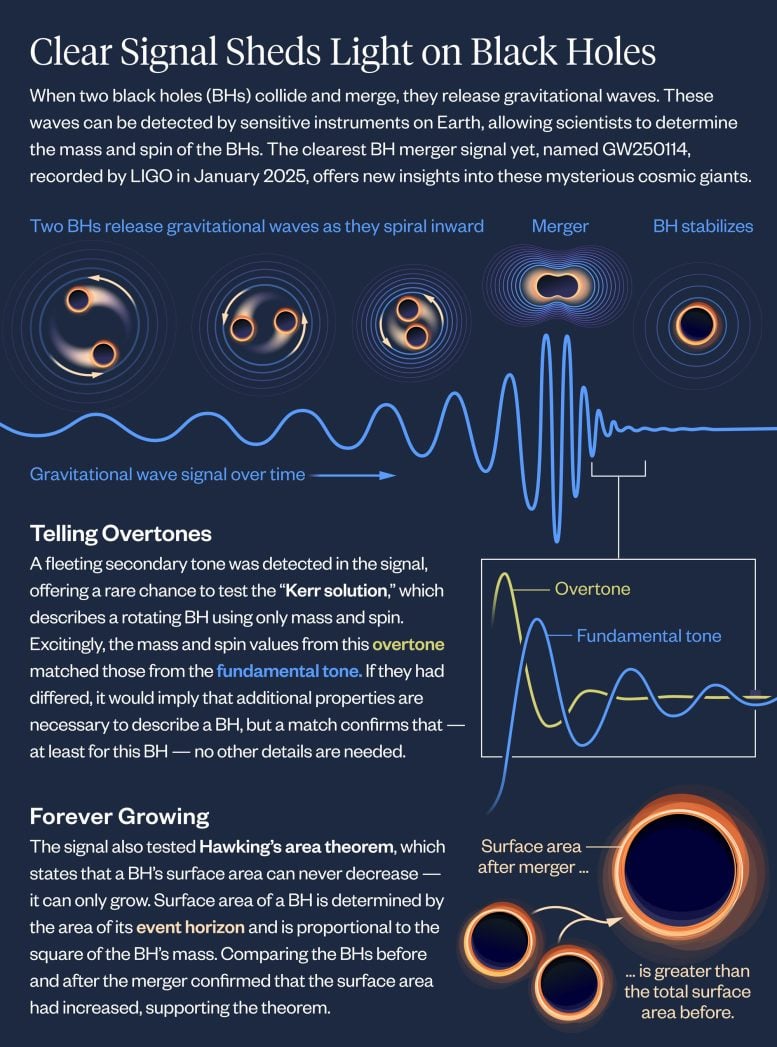
Recent observations of gravitational waves – ripples in space-time – have provided compelling confirmation of long-held theories about the nature of black holes, including a key conjecture dating back to 1963 and a foundational idea proposed by Stephen Hawking. The findings, stemming from analysis of the black hole merger event GW250114, significantly strengthen our understanding of thes enigmatic cosmic objects.
In 1963, physicist Roy Kerr, utilizing Albert Einstein’s general relativity, mathematically described black holes with a single equation. This equation posited that astrophysical black holes are fundamentally simple, characterized by only two properties: mass and spin. The new, high-resolution data from the LIGO, Virgo, and KAGRA gravitational wave detectors allowed scientists to measure the “ringdown” – the vibrations emitted as the merged black hole settled – with unprecedented precision. This analysis confirmed Kerr’s prediction,demonstrating that the resulting black hole was indeed defined solely by its mass and spin.
The observations also provided a robust test of Hawking’s area theorem, proposed by Stephen Hawking. This theorem states that the surface area of a black hole’s event horizon – the boundary beyond which nothing can escape – can only ever increase. Validating this theorem requires precise measurements of black holes both before and after a merger. While Hawking himself initially doubted the possibility of testing his theorem using merger signatures following the first detection in 2015, advancements in methodology, spearheaded by isi, Farr, and colleagues, led to a tentative confirmation in 2019, a year after Hawking’s death.
The new data boasts four times the resolution of previous measurements, offering significantly increased confidence in the validity of hawking’s theorem. This confirmation also suggests a connection to the second law of thermodynamics, which dictates that entropy – a measure of disorder – must increase or remain constant over time. Understanding the thermodynamics of black holes could potentially unlock breakthroughs in quantum gravity, the elusive effort to reconcile general relativity with quantum physics.
“It’s really profound that the size of a black hole’s event horizon behaves like entropy,” explains researcher Isi. “It has very deep theoretical implications and means that some aspects of black holes can be used to mathematically probe the true nature of space and time.”
Looking ahead, scientists anticipate even more revealing insights as detector sensitivity improves. Over the next decade,planned upgrades are expected to increase detector sensitivity tenfold,enabling more rigorous tests of black hole characteristics.
“Listening to the tones emitted by these black holes is our best hope for learning about the properties of the extreme space-times they produce,” states Farr, a professor at Stony Brook University. “And as we build more and better gravitational wave detectors, the precision will continue to improve.”
Isi emphasizes the shift in the field, stating, “For so long this field has been pure mathematical and theoretical speculation. But now we’re in a position of actually seeing these amazing processes in action, which highlights how much progress there’s been – and will continue to be - in this field.”
The research, titled “GW250114: Testing Hawking’s area Law and the Kerr Nature of Black holes” by A. G. Abac et al. (LIGO Scientific, Virgo, and KAGRA Collaborations), was published on September 10, 2025, in Physical Review Letters (DOI: 10.1103/kw5g-d732).
