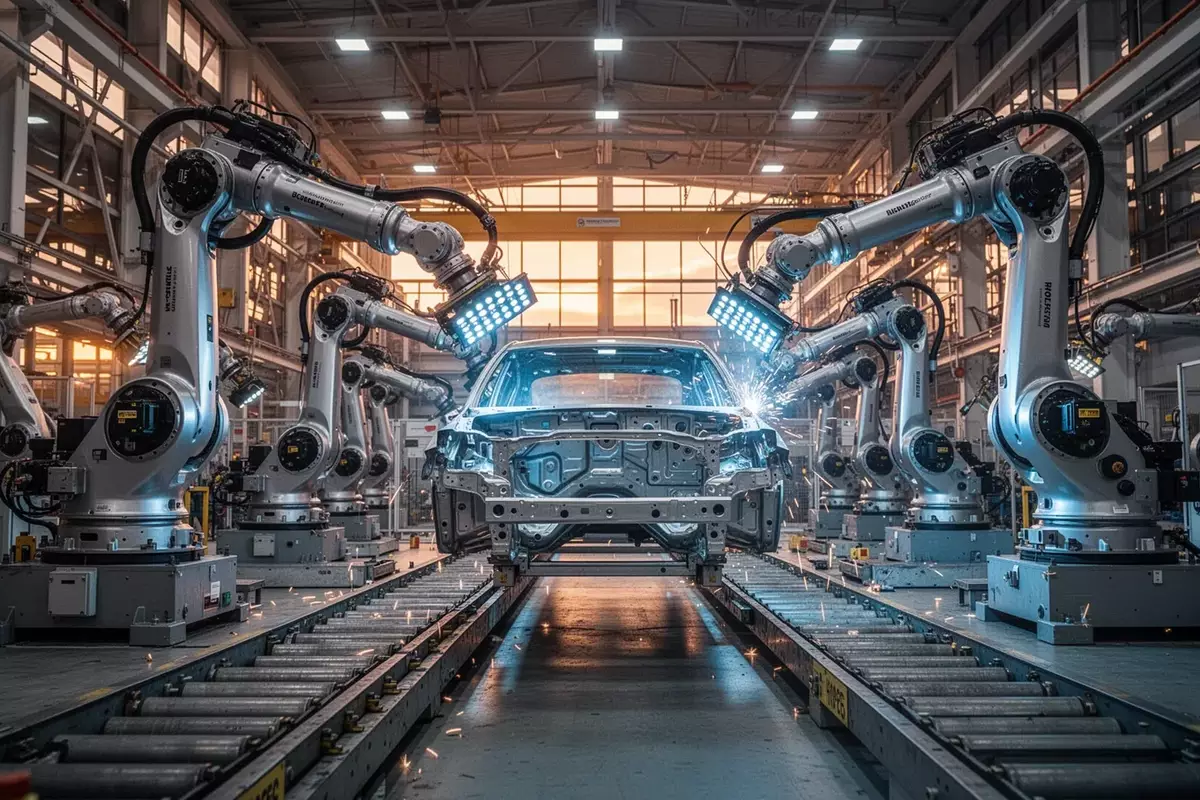
Billion-Dollar AI and Humanoid Robot Investments Drive Autonomous Manufacturing
Germany is attempting to pivot its industrial core from rigid, scripted automation to “Physical AI.” Although the press releases lean heavily on the narrative of maintaining a leadership position, the actual engineering shift is more pragmatic: moving away from fixed-sequence assembly lines toward autonomous agents capable of handling non-deterministic environments. This isn’t about the aesthetic of a humanoid; it’s about solving the flexibility bottleneck in high-precision manufacturing.
The Tech TL;DR:
- Production Pivot: BMW is deploying “Aeon” humanoid robots from Hexagon Robotics in Leipzig, shifting from US-based Figure pilots to European hardware for battery and component assembly.
- Value Divergence: Experts at Fraunhofer IPA distinguish between “sexy” humanoid prototypes (e.g., Tesla’s Optimus) and high-value industrial robots (e.g., advanced welding bots) that drive actual GDP.
- Strategic Sovereignty: The BMFTR’s Robotics Research Action Plan aims to use AI-integrated robotics to reshore production to Europe, reducing reliance on global supply chain volatility.
The Architecture of Physical AI: Beyond Rigid G-Code
For decades, industrial robotics has relied on deterministic programming—essentially sophisticated G-code where every millimeter of movement is pre-calculated. The BMFTR’s current push focuses on “intelligent robotic systems” that break this rigidity. The goal is to integrate Artificial Intelligence directly into the control loop, allowing robots to perceive environmental changes and adjust their kinematics in real-time without a manual rewrite of the logic controller.
This transition introduces significant technical debt. Traditional PLC (Programmable Logic Controller) environments are not designed for the stochastic nature of LLM-driven or VLM (Vision Language Model) decision-making. Integrating these requires a middleware layer that can translate high-level AI intent into low-latency motor commands. For enterprises, Which means a complete overhaul of the factory floor’s compute stack, necessitating industrial automation consultants who can bridge the gap between legacy OpTech and modern AI orchestration.
Tech Stack & Alternatives: The Humanoid Matrix
The current landscape is split between general-purpose humanoid experiments and specialized industrial agents. While the public focuses on the “Terminator” aesthetic, the actual deployment reality is measured in degrees of freedom (DoF) and Mean Time Between Failures (MTBF).

| System | Origin/Developer | Primary Use Case | Deployment Status |
|---|---|---|---|
| Aeon | Hexagon Robotics (CH/SE) | BMW Leipzig Pilot (Auto/Battery) | Active Testing/Pilot |
| Figure 2 | Figure / OpenAI (US) | BMW Spartanburg (USA) | Pilot Phase |
| Armar-7 | KIT (Germany) | Daily Support / Human Interaction | Research Prototype |
| Optimus | Tesla (US) | General Purpose / Logistics | Development/Demo |
The divergence in utility is sharp. Dr.-Ing. Werner Kraus, head of Automation and Robotics at the Fraunhofer Institute for Production Technology and Automation (IPA), provides a necessary reality check on the humanoid hype cycle.
“Developments like the Optimus from Tesla create attention. But the actual innovations happen elsewhere. A welding robot may not be as sexy as Optimus, but it already plays a much larger role in industrial production.”
Kraus explicitly doubts that humanoid robots will contribute significantly to value creation within the next two to five years, suggesting that the “all-rounder” vision is still trailing behind specialized robotic applications in terms of ROI.
Deployment Realities: The BMW Leipzig Case Study
BMW’s strategy reveals a calculated diversification of their robotics stack. After gathering data with Figure robots in their Spartanburg plant in the US, they have pivoted to Hexagon Robotics’ “Aeon” for their German operations. The Leipzig pilot focuses on three critical vectors: automotive production, battery manufacturing and component construction. Michael Ströbel, head of Process Management and Digitalization in Production, anticipates a scale-up to thousands of units within five years.
From a systems architecture perspective, this deployment is less about the robot’s legs and more about the integration of the robot into the existing Manufacturing Execution System (MES). The challenge is ensuring that an autonomous agent doesn’t introduce latency into a high-speed production line. This requires edge computing nodes capable of processing sensor data locally to avoid the round-trip delay of cloud-based AI inference.
Implementation Mandate: Conceptual ROS2 Node for Autonomous Grasping
To move from a rigid script to an AI-driven action, developers typically utilize the Robot Operating System (ROS2). Below is a conceptual Python implementation of a node that would interface a vision-based AI trigger with a robotic arm’s actuator.
import rclpy from rclpy.node import Node from geometry_msgs.msg import Pose from std_msgs.msg import String class AIPhysicalInterface(Node): def __init__(self): super().__init__('ai_robot_bridge') # Subscriber for AI-processed target coordinates self.subscription = self.create_subscription( String, 'ai_vision_target', self.listener_callback, 10) # Publisher for actual hardware actuator commands self.publisher_ = self.create_publisher(Pose, 'arm_actuator_cmd', 10) def listener_callback(self, msg): self.get_logger().info(f'AI Target Received: {msg.data}') # Logic to translate AI string coordinates to Pose object target_pose = self.parse_ai_coordinates(msg.data) self.publisher_.publish(target_pose) def parse_ai_coordinates(self, data): # Simplified coordinate mapping logic return Pose(position=..., orientation=...) def main(args=None): rclpy.init(args=args) node = AIPhysicalInterface() rclpy.spin(node) rclpy.shutdown()The Security Blast Radius of Autonomous Factories
Moving from isolated, air-gapped robots to AI-connected agents expands the attack surface exponentially. A robot that “learns” and “adapts” is a robot that can be manipulated via adversarial machine learning or compromised through its API endpoints. If an autonomous agent in a battery plant is hijacked, the risk isn’t just data loss—it’s physical kinetic damage and potential catastrophic failure of hazardous materials.
The shift toward “technological sovereignty” mentioned by the BMFTR isn’t just about economic independence; it’s about security. By controlling the full stack—from the hardware sensors to the AI weights—Europe aims to mitigate the risk of embedded backdoors in foreign-sourced robotics. Given this risk, enterprises are now treating robot deployment as a critical security event, deploying certified cybersecurity auditors and penetration testers to validate the isolation of their robotic control networks from the broader corporate WAN.
Editorial Kicker: The Sovereignty Gamble
Germany’s push to solidify its lead in robotics is a race against the commoditization of AI. If the underlying “intelligence” remains proprietary to a few US-based firms, European hardware becomes merely a peripheral. The success of the BMFTR’s action plan and the BMW pilots depends on whether they can build a native European AI ecosystem for physical movement. The goal is a world where the robot isn’t just a tool, but a self-correcting asset. For those managing the infrastructure, the focus must remain on the plumbing—latency, security, and integration—because the “sexy” humanoid is useless if the network can’t support its inference requirements.
Disclaimer: The technical analyses and security protocols detailed in this article are for informational purposes only. Always consult with certified IT and cybersecurity professionals before altering enterprise networks or handling sensitive data.