Banksy Unmasked: Does His Identity Change His Art’s Value?
The identity of the elusive street artist Banksy appears to have been revealed as Robin Gunningham, according to a Reuters investigation published last week. The report, which traced a series of movements and legal records, has ignited debate about the future of the artist’s work and the value of anonymity in art.
For decades, Banksy’s true identity has been a closely guarded secret, fueling the mystique surrounding his politically charged and often subversive art. His work, appearing unexpectedly in cities around the world – from London and New York to Bethlehem and, most recently, Ukraine – has consistently challenged authority and sparked public discourse. The revelation by Reuters has prompted a range of reactions, from disappointment among fans who cherished the enigma to skepticism about whether the unmasking will diminish the impact of his art.
“I feel like they are telling me how a magic trick is done,” said Thomas Evans, a Denver-based artist, in an Instagram post reflecting a sentiment echoed by many. “Sometimes I just want to enjoy the magic trick.”
However, art market experts suggest the impact on the financial value of Banksy’s work may be minimal. Acoris Andipa, director of the Andipa gallery in London, stated that buyers are primarily motivated by their appreciation for the art itself. “People buy his works because they absolutely love it,” Andipa said. “The main feedback that I get is that they really, frankly, don’t care if they recognize who he is.”
The Reuters investigation detailed how Gunningham, born around 1972, was arrested in 2000 for defacing a billboard in New York. A handwritten confession from that incident, unearthed by Reuters and confirmed by the Associated Press, described the act as a “humorous adjustment” to a billboard featuring a male model. Following a 2008 report in the Daily Mail suggesting Gunningham’s identity, Reuters reported that Banksy legally changed his name to David Jones – the second most popular name in Britain and also the birth name of the late rock star David Bowie, whose image inspired a 2012 Banksy painting of Queen Elizabeth II.
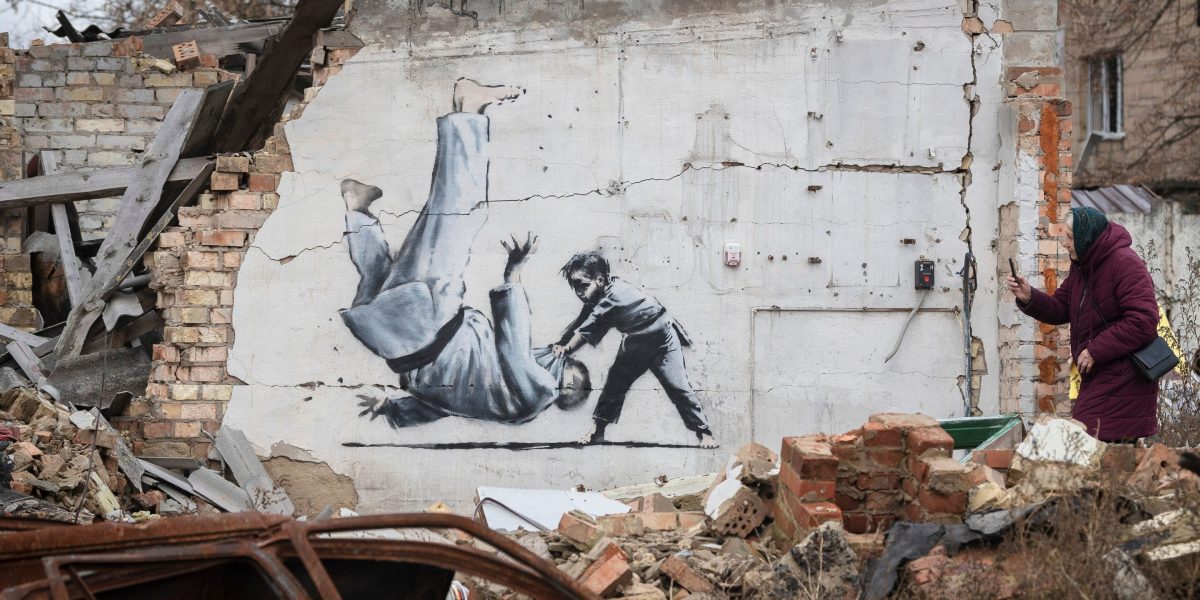
The investigation further linked a David Jones to a trip to Ukraine in late 2022, shortly before Banksy’s murals began appearing in towns and cities that had been targeted by Russian forces. Banksy later confirmed creating seven murals in the war zone, including an image of a child flipping a grown man wearing a judo belt – a pointed reference to Russian President Vladimir Putin’s well-known practice of the martial art.
The artist’s work has often operated in a legal gray area, and authorities have, at times, appeared to tolerate his interventions. Reuters noted that a Banksy stencil depicting a judge beating a protester was removed from the Royal Courts of Justice without any arrests being made, a contrast to the potential consequences faced by other graffiti artists.
The revelation has also prompted speculation that Banksy himself orchestrated the leak. Madeleine White, a senior sales and acquisitions consultant at London’s Hang-Up Gallery, suggested that the timing and lack of denial from the artist align with his history of stunts and satire. “As they say, ‘all publicity is good publicity,’” White observed, adding that the backlash has been directed at the media, not at Banksy or the potency of his work.
Experts emphasize that Banksy’s influence extends beyond his anonymity. Joe Syer, founder of MyArtBroker, noted the artist’s consistent response to global events as a key element of his relevance and value. Syer argued that anonymity has served to make the work universally accessible, “detached from personality, ego, or biography,” allowing it to resonate politically and culturally without being tied to an individual.
Christopher Banks, founder of the New York-based Objects of Affection Collection, framed the unmasking as a “structural stress test” of Banksy’s system for maintaining his absence. “Banksy’s best works carry their meaning without the author. He was there,” Banks wrote, referencing the artist’s murals in Ukraine and his expression of solidarity with the victims of the war. “The name matters less than the presence. The presence was always what the work was about.”
Banksy has not commented publicly on the Reuters report. His next move, and whether he will address the revelation directly, remains to be seen.