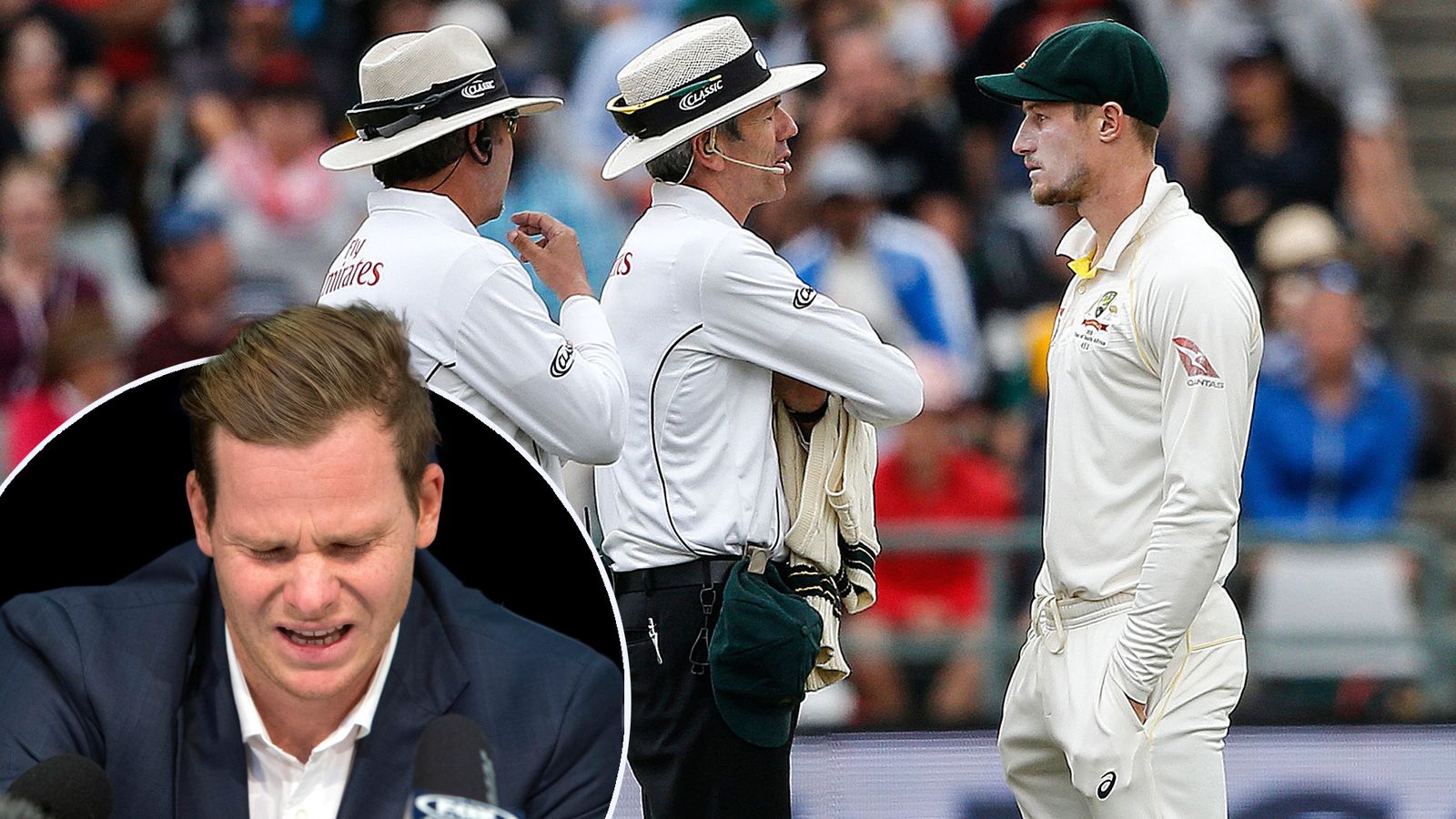
Bancroft Claims ‘Whole Team’ Knew About Sandpapergate Ball-Tampering Plot
Cameron Bancroft writes in a first-person account published Wednesday that the 2018 ball-tampering plot in Cape Town was known to more than the three players punished for it.
His statement lands after the scandal that became known as Sandpapergate, and after Cricket Australia announced a forum for players to give their versions of events.
Bancroft, caught on camera using sandpaper on the ball during the Cape Town Test in 2018, said the original public account “did not reflect” what he experienced on that tour. He writes that David Warner proposed the idea and that he discussed the ball’s reverse swing regularly with the bowlers — Pat Cummins, Mitchell Starc, Josh Hazlewood and Mitchell Marsh.
“How else am I to know if what I’m doing is effective or not if I don’t have these conversations with the bowlers bowling with it and the wicketkeeper?” he writes. “All the bowlers gave me feedback if my work on the ball was working. It was helpful.”
The scandal was thrust back into the spotlight this month after Usman Khawaja’s autobiography claimed the entire squad was aware of the plan to tamper with the ball during a Test in Cape Town. “It was all of us. Not the batters, not the bowlers, not the staff. All of us,” Khawaja wrote, according to AFP.
Bancroft names coaches and staff
In his account, Bancroft also names former bowling coach David Saker, saying he received encouragement from players and coaches about his work on the ball, and alleges former head coach Darren Lehmann knew what was happening. Lehmann, who quit as coach after the scandal, said: “I don’t think everybody would have known.”
Bancroft writes that he remembers one voice of dissent clearly. “Our media manager, Kate Hutchison, expressed her objection to what was happening,” he writes. “I recall her making it clear that she believed it was wrong, that she wanted nothing to do with it, and walking away from the discussion. I will never forget that. Somebody had spoken up.”
He also admits he withheld details during the original investigation, including when the sandpaper use began, how long it continued and who else was involved or aware.
Cummins denial the “final straw”
Bancroft says Cummins’s recent public denial prompted him to speak. “It made me feel angry, betrayed and alone,” he writes, adding that what he lived through on the South Africa tour “is not the public account” Cummins gave at his press conference and in the years previously when he has spoken on this time.
Cummins had rejected the claim. “When he says we all knew, if by that he means we knew sandpaper was going out on the field, he’s 100 percent wrong,” the current Test captain said. “He says that I and others were architects of a scheme to ball-tamper with sandpaper. That’s complete and utter nonsense.”

Starc has also stood by his earlier denials. “My opinion hasn’t changed, my recollection hasn’t changed from what we said in 2021,” he said, referring to a joint statement from the four main bowlers denying any knowledge, per AFP.
Former batting coach Graeme Hick called what Khawaja was implying “absolutely false,” while tour squad member Chadd Sayers took the opposite view: “I believe that everyone in that side knew what was going on and what was being used.”
Warner alleges a cover-up
Warner, found in 2018 to have led the plot and banned for a year, has backed Khawaja and attacked the original investigation. “It looks like they (Cricket Australia) had decided who they wanted to blame from the very beginning, ran a shoddy investigation to serve the purpose and now they want to maintain the false narrative that the bowlers had no idea,” he said, per AFP. “That stinks of a cover-up.”
Cricket Australia has resisted reopening the case. Chief executive Todd Greenberg said the governing body saw “no compelling reason” to revisit it, then acknowledged the damage: “Let’s be honest, the game is hurting at the moment.”
Interim chairman David Boon announced the forum for players to share their version of events. “We believe it is time for a circuit-breaker. This is not about litigating the past,” he said, according to AFP.
What the 2018 sanctions cost
The fallout reshaped Australian cricket. Smith and Warner received 12-month bans, Bancroft nine months, and all three were sent home before Australia lost the fourth Test by 492 runs and the series 3-1, Sky Sports detailed in its explainer.
Smith and Warner were pulled from the 2018 IPL, Bancroft lost a Somerset county deal, and Lehmann resigned after the final Test. Of the three players sanctioned, Bancroft saw his international career suffer the most damage, earning just two further caps for Australia following the 2018 test series against South Africa.
Cricket Australia, the body now weighing those competing accounts, traces its origins to the Australian Board of Control for International Cricket, formed in 1905 and first convened at Wesley College in Melbourne on 6 May 1905. The company took its current incorporated form in 1982 and is structured around six member organisations — the cricket bodies of New South Wales, Queensland, South Australia, Tasmania, Victoria and Western Australia — governed by nine independent directors.
It operates the men’s and women’s national teams alongside under-19, Australia A and disability teams, and negotiates players’ pay and welfare with the Australian Cricketers’ Association. The men’s team it fields played in the first-ever Test match, against England in 1877, and has won five World Cups.
The contradiction at the heart of the current dispute remains unresolved — Bancroft, Khawaja, Warner and Sayers on one side; Cummins, Starc and Hick on the other. Cummins’s manager, Neil Maxwell, said: “Pat’s position hasn’t changed in eight years. He’s been consistent and adamant from day one. There is nothing he hasn’t answered. And that includes in response to what Cam has now said.”