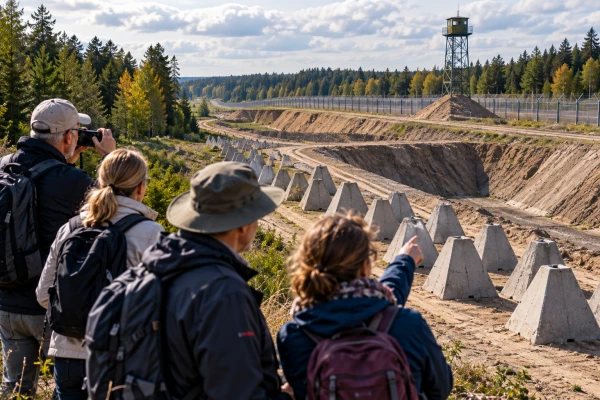
Baltic Defense Line draws tourists to Estonia’s border region
Travelers visiting the border region of Võrumaa County and the historical region of Setomaa are encountering an area where defensive infrastructure has become a point of interest alongside traditional landmarks. Driven by intense curiosity surrounding the newly developing Baltic defense line, tourists are altering standard excursion routes to view military infrastructure situated just kilometers from the Russian border.
Dragon’s Teeth Replace Cultural Landmarks
The geopolitical realities of the region have unintentionally spawned a novel form of peacetime tourism. While visitors historically traveled to southeastern Estonia for local culture and natural scenery, current itineraries increasingly focus on military engineering projects designed to deter potential aggression.
Tour Groups Alter Routes Near the Border
Guide and tour organizer Helen Alumaa told the Estonian public broadcaster ERR that the summer season required multiple adjustments to excursion routes. Tour groups now regularly approach border structures at the maximum permitted distance. Guides use these stops to explain the mechanics of anti-tank ditches and display the concrete fortifications.
Near the village of Meremäe, located just a few kilometers from the Russian border, anti-tank ditches and defensive embankments have already been established on private land. These installations hold a particular appeal for foreign guests visiting the Baltic state.
Foreign Visitors Ask About Safety
Foreign visitors frequently direct inquiries beyond the physical structures themselves. Kaidi Kerdt, a local farm owner in the border area, noted that tourists regularly question residents regarding safety conditions near the Russian border and whether local populations experience fear regarding potential military threats. In response, locals emphasize their sense of security, pointing to the constant presence and active patrols of police and border guards in the area. Conversely, Estonian domestic tourists exhibit significantly less interest in such security inquiries.
The Baltic Defense Line Initiative
The fortifications drawing visitor attention form a core component of the Baltic defense line, a collaborative initiative established by the defense ministers of Estonia, Latvia, and Lithuania in January 2024. Each participating nation is currently constructing its own defensive network.
Estonia’s domestic plans involve the deployment of up to 600 concrete bunkers alongside anti-tank obstacles, barbed wire fences, and engineering supply depots. Plans additionally call for the construction of up to 40 kilometers of anti-tank ditches over the coming years. The initial sequence of bunkers is already established in the country’s southeast.
Bunkers Engineered Against Artillery
Official data indicates that these bunkers are engineered to protect military personnel inside from direct hits by 152-millimeter artillery shells. The Estonian Ministry of Defense stresses that the construction effort does not signal an immediate military threat. Instead, the infrastructure aims to prepare defensive positions in advance to hinder and slow down an adversary’s advance in a conflict scenario, buying critical time for the deployment of national defense forces and allied units.
