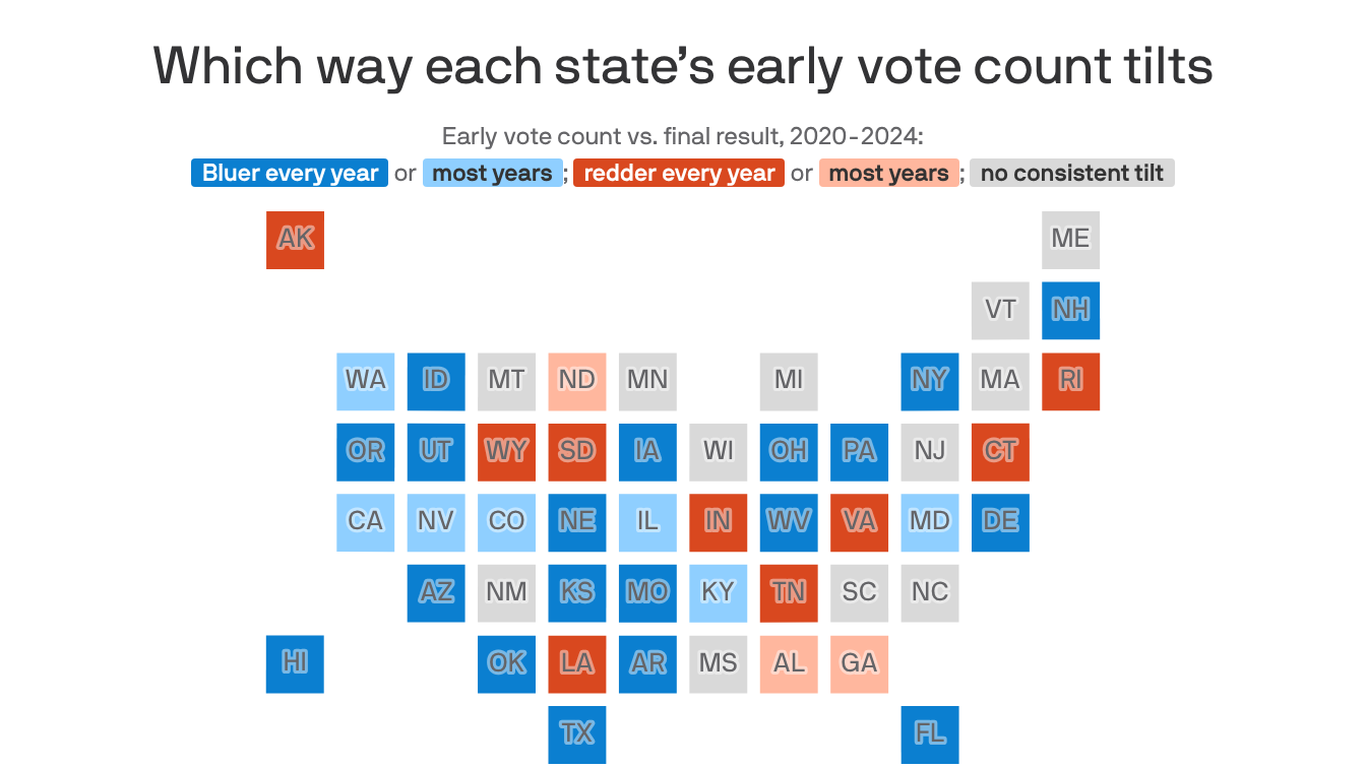
Axios analysis shows early midterm results skew Republican
Early midterm election results frequently present a misleading picture of American contests because fast-counting states and differing ballot types skew initial counts toward early advantages that shift over subsequent days and weeks, Axios reported.
The Red Head Start in National Vote Counts
In every national election since 2018, House and Senate votes counted by 9:00 PM Eastern Time have run between 4 and 9 percentage points more Republican than the final result, according to an Axios analysis of vote counts from the Associated Press and Edison Research. This pattern stems primarily from geography and reporting speeds. Fast-counting Florida and other right-leaning states report their totals early. At 9:00 PM on election night in 2022, Florida alone accounted for 40% of all Senate votes counted nationwide.
By 11:00 PM, more House races had been called for Republicans than for Democrats in all four elections, including 2018 and 2020, when Democrats won the House. That early tilt fades slowly.
Vote Counting Order Creates Sharp Political Swings
States handle different types of ballots in varying orders, creating distinct political swings throughout election night. Jurisdictions that process mail and early ballots first tend to start bluer than they finish, while those prioritizing in-person Election Day votes start redder.

Past election nights illustrate these sharp reversals. In Ohio during the 2024 Senate race, Sherrod Brown and Bernie Moreno were tied at 9:00 PM with half of the state’s votes counted, before Moreno ultimately won by 4 points. In Nebraska that same year, independent Dan Osborn led Sen. Deb Fischer at 11:00 PM with half the votes counted, but Fischer eventually won by 7 points. Back in 2018, Beto O’Rourke held a lead over Ted Cruz at 9:00 PM with nearly half of Texas counted, yet Cruz secured a 3-point victory. In Kansas during the 2020 cycle, Roger Marshall trailed by 8 points at 9:00 PM before winning by double digits.
Other contests swing in multiple directions as different voting methods are tallied. Elissa Slotkin led Mike Rogers by 13 points at 9:00 PM in the 2024 Michigan Senate race, fell behind by 3 points at midnight, and ultimately won by less than half a point. Conversely, states like Maine and Alaska start out red and count slowly. In 2020, Susan Collins led by 18 points at 11:00 PM with 16% of Maine counted, finishing with a 9-point win.
Timeline of the Evening Returns
Election night unfolds across a predictable chronological sequence across time zones:
- 6:00 PM ET: The first polls close in parts of Indiana and Kentucky, releasing initial House returns.
- 7:00 PM ET: Polls close in key Senate states including Georgia, South Carolina, most of Florida, and New Hampshire.
- The early Republican tilt should begin fading.
Elections are managed locally throughout the United States, meaning administrative procedures and processing speeds differ widely by state. While non-competitive races are often called quickly, tightly contested elections require days or weeks of methodical tabulation.
Information Gaps Invite Partisan Disinformation About Results
The lag between casting ballots and final results creates an information vacuum that partisan actors frequently exploit to spread disinformation about election integrity. Lawrence Norden, vice president of the Elections and Government Program at the Brennan Center for Justice, cautioned that early vote shifts reflect logistical realities rather than irregularities.

The reality is that Arizona doesn’t really take any longer to count the votes than other states, but the reason that they can attack us while they, you know, don’t receive any comments is because we have very close elections.William Gates, executive director of the Arizona State University’s Mechanics of Democracy Laboratory
State election administrators emphasize that preliminary election night numbers are provisional. According to the United States Election Assistance Commission, official validation requires subsequent reviews, provisional ballot curing periods, and canvassing to reconcile records before certification.
Future Counting and Ranked-Choice Deadlines
Outstanding ballots will continue to shape the final balance of power well past election night. In Alaska, if no candidate secures a majority of first-choice votes, the state will run its ranked-choice tally on November 18. Meanwhile, historical precedent indicates that final certification can stretch into December; the last United States House race of the 2024 cycle was not called until December 3.