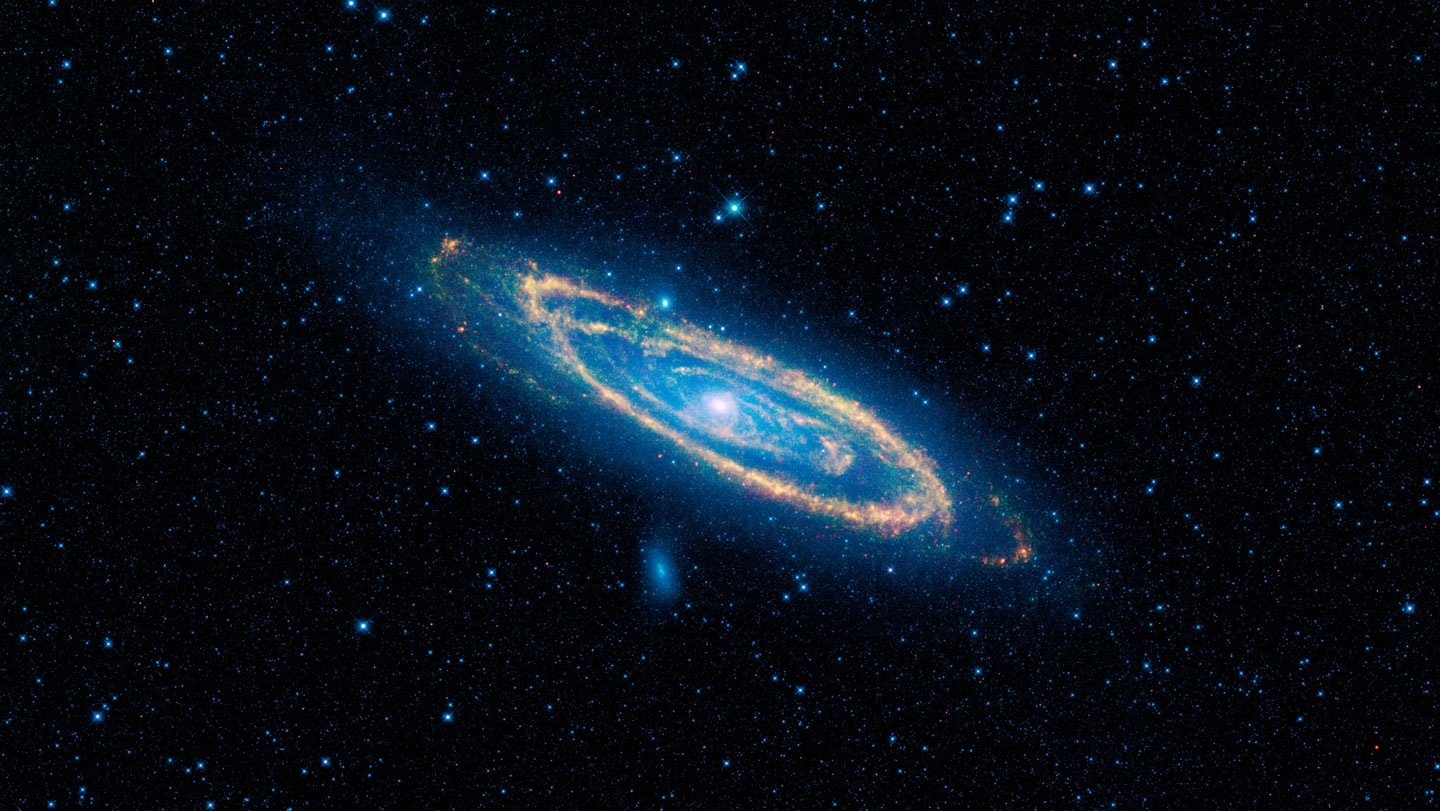
Astronomers Watch Two Stars Merge in Andromeda Galaxy
Astronomers witnessed two stars merge in the Andromeda galaxy, capturing an elusive common-envelope evolution that culminated in an October 2025 eruption.
The system, located about 2.5 million light-years from Earth, features a massive primary star nicknamed Big Bao and a smaller companion called Little Bao. Before the merger, the primary star measured about 7 solar masses, reached roughly 350 times the radius of the Sun, and shone about 18,000 times as bright as the Sun. Its companion weighed about 0.7 solar masses, making it slightly less massive than the Sun.
After examining nearly 30 years of telescope data, researchers found that the giant star began brightening in 2018. A smaller star was circling ever closer around its giant companion and eventually slipped inside its outermost layers.
Stellar Spiral and Eruption
As Little Bao orbited inside Big Bao’s gas outer layers, the surrounding gas pushed back against the smaller star. That drag forced Little Bao to spiral inward and transfer energy to the surrounding gas, which escaped partly as light and made Big Bao shine brighter.

Co-author Kishalay De of Columbia University explained the ongoing process as the companion kept orbiting. As it moved, “it keeps peeling off the primary star’s outer layers, and that gas flows away into the surrounding space,” De said.
Researchers analyzed the system to determine what triggered the October 2025 eruption. While an outburst throwing off enough shared gas could have allowed both stars to survive in a tighter orbit, the team estimated that only about a tenth of the giant’s outer gas actually escaped, expelling around 0.1 to 0.2 solar masses of material.
The fast-moving gas carried energy suggesting that Little Bao reached Big Bao’s core. De described the companion’s plunge as “almost like a bomb exploding inside a living star.”
Telescopes Track Eruption but Dust Obscures System
A fleet of observatories tracked the stellar event, including NASA’s James Webb Space Telescope, which observed Bao on December 24, 2025, 47 days after the eruption peaked, alongside observations from the Swift Observatory, SPHEREx, NEOWISE, and ground-based telescopes.
Too much dust currently clouds the system to directly view what remains. Dust settling will take years or even decades, but researchers intend to keep watching for similar systems.
“Now we can go and try to look for similar systems,” Viraj Karambelkar, an astrophysicist at Columbia University, said, “and hopefully aim to catch more of these systems even before they erupt.”