
Astronomers Discover Enormous Cosmic Structure, ‘Quipu’
Scientists have uncovered an immense cosmic structure, christened Quipu, which dwarfs previous discoveries. Spanning approximately 1.3 billion light-years, this colossal filament is challenging astronomers’ comprehension of cosmic architecture and its influence on galactic behavior.
The Extraordinary Size of Quipu
Quipu’s staggering length, about 7.6 sextillion miles, demands a reconsideration of how cosmic geography molds the universe. Its sheer mass, estimated at around 200 quadrillion times the Sun’s, is a force of nature in itself.
This immense mass pulls galaxies, hot gas, and dark matter into an elongated zone. Such a significant concentration of matter can subtly skew measurements of cosmic expansion and modify the cosmic microwave background (CMB).
Quipu and the Cosmic Web
Cosmologists imagine the universe as a vast web, with galaxies residing at the points where filaments intersect. Quipu serves as a prominent strand within this intricate network, stretching between 400 and 800 million light-years from Earth.
Simulations, grounded in the ΛCDM model, have long anticipated these immense filaments, and Quipu affirms these projections by matching their mass and size.
Locating the Cosmic Giant
Scientists employed a clever technique to identify Quipu. Galaxy clusters emit X-rays when the gas inside them hits tens of millions of degrees. Researchers observed that 68 X-ray-bright clusters aligned like beads along a cosmic cord, revealing the filament’s structure.
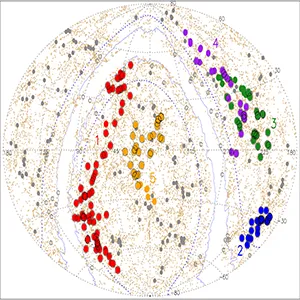
The study leveraged the CLASSIX survey, combining data from space-based observatories. Once the filament’s backbone was mapped, models filled in the missing dark matter interwoven within the bright markers.
The structure holds roughly a quarter of all matter in its vicinity. This substantial mass generates subtle movement in nearby galaxies, possibly influencing the Hubble flow, which is used to assess cosmic expansion. One study found that the distribution of galaxies within cosmic filaments can impact a galaxy’s star formation rate (IOP Science, 2022).
“They are thus transient configurations. They are special physical entities with characteristic properties and special cosmic environments deserving special attention,”
—Hans Böhringer, Max-Planck Institute for Extraterrestrial Physics
Looking Ahead
Future sky surveys are poised to examine filaments with finer detail. They aim to integrate their influence into precise measurements of the CMB and track how galaxies evolve within these immense structures. Quipu’s discovery is a major milestone, yet further surprises surely await in the universe.

