
Ancient Stardust Found in Asteroid Bennu Samples Rewrites Solar System History
Table of Contents
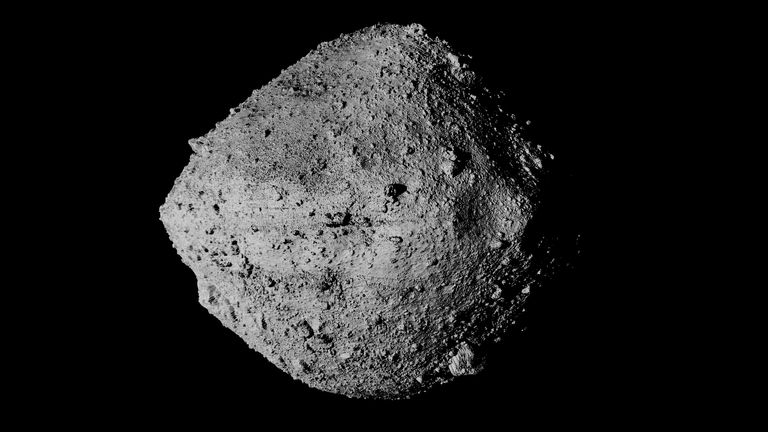
Washington, D.C. – August 22, 2025 – In a groundbreaking revelation, scientists have identified material older than the sun within dust collected from asteroid Bennu by NASA’s OSIRIS-REx spacecraft. the analysis reveals the presence of “presolar grains,” remnants of stars that existed before our solar system formed, offering an unprecedented glimpse into the universe’s earliest epochs.
Unveiling the Secrets of Bennu
The OSIRIS-REx mission, a feat of engineering and scientific ambition, successfully touched down on Bennu in 2020, collecting approximately 120 grams of surface material. This sample was carefully returned to Earth in 2023, initiating a comprehensive analysis by an international team of researchers, including experts from the Natural History Museum in London. The findings, published this week, detail the remarkable composition of Bennu, a carbonaceous asteroid considered a time capsule of the early solar system.

Chemical analysis has revealed that Bennu’s composition is a complex mixture of materials originating from diverse locations within the solar system and even beyond.This includes organic molecules,water-bearing minerals,and,most considerably,presolar grains - microscopic particles formed in the atmospheres of dying stars billions of years ago. Our data suggest that Bennu’s parent asteroid formed in the outer parts of the solar system, possibly beyond the orbit of Saturn,
stated Professor Jessica Barnes of the University of Arizona, a lead author of the study.
Did You Know? Presolar grains are incredibly rare on Earth, as they are typically destroyed by atmospheric entry and geological processes. Asteroids like Bennu, however, offer a pristine environment for their preservation.
A Window into the Early Solar System
The discovery of presolar grains within bennu’s sample provides a unique opportunity to study the building blocks of our solar system in their original form. These grains contain isotopic signatures that differ from those found in materials formed within our sun’s vicinity,offering clues about the conditions that existed before the solar system coalesced. Further research at the Natural History Museum has uncovered evidence of water-driven chemical reactions occurring over 4.5 billion years ago, predating the full formation of Earth. This suggests that the ingredients for life may have been present in the early solar system even before our planet emerged.
Key Findings from the Bennu Sample Analysis
| Feature | Description |
|---|---|
| Presolar Grains | Microscopic particles formed in dying stars before the solar system’s formation. |
| Organic Molecules | Complex carbon-based compounds, potential building blocks of life. |
| Water-bearing Minerals | Evidence of water activity in the early solar system. |
| Formation Location | Likely originated beyond the orbit of Saturn. |
| Sample Mass | Approximately 120 grams collected by OSIRIS-REx. |
Professor Sara Russell, a planetary scientist at the Natural History Museum and co-author of the study, emphasized the importance of the findings: We’re looking at a unique snapshot of the outer Solar System at [the time of] the birth of our sun. Some of these grains have survived billions of years of Solar System evolution almost untouched and can tell us more about the environment in which planets were born.
This research builds upon previous findings that identified the building blocks of life within the Bennu sample earlier this year.
Pro Tip: Understanding the composition of asteroids like Bennu is crucial for planetary defense, as it helps scientists assess the potential threat posed by near-earth objects.
What implications do these findings have for our understanding of the origins of life? And how will future asteroid missions build upon the success of OSIRIS-REx?
The Ongoing Quest to Understand Our Cosmic Origins
the study of asteroids and other celestial bodies is a cornerstone of modern astronomy and planetary science. Missions like OSIRIS-REx are not only expanding our knowledge of the solar system’s formation but also providing valuable insights into the potential for life beyond Earth. The ongoing analysis of the Bennu sample, alongside data from other missions, promises to unlock further secrets about our cosmic origins and the processes that shaped our planetary neighborhood. Future missions, such as NASA’s Psyche mission to a metal-rich asteroid and the Japanese Aerospace Exploration Agency’s (JAXA) Martian Moons eXploration (MMX) mission, will continue to push the boundaries of our understanding.
Frequently Asked Questions about asteroid Bennu
- What is asteroid Bennu? Bennu is a carbonaceous asteroid orbiting the Sun, classified as a perhaps hazardous asteroid due to its close approaches to Earth.
- What was the purpose of the OSIRIS-REx mission? The mission aimed to collect a sample from Bennu and return it to Earth for detailed analysis, providing insights into the early solar system.
- What are presolar grains? These are microscopic particles formed in the atmospheres of dying stars before the formation of our solar system, offering a glimpse into the universe’s early history.
- Why is the Bennu sample so vital? It contains pristine materials from the early solar system, including organic molecules and water-bearing minerals, potentially revealing clues about the origins of life.
- How did scientists analyze the Bennu sample? Researchers used advanced chemical analysis techniques to identify the composition of the sample and determine the age and origin of its components.
The findings from the Bennu sample represent a monumental step forward in our quest to understand the universe and our place within it. As Professor Russell aptly stated, Studying Bennu has given us the opportunity to investigate a novel type of space rock, and we are learning new things about it every day.
The lack of reaction with the Earth’s atmosphere has given us the opportunity to study the history of the asteroid, and the evolution of the minerals it contains, in incomparable detail.
We invite you to share this interesting discovery with yoru network, leave your thoughts in the comments below, and subscribe to our newsletter for more groundbreaking science news.
