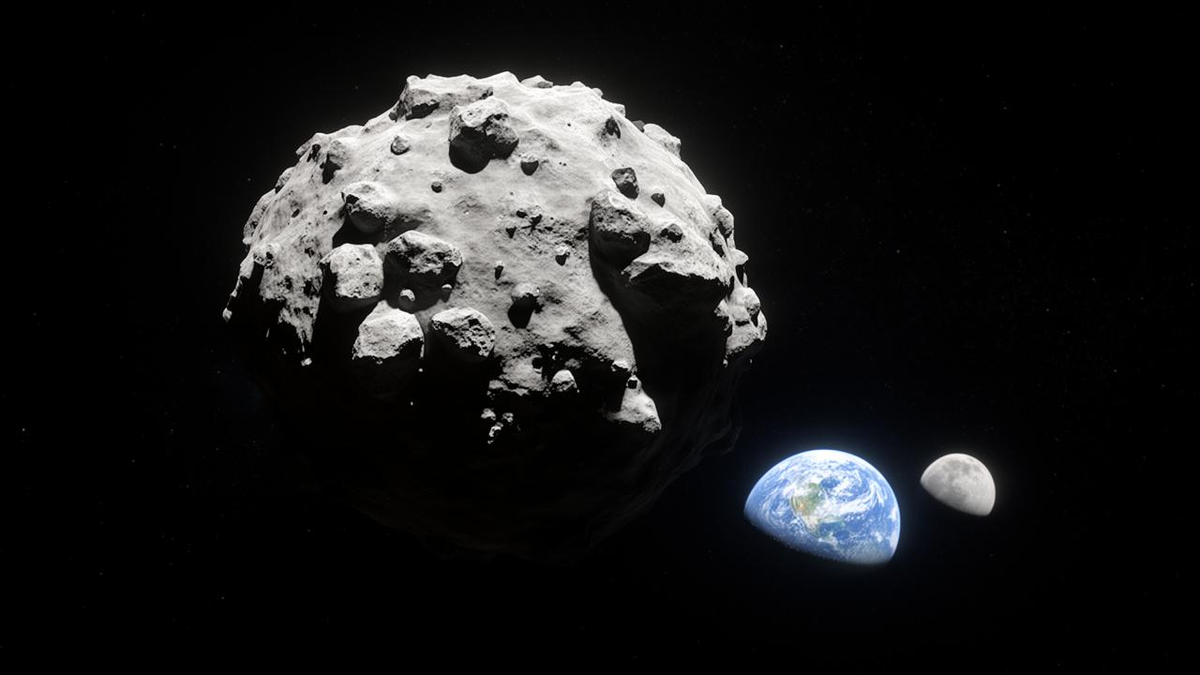
Asteroid 1999 AN10 to Pass Earth at Lunar Distance in 2027
On August 7, 2027, near-Earth asteroid 1999 AN10 will swing by our planet at a range of roughly 389,855 km—about the same as the mean Earth–Moon separation—BigGo Finance reported.
The mountain-sized space rock is around 800 to 1,800 meters wide (about 0.5 to 1.1 miles) and has been labelled a potentially hazardous asteroid by NASA, though there is no chance of it impacting Earth in 2027, EarthSky reported.
Closest approach will occur at 7:12:05 UTC on August 7, 2027, which corresponds to 2:12:05 am CDT on August 7 for the Americas. The asteroid is projected to peak around magnitude 7.3 as it passes through the night sky over North and South America, making it possible to spot with binoculars as it glides by. Overnight on August 7, 2027, the asteroid will pass through the constellations Taurus, Aries, Pisces, and Pegasus.
The geocentric distance at closest approach will be about 389,855 km (242,240 miles), while its distance from the Moon will be about 763,391 km, roughly twice its distance from Earth. The object will not enter the atmosphere and will simply continue along its orbit. It belongs to the Apollo group, crossing Earth’s orbit and traveling around the Sun on an elongated orbit extending beyond Mars’ orbit with a period of 643 days.
Early on, researchers feared a future impact, and when first discovered the asteroid was considered a possible collision threat for 2044 or 2046. However, additional observations ruled out an impact risk for at least 100 years. Gathering position data at closest approach will sharpen prediction accuracy and aid in devising planetary defense strategies. NASA’s OSIRIS-APEX spacecraft will study the asteroid after the encounter.

Future Asteroid Encounters and Research
Other objects are also monitored for their proximity to Earth. Asteroid 2001 WN5, which measures approximately 940 meters (0.58 mile), will pass inside the moon’s orbit on June 26, 2028, at a distance of about 248,700 km (154,500 miles) from Earth’s center.
Meanwhile, the asteroid 101955 Bennu, which is about 500 meters (1/3 mile) wide, has an estimated impact probability of approximately 1 in 2,700 for September 24, 2182, according to NASA’s 2021 orbital analysis. Regarding the notable asteroid 99942 Apophis, it is expected to reach a closest approach of about 31,200 km on April 13, 2029.
Demonstrations of planetary defense technology are already underway. NASA’s DART probe, launched in late 2021, struck the asteroid Dimorphos in 2022 at about 6 km per second (more than 13,000 mph), shortening Dimorphos’ orbital period by 33 minutes. The European Space Agency launched the Hera probe in October 2024 toward Didymos and Dimorphos, successfully capturing its first images from a distance of about 800 miles after a Mars flyby.
It is unclear how precisely the new observational data gathered during the 2027 flyby will refine our long-term orbital models for the asteroid.