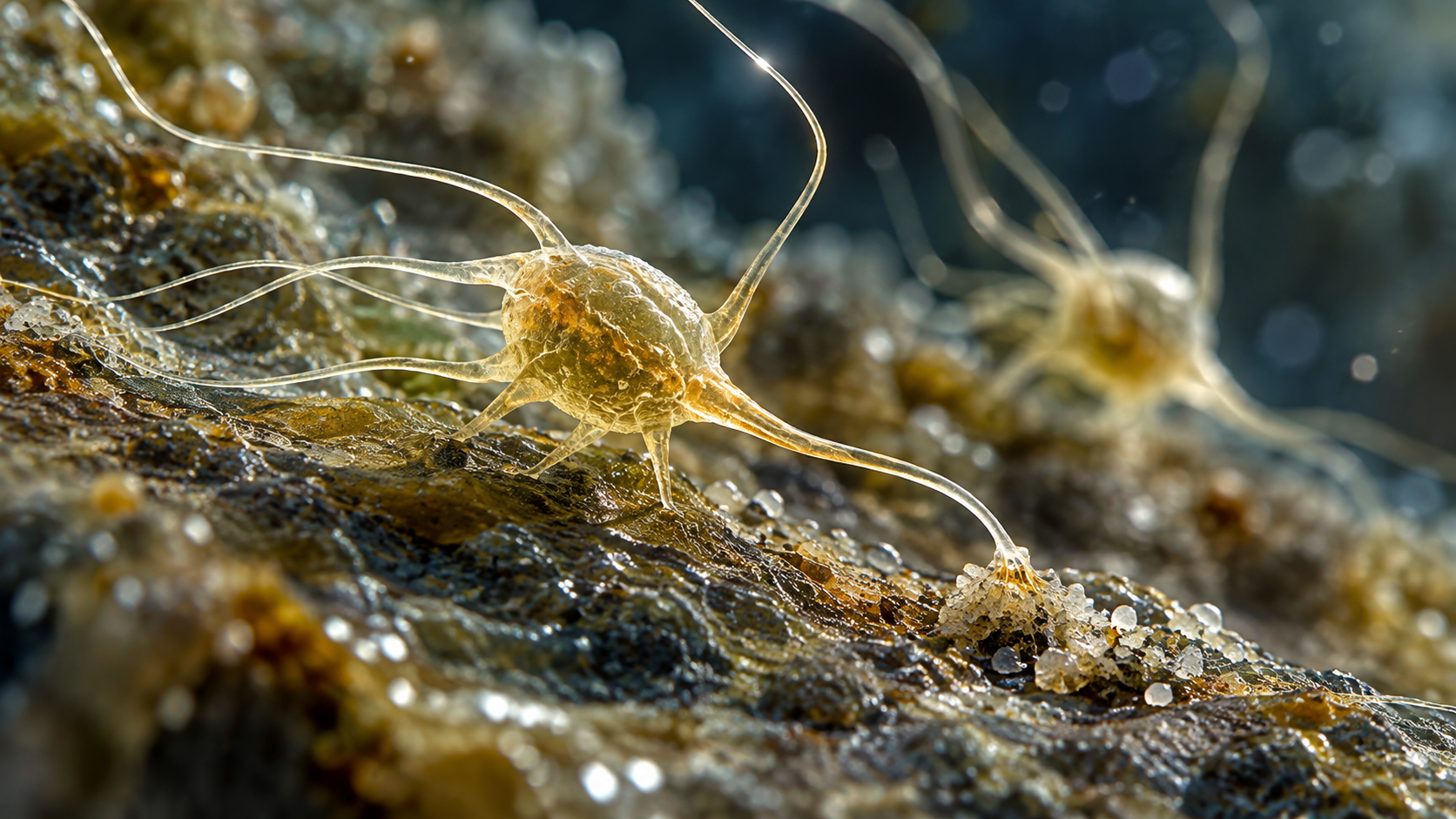
Asgard Archaea Crawling Behavior Reveals Origins of Complex Cell Movement
Asgard Archaea Study Reveals Cellular Movement Resembling Eukaryotes
Living Asgard archaea crawl across surfaces using rapidly growing and retracting protrusions powered by an actin-like internal skeleton, according to a study published in Nature. The microorganisms, which are considered the closest known prokaryotic relatives of all animals, plants, and fungi, exhibit cellular movement strikingly similar to complex eukaryotic cells like amoebae and human immune cells.
Asgard Archaea Use Actin-Controlled Protrusions to Crawl
- Core Discovery: Researchers filmed living Asgard archaea crawling across surfaces using flexible, actin-controlled protrusions.
- Methodology: Philipp Radler and colleagues at the University of Vienna developed an oxygen-free microscopy system to keep anaerobic Candidatus Lokiarchaeum ossiferum alive.
- Evolutionary Impact: The findings suggest that sophisticated actin-driven cellular machinery existed before the emergence of eukaryotic life roughly 2 billion years ago.
Oxygen-Free Microscopy Captures Living Lokiarchaeoata
Studying living Asgard archaea has historically presented major technical barriers because the organisms grow slowly and often depend on surrounding microorganisms. Earlier cultivation breakthroughs made first-generation samples available, but direct observation of their behavioral mechanics remained limited to frozen electron-microscope images and static genome sequences. To overcome these experimental hurdles, Philipp Radler and colleagues developed a specialized oxygen-free microscopy system designed to maintain anaerobic organisms during active recording.
The research team successfully monitored Candidatus Lokiarchaeum ossiferum cultivated in Vienna alongside Candidatus Margulisarchaeum peptidophilum cultivated by Japanese collaborators. L. ossiferum were grown in sealed, pressurized serum bottles under an 80:20% nitrogen-carbon dioxide atmosphere at 20 degrees Celsius. Quantitative PCR using lokiarchaeal-specific primers for 16S rRNA monitored growth, selecting cultures with densities exceeding 1 million cells per milliliter for live-cell imaging.

Actin-Based Protrusions Drive Rapid Shape Shifting
Under the microscope, both Asgard lineages transformed their shapes continuously. The protrusions of L. ossiferum grew at approximately 1.5 micrometers per minute, extending outward up to 15 micrometers before retracting. Some structures snapped backward more than five times faster than their initial growth rate. Cells achieved this behavior while maintaining bodies only around a micrometer across, typically deploying about five protrusions simultaneously to expand their environmental interaction surface area.
Further analysis revealed that these microorganisms redistributed existing membrane supplies rather than continuously synthesizing new surface material. When one protrusion shortened, another extended to compensate. Meanwhile, the second observed lineage, M. peptidophilum, demonstrated even faster dynamics, with protrusions extending at roughly 4.8 micrometers per minute.
Surface Crawling Mechanics in Microbial Relatives
The dynamic structures served a functional locomotory purpose beyond mere shape shifting. Approximately half of the observed L. ossiferum cells shifted their central bodies across glass surfaces. Median movement speeds reached roughly 1.6 micrometers per minute for L. ossiferum, while M. peptidophilum traversed surfaces at approximately 3.4 micrometers per minute.
Individual cells utilized distinct mechanical strategies to move across surfaces. Some attached the tips of forward-projecting extensions to the glass and shortened them to pull the main cell body forward. Others executed smoother gliding motions while keeping protrusions oriented ahead of them. Rather than pursuing fixed destinations, the microorganisms generally exhibited irregular wandering patterns.