Archaeologists Identify Second Texas Bison Jump Used 3,000 Years
Archaeologists have identified a second bison jump on the southern Plains, a 65-foot-tall cliff spur in Caprock Canyons State Park where Indigenous hunters drove herds to their deaths for roughly 3,000 years.
The site, named Nighthawk, is only the second such hunting facility ever confirmed in Texas, challenging the long-held view that the technique was largely confined to the northern Plains.
The findings, published Nov. 9 in the journal American Antiquity, are based on 27 radiocarbon dates from bone and charcoal that document at least seven mass kill events between about 1550 B.C. and A.D. 1550. The largest single event, dubbed Kill 3, occurred around A.D. 300 to 400 and yielded 1,436 bones from at least 17 animals — a harvest that would have required a large, well-coordinated workforce.
“The only way bison can arrive at the site is by falling from above, as the site surface is sandwiched between two cliffs,” the researchers wrote.
Unlike northern Plains jumps where terrain often concealed the drop, Nighthawk sits on a narrow spur jutting out like a peninsula, where the animals could likely see the edge ahead. “Instead of a stampede toward a surprise fall, Nighthawk could have operated more like ‘walking the plank,'” according to the study.

Gus Costa, an archaeologist at Rice University and the study’s first author, said the repeated use of the same location over millennia indicates a deep cultural connection.
“Returning to the same place over and over again over 3,000 years shows that people had a significant connection to the Nighthawk hunting facility,” Costa said in a statement. He added that the long gaps between kills — averaging 500 years — suggest the hunting knowledge was passed down continuously rather than independently reinvented.
“Bison jumping is a complicated community effort,” Costa said. “Large scale bison harvests (like jumps) are exciting because they require a large group of people working together to be successful.”
The purpose of the southern Plains hunts remains uncertain. In the north, fall jumps provisioned communities for winter through pemmican, a shelf-stable mix of dried meat and rendered fat. But the researchers wrote that the warmer Texas climate would have limited bison fat preservation to a few weeks, raising the possibility that the hunts served more for displaying power and building alliances than for long-term food storage.
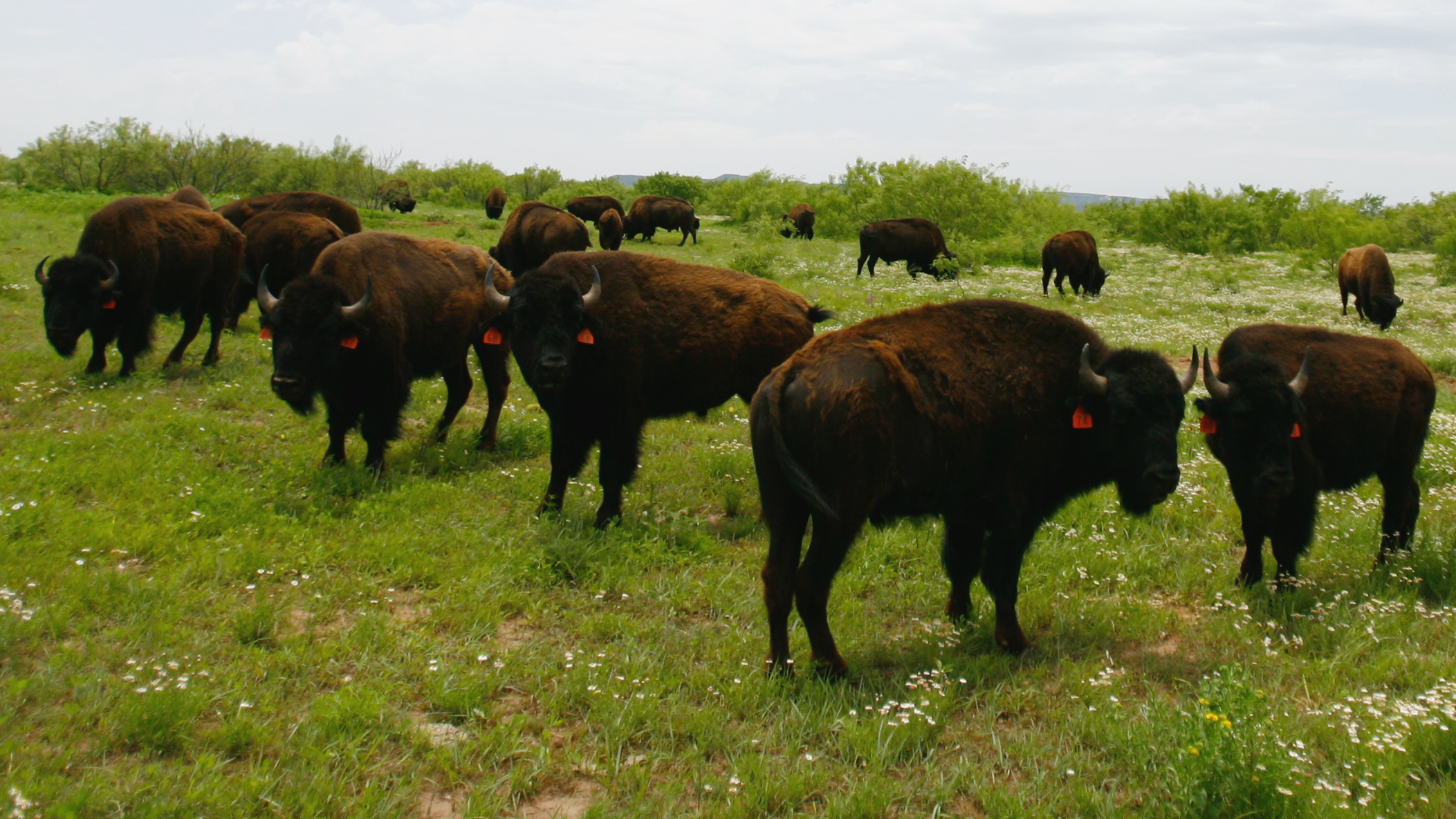
Caprock Canyons State Park spans 17,500 acres along the eastern edge of the Llano Estacado in Briscoe County, Texas. The State of Texas purchased approximately 14,100 acres of the historic JA Ranch in 1975, and the park opened in 1982. It now hosts the official State Bison Herd of Texas, descended from animals Charles Goodnight preserved in the late 1800s; the herd was donated to the state in 1997 and has roamed parkwide since 2011.
Before Nighthawk, Bonfire Shelter — identified more than 60 years ago — was the only scientifically verified bison jump in Texas. The team now counts eight potential jump sites within 15 square kilometers of the park, though erosion has likely destroyed much of the evidence.
“For a long time when it comes to Indigenous bison hunting culture, the Southern Plains hasn’t received much respect, at least when compared to the north,” Costa said. “The absence of surviving evidence is not evidence of absence.”