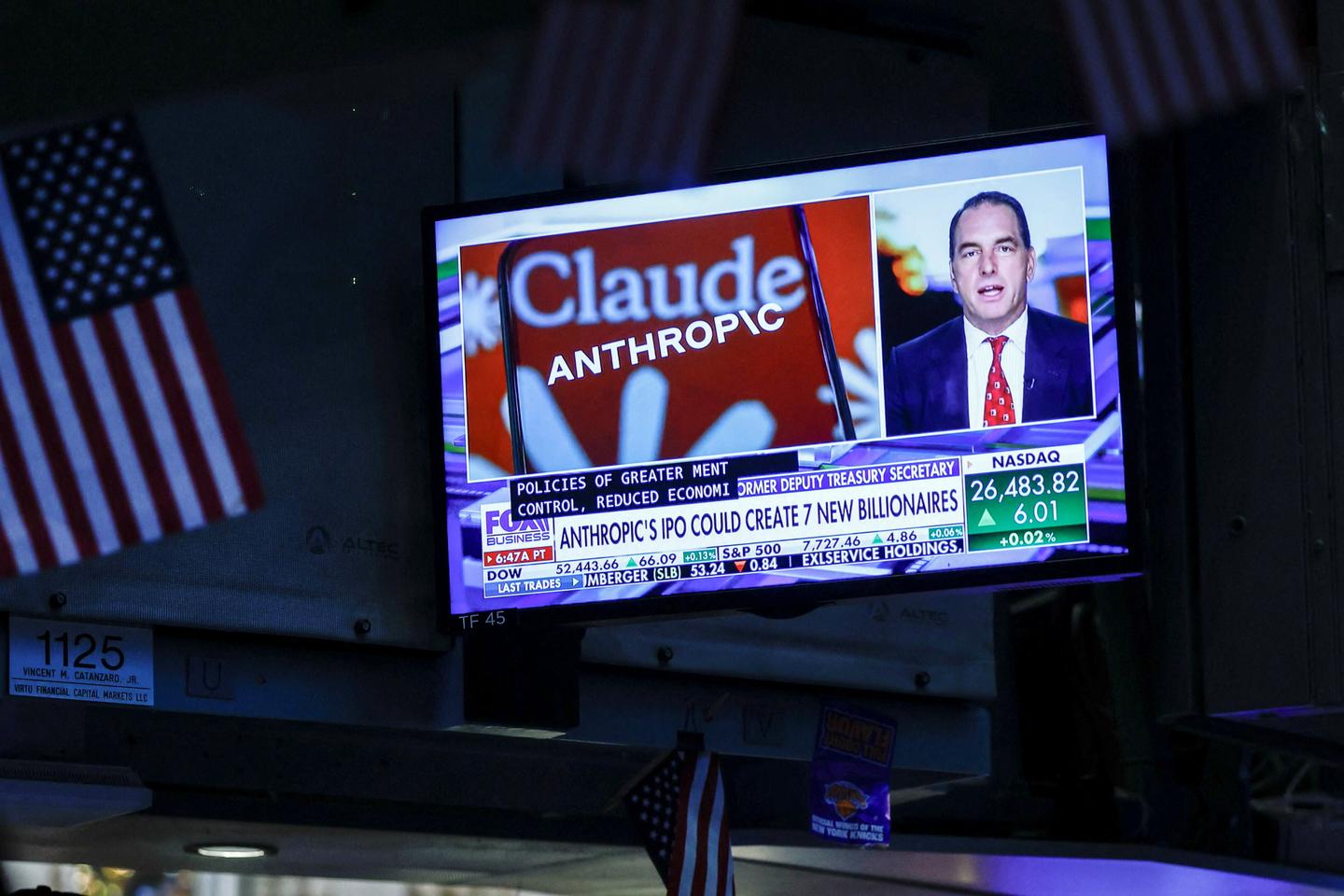
Anthropic Goes Public Before OpenAI, Capping Stunning Reversal
“We already had a first version of Claude, but we hadn’t released it.” That is how Dario Amodei recalled his company’s cautious start, according to Le Monde.fr — and on Thursday, November 19, Anthropic goes public before OpenAI, the rival that beat it to market by three years.
The San Francisco company behind the Claude models lists on Wall Street on Thursday, Le Monde.fr reported, capping a reversal few in the sector predicted. OpenAI, the pioneer that launched ChatGPT in November 2022, will watch a firm founded by its own alumni overtake it to the public markets — and, by 2026, catch up with it economically.
The listing is expected to be one of the largest in history. Anthropic’s shareholders were floating a $2,000 billion valuation as recently as early autumn; the target has since slipped to between $1,300 billion and $1,400 billion. The offering, led by Goldman Sachs and Morgan Stanley, could raise as much as $100 billion and make Anthropic the first frontier-model provider to trade publicly.
What investors will buy is a company that grew faster than any start-up on record — and that says so itself, in black and white, in its prospectus. Anthropic generates “almost all” of its revenue from its AI tools, the filing states, with no advertising empire to absorb a shock, and it warns that “the gap between the most advanced AI models could narrow.”
A bet on business customers
The rivalry was born in 2021, when Anthropic was founded in San Francisco by seven former OpenAI employees, among them the siblings Dario and Daniela Amodei. When ChatGPT reached 1 million users in five days at the end of 2022, Anthropic had nothing on the market. Its founders believed in scaling models but also described themselves as worried about AI’s “existential” risks, close to the “effective altruism” movement.

“We didn’t have a consumer approach at this stage,” a company spokesperson told TechCrunch after Claude launched in March 2023. The choice structured everything that followed: Anthropic aimed at corporate clients, building products such as Claude Code and Claude Cowork into enterprises worldwide.
The numbers behind that bet, per Anthropic’s listing documents: revenue of about $16.3 billion in the first half of 2026, against $1.2 billion a year earlier, while operating losses narrowed to $693 million from roughly three times that in the first half of 2025. The Amodeis drew $18 million and $16 million respectively in salary and shares in 2025.
| Measure (per listing documents) | First half 2025 | First half 2026 |
|---|---|---|
| Revenue | $1.2 billion | $16.3 billion |
| Operating loss | roughly three times the 2026 figure | $693 million |
| Valuation at last funding round | — | $965 billion (May 2026, triple the February level) |
Growth cools, prices collapse
The cooling is visible in the growth curve. Quarterly expansion ran at 145% between the first and second quarters of 2026, then fell to 45% over the following three months — enough to push the valuation shareholders had been promoting down from $2,000 billion to between $1,300 billion and $1,400 billion.
Price competition is the second pressure. The cost of processing a given volume of text with an AI model at a given capability level fell from $17 at the end of 2024 to 50 cents today, a 97% drop, according to Morningstar. Anthropic itself cut its rates by 20% in September and again in November; OpenAI cut the price of one flagship model fivefold in July.

“Even if the unit price falls by 90%, total spending keeps rising as long as usage grows at the same pace,” said Malik Ahmed Khan, an analyst at Morningstar. The usage data, though, is turning: at Vercel, a developer platform that routes requests across models, more than 70% of text was processed by open-weight models in September, against 13% in April — and Anthropic’s share of that spending has dropped below half.
Open models now trail closed ones like Claude and ChatGPT by only about four months on average, according to the research institute Epoch AI. The Chinese firm Moonshot has just released Kimi K3.1 Pro, with performance close to the best American models at half the price of Anthropic’s flagship Claude Opus 5.5, according to Capital. “Beijing will not wait,” warned Dylan Patel, founder of the research firm SemiAnalysis.
Anthropic’s own safety measures are a further drag, the company concedes in its prospectus: they “could slow our progress against competitors that do not adopt similar constraints.”
$417 billion in committed spend
The third threat is on the balance sheet. Since the end of 2025, Anthropic has committed to pay at least $417 billion for chip and server rental — thirteen years of sales at the first half’s revenue pace — and the bill could more than double counting revocable or projected contracts. The company warns these commitments “must generally be honored regardless of our revenue or utilization.”
Spending on chips and AI infrastructure was at $9 billion for the first half, against debt of $6.2 billion. “We have taken on substantial debt to operate and grow our business (…) and our ability to service this debt could be limited by our cash flows and liquidity,” the filing says. Borrowings across the AI sector could reach $750 billion by the end of the year.
The exposure spreads through the industry. Google and Amazon are at once Anthropic’s shareholders, suppliers and resellers, and the International Monetary Fund has flagged a “triple penalty” risk from these cross-investments: falling shares, harder-to-refinance debt and shrinking revenue at the same time.
Four years ago Anthropic had no product and a held-back model; in February, at an AI summit in New Delhi, Amodei and OpenAI’s Sam Altman declined to shake hands on stage, Le Monde.fr reported.
More than 80% of Anthropic’s revenue last quarter came from models less than six months old, the company says — the number that will decide whether Thursday’s listing crowns a turnaround or prices in a squeeze.