
Ant Queens Defy Species Boundaries, Producing Offspring of Two Distinct Species
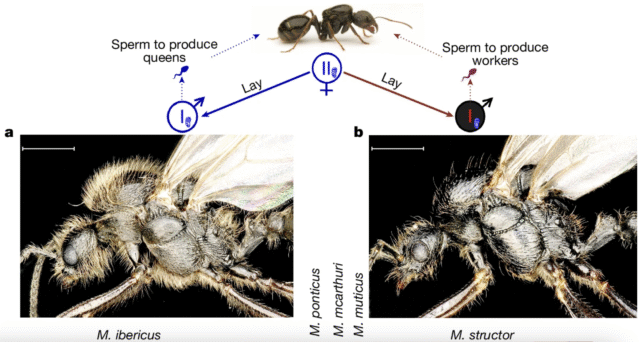
Madrid, Spain – In a discovery challenging conventional understandings of species and individuality, researchers have found that queens of the Iberian harvester ant, M. ibericus, can produce offspring belonging to two different species – their own and M. structor – utilizing a unique reproductive strategy. the findings,published in Nature this week,reveal a complex relationship where M. structor exists as a sort of genetic contributor within M. ibericus colonies.
The two species diverged over 5 million years ago. Though, M. ibericus queens exhibit remarkable control over the genetic makeup of their offspring.They can reproduce asexually, creating clones of themselves, or fertilize eggs with sperm from either their own species or M. structor. Remarkably, they can even eliminate their own nuclear DNA, using the egg solely to develop male M.structor clones.All offspring, nonetheless of origin, share the queen’s mitochondrial DNA. This results in increased genetic diversity within the colony without requiring external mating. Researchers describe the arrangement as a “two-species superorganism,” blurring the lines of individual identity.While M. structor males produced by M. ibericus queens differ morphologically from those produced by M. structor queens, their genomes are identical. Entomologist Jessica Purcell, not involved in the study, suggests these M. structor males have become “an integral part of M. ibericus populations,” and likens the process to horizontal gene transfer, creating a new, distinct genetic lineage.
The study, led by Juvé et al., is available in Nature (https://doi.org/10.1038/s41586-025-09425-w), with commentary from Purcell available here (https://doi.org/10.1038/d41586-025-02524-8).
