
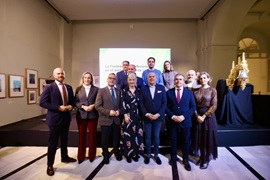
SEVILLE, Spain – The Andalusian regional government is launching a pioneering initiative to provide specialized vocational training in the crafts of sacred art, a sector of significant cultural, historical, and economic importance to the region. The program, spearheaded by the Regional Ministry of Educational Development and Vocational Training, will offer extracurricular projects designed to bolster skills in techniques central to Andalusia’s artistic heritage.
The initiative targets students in vocational training programs across the Manufacturing Mechanics, Wood, Furniture and Cork, and Textile, Clothing and Leather families. It reflects a broader effort by the Juanma Moreno administration to recognize and support professionals linked to religious cultural heritage, building on existing aid programs for restoration projects and advocacy for local workshops against foreign competition.
“It is essential to guarantee the continuity of these trades, which until now have been transmitted privately, within workshops and families, have a regulated, official, specialized and, above all, excellent training,” stated Patricia del Pozo, the Regional Minister of Culture and Sport, at the opening of the ‘Vocational Training in Sacred Art’ conference in Seville. “These trades represent what makes us unique in the world and, finally, they will obtain an official letter of nature.”
Del Pozo emphasized the economic and cultural significance of sacred art, noting its role in providing highly specialized employment, preserving centuries-old traditions, and gaining international recognition in fields like fashion, cinema, and the performing arts.
Pablo Quesada, the Deputy Minister for Educational Development and Vocational Training, announced that the new program is designed for students in the aforementioned vocational families and aims to facilitate practical training and increase employability through direct collaboration with businesses, prioritizing micro and small enterprises within the sector.
The program will offer six extracurricular training lines: sacred goldsmithing for monumental and processional utilize – designs, shaping, and finishing techniques (Manufacturing Mechanics); sacred goldsmithing in small format – designs, shaping, and finishing techniques (Manufacturing Mechanics); sacred carving in wood – styles, materials, design and execution techniques (Wood, Furniture and Cork); traditional gilding in wood – history, materials and techniques applied to sacred carving (Wood, Furniture and Cork); sacred embroidery in gold – fundamentals, language and introduction to techniques (Textile, Clothing and Leather); and sacred embroidery in gold – advanced execution, assembly and conservation (Textile, Clothing and Leather).
The initiative has been allocated a budget of €700,000 and will run until June 30th of this year. Quesada stressed that the program aims not only for technical excellence but also to ensure the survival of trades that are economic drivers in many Andalusian towns. “By involving experts from the sector in the training of young people, we guarantee that traditional techniques are merged with the structure of modern FP,” he said.
The program will actively involve specialized companies, allowing students to work in real production environments and establish pre-graduation employment connections. “We want our young people to see in Sacred Art a real opportunity for the future, professionalized and backed by quality public training,” Quesada stated.
In October 2025, the Regional Ministry established commissions of experts comprised of vocational training teachers and recognized professionals – sculptors, goldsmiths, and embroiderers – to design three specialized courses: a Course of Specialization in Design and Production of Goldsmithing Elements for Sacred Art; a Course of Specialization in Design and Production of Elements of Sacred Art in Wood; and a Course of Specialization in Design and Production of Embroidery in Sacred Textiles. These proposals have been submitted to the Ministry of Education, Vocational Training and Sports for evaluation and potential approval as specialized itineraries.
the Andalusian Institute of Professional Qualifications (IACP) has developed three proposals for specific competency standards for professional profiles in the sacred art sector, currently absent from the National Catalogue of Professional Competency Standards. These standards cover key competencies in embroidery in sacred textiles, design and production of goldsmithing elements for sacred art, and design and production of elements of sacred art in wood. These proposals have been formally submitted to the National Institute of Qualifications (INCUAL) for evaluation and potential integration into the national framework, ensuring alignment of qualifications with sector demands. This submission will also allow professionals in the field of Sacred Art to obtain official accreditation of their competencies through participation in competency evaluation and accreditation procedures (PEAC) managed by the IACP, reinforcing professional recognition and the quality of the productive fabric linked to sacred art in Andalusia.
