
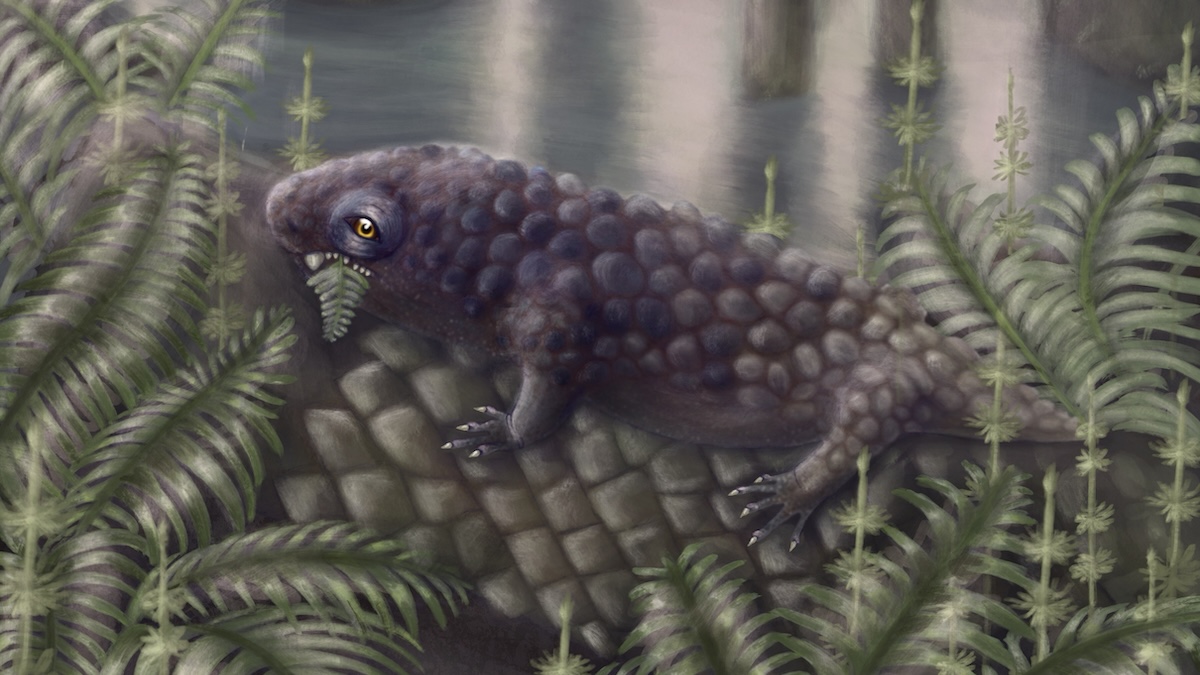
A newly discovered fossil skull from Nova Scotia, Canada, reveals that one of the earliest land animals, Tyrannoroter heberti, was among the first tetrapods to experiment with a plant-based diet, according to a study published today in the journal Systematic Palaeontology.
The 307-million-year-old fossil, unearthed within a fossilized tree stump, belonged to a creature roughly the size of an American football – approximately 25 centimeters (10 inches) long – and represents a significant shift in understanding the dietary evolution of early terrestrial vertebrates. Researchers at the Field Museum in Chicago and Carleton University in Canada co-led the study, utilizing high-resolution micro-CT scanning to analyze the skull’s internal structure.
“This is one of the oldest known four-legged animals to eat its veggies,” said Arjan Mann, evolutionary biologist at the Field Museum and co-lead author of the study. “It shows that experimentation with herbivory goes all the way back to the earliest terrestrial tetrapods – the ancient relatives of all land vertebrates, including us.”
While the first vertebrates ventured onto land around 370 million years ago, plants had already established themselves on the continents for over 100 million years. For a considerable period, these early land animals primarily preyed on each other. Tyrannoroter represents a pivotal moment in the transition towards utilizing the abundant plant life as a food source.
The CT scans revealed a unique dental arrangement. Beyond the typical teeth found in the jawbone, Tyrannoroter possessed bony plates, known as dental batteries, on both the roof of its mouth and in its lower jaw. These plates would have functioned by grinding against each other, effectively breaking down tough plant matter – a feature later seen in herbivores like dinosaurs. “We were most excited to see what was hidden inside the mouth of this animal once it was scanned – a mouth jam-packed with a whole additional set of teeth for crushing and grinding food, like plants,” said Hillary Maddin, paleontologist at Carleton University and senior author of the study.
The animal, a member of the pantylid group – closely related to the last common ancestor of reptiles and mammals – likely wasn’t exclusively herbivorous. Researchers suggest that Tyrannoroter may have supplemented its plant-based diet with insects and other arthropods. The dental batteries themselves may have initially evolved to process the exoskeletons of these invertebrates, later adapting to efficiently grind plant material. The consumption of insects, which themselves fed on plants, could have also helped establish the necessary gut microbiome for digesting cellulose.
Further examination of other pantylid specimens revealed similar dental structures, including one fossil dating back as far as 318 million years. This suggests that herbivory was more widespread and developed rapidly among pantylids following the initial terrestrialization of tetrapods. “These findings, among other recent studies, provide direct evidence that revise the timeline of the origin of herbivory, revealing that various herbivorous forms arose quickly following terrestrialization of tetrapods,” the researchers wrote in their published study.
Paleontologists have not yet determined the exact species of ferns or other plants that Tyrannoroter consumed, and further research is planned to investigate the ancient ecosystem in which it lived.
