
Table of Contents
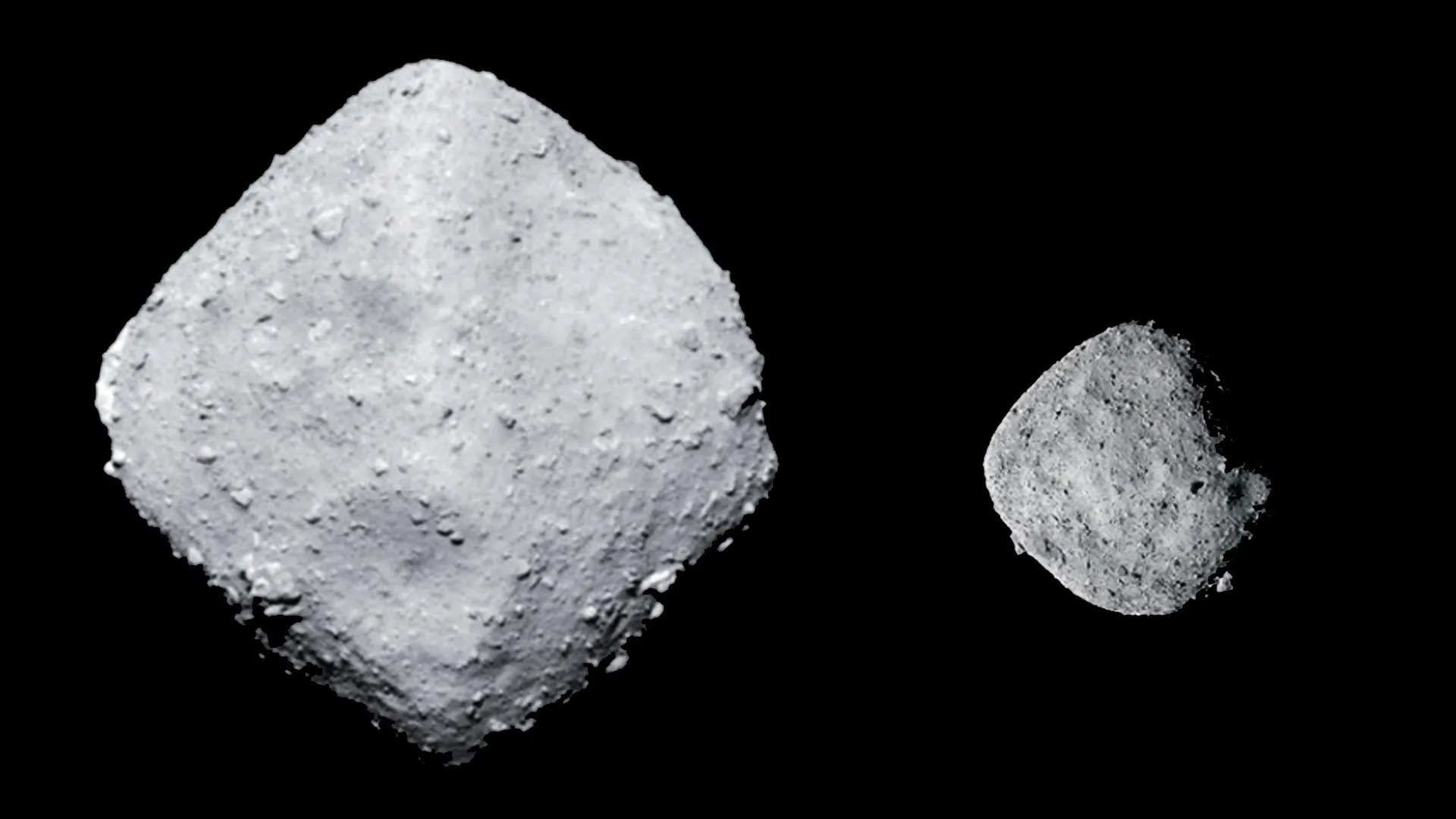
New research indicates that asteroids Bennu and Ryugu, both near-Earth objects studied by NASA and the Japan Aerospace Exploration Agency, likely originated from the same parent asteroid as Polana, a much larger asteroid in the main asteroid belt. This discovery provides valuable insights into the solar system’s early history and the formation of asteroid families.
The Connection Revealed Through Spectral Analysis
A thorough review of data conducted by the southwest Research Institute (SwRI) compared spectroscopic data from Polana with samples collected from Bennu and Ryugu.The analysis revealed significant similarities in their near-infrared spectrum, strongly suggesting a shared origin. “Very early in the formation of the solar system, we believe large asteroids collided and broke into pieces to form an ‘asteroid family’ with Polana as the largest remaining body,” explained Dr. Anicia Arredondo,lead author of the study and a researcher at SwRI.
The research team utilized the James Webb Space Telescope to observe Polana, focusing on near-infrared and mid-infrared wavelengths. This data was then compared with physical samples of Ryugu and Bennu, obtained through the Hayabusa2 and OSIRIS-REx missions respectively. The Hayabusa2 spacecraft returned Ryugu samples to Earth in late 2020, while OSIRIS-REx delivered Bennu samples in late 2023.
Understanding the Asteroids: Size, Orbit, and significance
Bennu and Ryugu are classified as near-Earth asteroids due to their orbits bringing them within the orbit of Mars. Though, they pose no immediate threat to Earth, with closest approach distances of approximately 1.9 million miles (Bennu) and 1 million miles (Ryugu). Despite being relatively small – Bennu is about one-third of a mile in diameter, comparable to the Empire State Building, and Ryugu is twice that size - their connection to the 33-mile-wide Polana is significant.
Scientists hypothesize that Jupiter’s gravitational influence propelled Bennu and ryugu away from Polana’s vicinity.
Did You Know?
Bennu is one of the potentially hazardous asteroids identified by NASA, meaning it has a small chance of impacting Earth in the future, though current calculations show no imminent risk.
Spectral Variations and Surface Evolution
While the spectral data exhibited some variances, the team persistent they were insufficient to disprove the hypothesis of a common origin. Dr. Tracy Becker, a co-author of the paper from swri, noted that the asteroids have undergone independent journeys through the solar system. ”Bennu and Ryugu are now much closer to the Sun than Polana,so their surfaces may be more affected by solar radiation and solar particles,” she stated.
Furthermore,Polana’s greater age suggests it has experienced a longer period of micrometeoroid impacts,potentially altering its surface composition.
Pro Tip:
Studying asteroid compositions helps scientists understand the building blocks of planets and the conditions present during the solar system’s formation.
Key Asteroid Data
| Asteroid | Diameter | Distance from Sun (approx.) | Mission(s) |
|---|---|---|---|
| Polana | 33 miles | 2.7 AU | James Webb Space Telescope |
| Bennu | ~0.3 miles | 1.1 AU | OSIRIS-REx |
| Ryugu | ~0.6 miles | 1.2 AU | Hayabusa2 |
The team’s findings build upon previous research into asteroid families and their origins. According to Binzel et al. (2001), spectral analysis is a crucial tool for identifying relationships between asteroids and understanding their evolutionary history [1]. What implications does this discovery have for our understanding of planetary formation?
“They are similar enough that we feel confident that all three asteroids could have come from the same parent body,” Arredondo concluded. How will future missions build upon these findings to further unravel the mysteries of the early solar system?
evergreen Context: Asteroid Research and Solar system Formation
The study of asteroids is basic to understanding the formation and evolution of our solar system. asteroids are remnants from the early stages of planetary formation, providing a glimpse into the conditions that existed billions of years ago. Research into asteroid families, like the Polana family, helps scientists trace the origins of these objects and understand the processes that shaped the solar system. Ongoing and future missions, such as those planned by NASA and JAXA, will continue to provide valuable data and refine our understanding of these celestial bodies. The analysis of asteroid samples, like those returned by Hayabusa2 and OSIRIS-REx, is notably crucial, as it allows for detailed laboratory analysis of their composition and structure.
Frequently Asked Questions About Asteroid Origins
- What are asteroid families? Asteroid families are groups of asteroids that share similar orbital characteristics and are believed to have originated from the breakup of a larger parent asteroid.
- how do scientists determine the origin of asteroids? Scientists use various methods, including spectral analysis, orbital calculations, and the study of asteroid composition, to determine the origin of asteroids.
- What is the significance of the Polana asteroid? Polana is a large asteroid in the main asteroid belt and is believed to be the parent body of the Bennu and Ryugu asteroids.
- Are Bennu and Ryugu a threat to Earth? While classified as near-Earth asteroids, Bennu and Ryugu currently pose no significant threat to Earth.
- What is the role of missions like OSIRIS-REx and Hayabusa2? These missions collect samples from asteroids and return them to Earth for detailed analysis, providing valuable insights into their composition and origin.
Disclaimer: This article provides information for general knowledge and educational purposes only, and does not constitute scientific or professional advice.
We hope you found this article insightful! If you enjoyed learning about the origins of Bennu and Ryugu, please share it with your friends and colleagues. Don’t forget to subscribe to our newsletter for more breaking news and in-depth analysis from around the world.
